
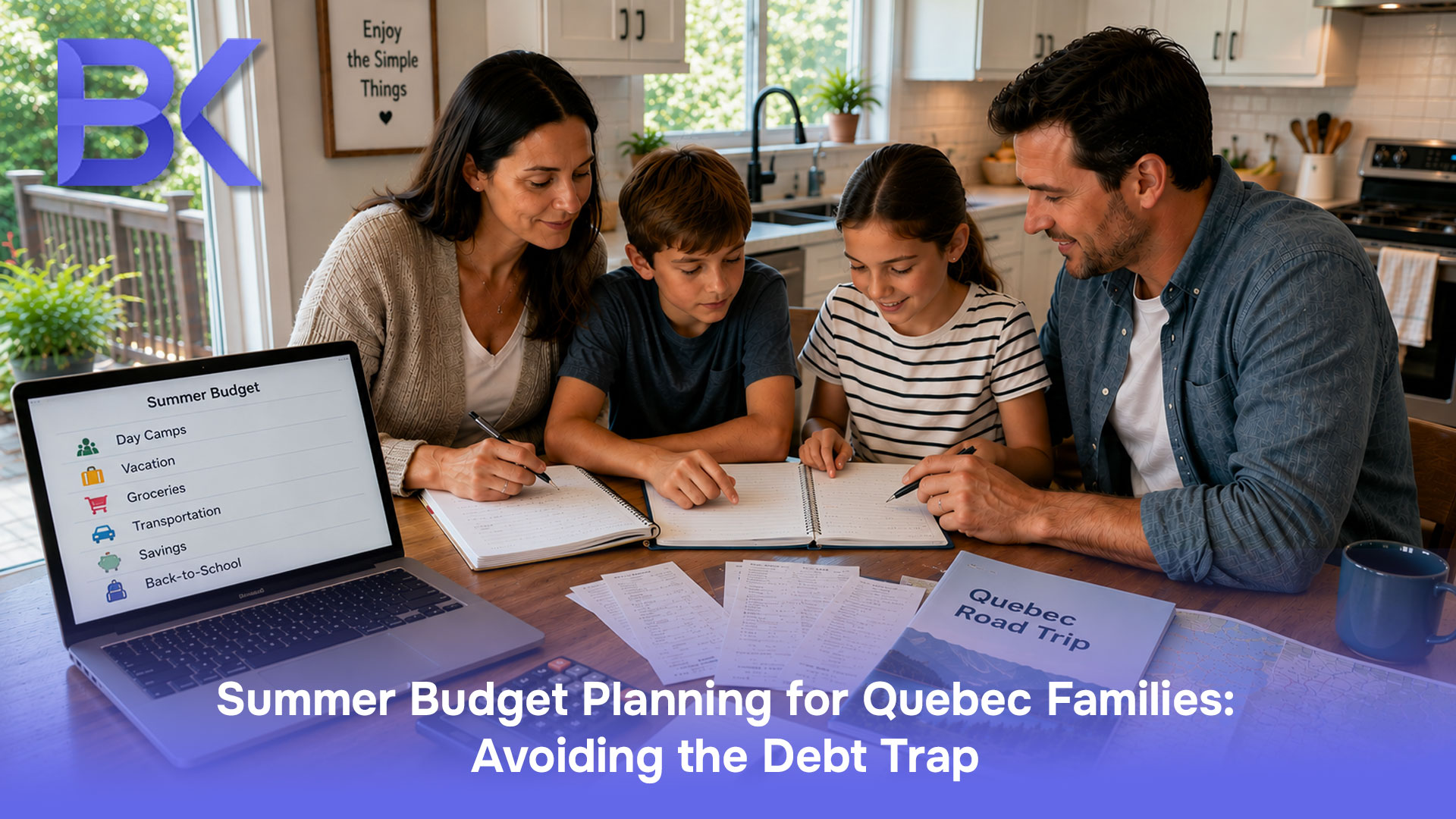
Summer creates a unique financial pressure period for Quebec families. Seasonal childcare, day camps, family travel, rising grocery prices, and upcoming back-to-school costs all overlap within a tight 10-week window.
Without structured planning, many households rely too heavily on credit during the summer months, feeling the financial hangover well into the fall.
Summer budgeting doesn't mean sacrificing fun – it means prioritizing, setting clear spending limits, and managing cash flow wisely. Overspending rarely results from one large vacation; it usually stems from dozens of small, unplanned daily expenses.
A practical family budget and proactive financial planning in Quebec help you enjoy summer without stress.

Quebec Seasonal Costs, Taxes, and Your Summer Budget
To budget effectively, you must understand your actual spending capacity. In 2026, Quebec families face sustained pressure from housing, food, and transport. For example, residential electricity rates from Hydro-Québec increased by 3% as of April 1, 2026. For a typical family of four running air conditioning, this adds roughly $80–$100 a year to utility costs – enough to cover a weekend day camp or an extra grocery trip.
These recurring seasonal costs should be integrated into your financial plan rather than treated as a surprise.
Leverage Quebec Tax Credits
Don't forget Quebec-specific tax benefits: federal and provincial childcare expense credits can significantly reduce the net cost of municipal day camps and summer childcare. Always ask for an RL-24 slip from your camp provider.
The "Net Income First" Approach
Planning a summer budget from gross salary alone is a common error; start with monthly net cash flow after deductions and fixed commitments. Follow these 4 steps:
- Calculate monthly net income: After all deductions, taxes, and QPP contributions.
- Subtract fixed expenses: Mortgage/rent, insurance, utilities, and debt payments.
- Isolate mandatory seasonal costs: Day camps, childcare, summer transport, and increased groceries.
- Identify your "Fun Budget": What remains is your actual budget for vacations, dining out, and unexpected entertainment.
Smart Tax Refund Strategy
If you recently received your NOA and a tax refund, avoid treating it as "free spending money." Allocate your tax refund purposefully: part to emergency savings, part to summer costs, and part to future goals like debt reduction. This prevents a cash crunch in September. A tax refund is best treated as planned cash, not bonus money.
| Summer Expense Type | Typical Budget Risk | Better Budget Move |
| Vacation booking | Paying all at once on credit | Sinking funds: Save monthly before travel |
| Kids’ day camps | Multiple surprise add-ons | Confirm full fee list (and RL-24 eligibility) early |
| Dining out | Frequent small overspending | Set a strict weekly "food-out" limit |
Financial Planning's Impact on Your Summer Budget
Summer spending must align with your broader financial plan. Focusing only on June-August misses the September impact of school, clothing, activities, and routine bills returning.
Categorize spending: essentials, planned fun, and optional extras. Essentials cover camps, childcare, transport, groceries, and health needs. Planned fun includes one main vacation or local outings. Optional extras are impulse buys and last-minute entertainment.
Establish a simple rule: any new summer cost must come from the optional category unless the entire plan is intentionally revised. This keeps the budget dynamic and realistic.
Review Spending Weekly, Not Monthly
Review spending weekly, not monthly. Using a structured budgeting tool can make seasonal expense tracking easier for families. This helps catch deviations early and stay within limits.
Recommended tools for Quebec families:
- FCAC Budget Planner (English/French) – official Canadian budgeting tool
- Mint or YNAB (You Need A Budget) – for automation and category tracking
- Excel/Google Sheets template with categories: camps, transport, groceries, fun, savings
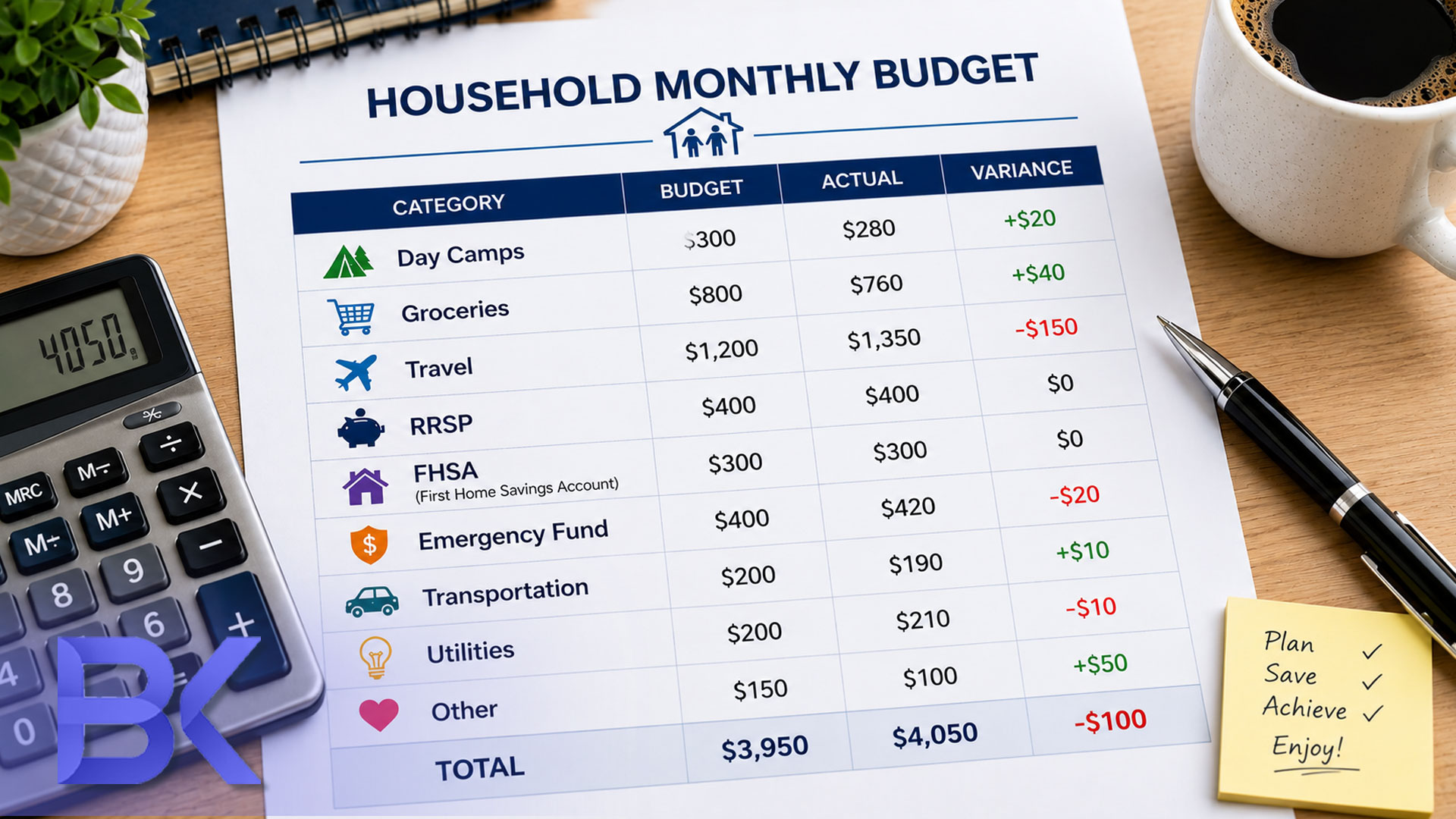
Sinking Funds For Next Summer
While it's too late to save for this summer, start setting aside funds monthly starting in September for next year's travel, camps and children’s activities. Automated transfers reduce reliance on debt during peak summer months.
Rule of thumb: save 3–5% of your monthly net income, or a fixed amount that will cover your expected summer costs.
Example: if your summer expenses total $3,000, start saving $250/month for 12 months, or $500/month for 6 months before summer.
RRSP Contributions and Summer Spending
Summer overspending can severely impact your retirement planning by forcing you to pause contributions or, worse, dip into long-term savings. An expensive season can easily negate months of diligent saving.
If you contribute to an RRSP regularly, strive to maintain at least a reduced automatic contribution through the summer. For Quebec professionals in higher tax brackets, consistent RRSP contributions reduce taxable income while preserving long-term discipline.
- The Math: For example, if you earn $80,000 and maintain a $5,000 RRSP contribution, you reduce your taxable income by $5,000, potentially securing a $1,200–$1,800 tax refund depending on your marginal rate.
Temporarily lowering contributions to accommodate summer cash flow is reasonable, but stopping entirely makes restarting much harder in the fall. Consistency is key. Alternatively, build a separate seasonal reserve during the winter so vacation costs never interfere with your retirement savings.
| Summer Choice | Short-Term Benefit | Long-Term Effect |
| Use credit for travel | Immediate convenience | Debt and interest |
| Reduce trip length | Lower upfront cost | Better cash flow control |
| Protect savings goals | Less short-term spending | Stronger financial stability |
FHSA Contributions and Goal-Based Summer Budgeting
Summer often coincides with moving plans, renovations, or home-buying preparations. For eligible first-time homebuyers, the First Home Savings Account (FHSA) remains one of the most tax-efficient savings tools available.
Young professionals in Quebec often struggle to balance summer lifestyle spending with home savings. The solution isn't zero enjoyment, but rather setting a defined limit so short-term fun doesn't delay major life goals. For many first-time homebuyers, preserving FHSA contribution room will have greater long-term value than financing vacation spending with credit. (Readers can review the official FHSA eligibility guidelines from the CRA).
- The Golden Rule: If your goal is to buy a home within 1–3 years, use goal-based budgeting.For debt-focused households or first-time homebuyers, a conservative vacation cap might be 5% of monthly net income, but families should adapt the number to their goals and cash flow. This creates a clear, mathematical boundary and protects your down-payment progress.
Family discussion matters
Couples must agree on travel limits, camp budgets, and children’s spending beforehand. Misalignment causes more overspending than income level.

5 questions for a family budget discussion:
- What are the top 3 summer priorities?
- What is the maximum budget for a vacation?
- How much are we willing to spend on camps/childcare?
- What percentage of income goes to long-term goals (home, retirement)?
- What will we do if spending exceeds the plan?
Quebec Mortgages and Summer Cash Flow
Quebec homeowners frequently underestimate summer’s impact on housing cash flow. Higher hydro use for air conditioning, exterior maintenance, landscaping, and unexpected repairs can quickly converge. Add regular mortgage payments to the mix, and the margin for financial error becomes incredibly small.
This is especially true for families approaching an upcoming mortgage renewal in the current interest rate environment. Summer discretionary spending must be evaluated alongside your projected renewal affordability.
Vacation After Fixed Costs
Plan travel only after accounting for your mortgage, property taxes, home insurance, and essential household expenses. Many families reverse this order and end up using high-interest credit for basic September needs.
The Staycation Strategy
A lower-cost local summer (a "staycation") can significantly improve your cash flow stability. It acts as a powerful financial reset if your primary focus is debt reduction, maximizing your FHSA, or preparing for higher mortgage renewal rates.
2 Real Cases: Summer Budgets in Action
Case 1: Montreal family with camp and travel overload
- The Situation: A family with a $6,000/month net income planned $1,200 for camps, $2,000 for a vacation, and $800 for extra fun. By mid-July, they had overspent by $1,500 and were using credit cards for groceries.
- The Solution: We intervened, reducing their "fun" budget to $300/month for August, strategically applied $1,000 of their delayed tax refund to cover the gap, and set up an automated $500/month transfer starting in September for next summer.
- Result: They entered September debt-free and successfully rebuilt a $3,000 emergency fund by winter.
Case 2: Young Quebec couple saving for a first home
- The Situation: A couple earning $7,000/month net aimed for a $60,000 down payment in 2 years. Their original summer vacation plan was $3,500.
- The Solution: We ran the numbers. They voluntarily reduced their vacation budget to $1,500 (opting for a local Quebec road trip) and kept their $400/month FHSA contributions active.
- Result: Two years later, they successfully saved $58,000, took a debt-free trip, and stayed perfectly on track to purchase their home.
FAQ
1. How can Quebec families avoid overspending in summer?
- Step 1: automate summer savings (3–5% of income)
- Step 2: set a weekly fun limit ($100–$200 per family)
- Step 3: review your budget every week (15 minutes)
2. How should Quebec families use a tax refund during summer?
A highly effective split is the 30/30/40 rule:
- 30% for summer expenses
- 30% for emergency savings
- 40% for debt reduction or RRSP/FHSA contributions
3. Can summer overspending affect RRSP goals?
Absolutely. If summer costs cause you to pause your automatic contributions or dip into long-term savings, your compound interest growth is interrupted, harming your retirement timeline.
4. Is the FHSA relevant to summer budget planning?
Yes, particularly for young renters. Diverting funds to an expensive summer vacation instead of your FHSA can significantly delay your home savings progress and cost you valuable tax deductions.
5. What is the best vacation budget rule for families in Quebec?
Set a fixed dollar amount before looking at hotels or flights. Make the trip fit your pre-determined budget, not the other way around.
Disclaimer: This article is for informational purposes only and is not individualized financial, tax, mortgage, or investment advice. Consult a qualified financial professional for advice based on your specific situation.
Don't Let Summer Spending Derail Your Financial Future
Planning summer expenses should support – not disrupt – your long-term financial goals. At BK Financial Services, we help Quebec families and professionals build practical financial strategies for budgeting, mortgage preparation, RRSP optimization, and FHSA planning.
Before you book that next trip, let's make sure your cash flow is optimized.
Book Your Free Consultation Today:
- Phone: +1-514-834-5558
- Email: contact@bkfinancialservices.ca
- Website: https://bkfinancialservices.ca
(Consultations available in English, French, and Hebrew)
Disclaimer: This article is provided for informational purposes only and does not constitute individualized financial, tax, mortgage, or investment advice. Utility rates, tax credits, and government programs are subject to change. Always consult with a qualified financial professional to evaluate your specific situation and cash flow needs.