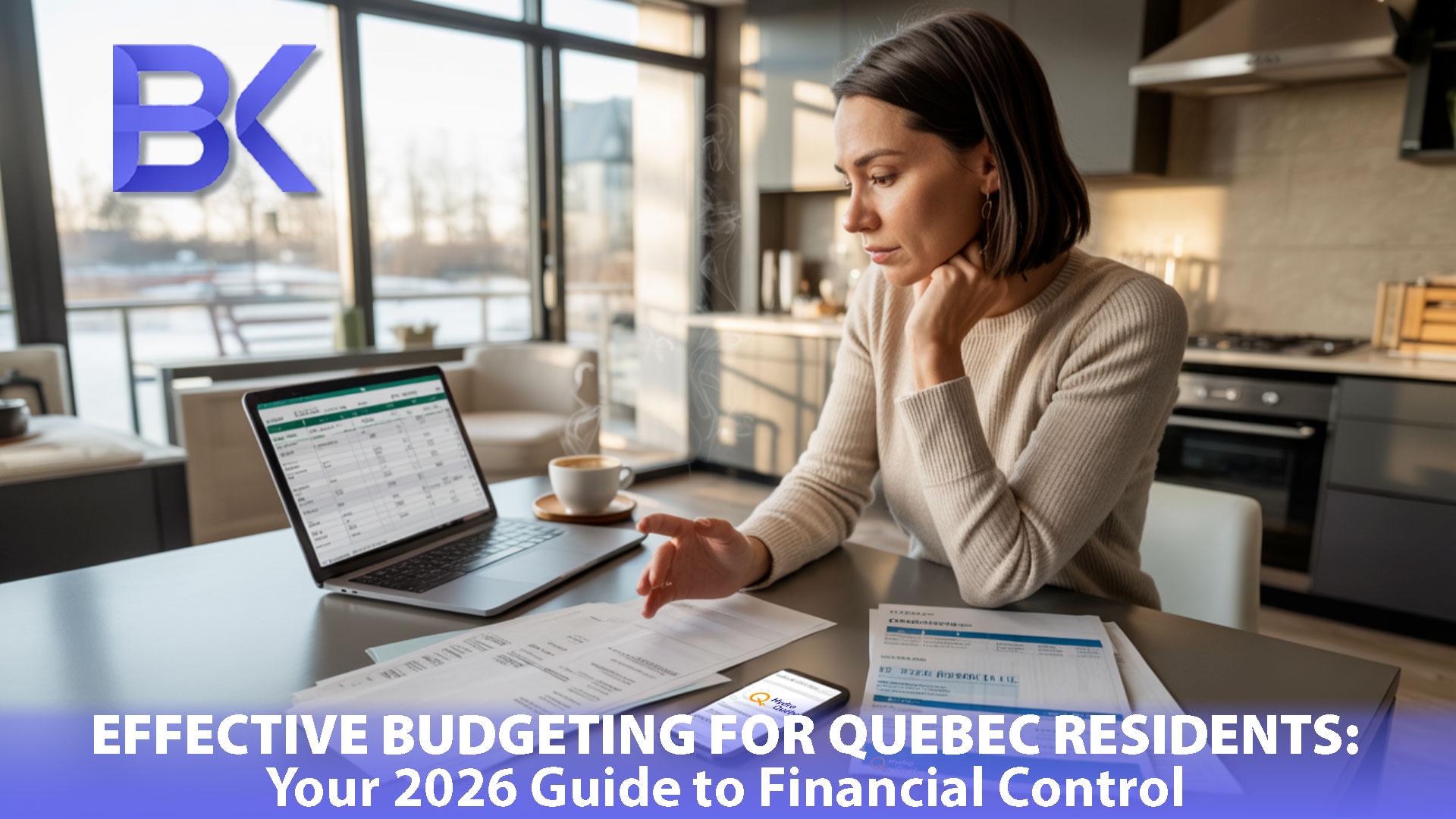
Living in Quebec involves unique taxes, benefits, Hydro bills, and rising housing costs. Without a clear financial plan, your paycheque can disappear quickly.
A realistic budget tailored for Quebec residents can change this. Understanding your net income, recurring expenses, and tax-saving opportunities puts you in control of your money.
This 2026 guide covers financial basics for Quebec residents. It shows you how to build a simple budget that works, integrating Quebec taxes, RRSP planning, FHSA saving for a first home, and debt repayment.
Understanding Your Net Income in Quebec
For Quebec residents, your budget starts with real net income, not gross salary. This is your pay after federal and provincial tax, CPP/QPP, EI, QPIP, and group benefits. In 2026, 25–35% of gross pay is often deducted, depending on income and benefits.
To determine your net income, examine your last three pay stubs. Identify your gross pay, federal and Quebec income tax, QPP, EI, QPIP, union dues, and group insurance. Note the net pay deposited into your account.
Include all other net income: child benefits, GST/QST credits, rental income, self-employment, or support payments. Your budget must only reflect money actually received. A financial planner can also review your paycheque to suggest tax adjustments or increased RRSP contributions.

Demystifying Your Quebec Pay Stub
A common Quebec budgeting challenge is misunderstanding pay stub codes. Lines like QPIP, QPP, and group insurance can obscure your true monthly available funds.
Create a simple sheet: income per pay, total deductions, and net per pay. Multiply your net pay by the number of pay periods (e.g., 26 for bi-weekly). This reveals your actual annual net income, often differing significantly from assumptions. This clarity is vital for major commitments like rent, a mortgage, or daycare fees.
Strategic Use of Quebec Tax Refunds
Quebec residents often receive large tax refunds because not all credits and deductions are optimized yearly. Instead of viewing your refund as bonus money, integrate it into your annual budget.
Decide in advance how to use any refund: pay down high-interest debt, contribute to RRSPs, or build an emergency fund. When tax planning and budgeting align, you can smooth cash flow and avoid yearly financial fluctuations.
| Budget Element | Why It Matters in Quebec | Practical Tip for 2026 |
| Net Income | High deductions affect real spending power | Build budget from pay stubs, not salary offers |
| Housing Costs | Montreal & Quebec City rents rising steadily | Keep total housing ≤ 30–35% of net income |
| Hydro & Heating | Seasonal energy spikes in winter | Average last 12 months to create stable monthly line |
| Childcare & School Costs | Subsidized daycare vs private impacts cash flow | Compare net-of-tax cost of each childcare option |
Quebec Taxes and Your Budget: Key Considerations
Quebec’s combined tax system directly impacts your budget. Your use of RRSPs, FHSAs, and deductions influences take-home pay and long-term savings. In 2026, combined marginal tax rates for middle-income Quebecers can exceed 37%, making tax planning essential.
In your budget, add a line for planned RRSP contributions, not just general "savings." Every RRSP dollar may generate a tax refund. This refund can then be redirected to your TFSA, emergency fund, or debt reduction. Effective financial planning balances current cash flow with future tax savings.
Integrating RRSP Planning into Your Monthly Budget
Instead of rushing an RRSP contribution in February, divide your annual target by 12. Add this amount to your monthly budget. For instance, a $3,600 annual goal becomes $300 per month. In Quebec, payroll deductions for RRSPs can lower tax at source, increasing your net pay. Request a reduction in source deductions.
Include this as a fixed expense, like rent. Shifting your mindset from "optional saving" to a "non-negotiable payment to your future self" is a powerful budgeting habit. It also stabilizes your tax results year-to-year, preventing surprises.
Maximizing FHSA for First-Home Savings in Quebec
For Quebec residents planning to buy a home, the First Home Savings Account (FHSA) is a crucial budget line. Contributions are tax-deductible (like an RRSP), and withdrawals for a qualifying first home are tax-free (like a TFSA).
To incorporate an FHSA, determine a realistic monthly amount based on your housing timeline. For example, $250 per month for five years builds significant down payment equity while reducing your annual tax bill. Integrating the FHSA into your budget moves you from just dreaming to concrete home-buying action.

Managing Fixed Expenses in Your Quebec Budget
Once your net income is clear, list all fixed monthly expenses. These are costs difficult to change quickly: rent or mortgage, condo fees, property tax installments, insurance, cell phone, internet, daycare, and subscriptions. In Quebec, remember Hydro-Québec and heating, as winter bills can be significantly higher.
A practical strategy is to average Hydro and heating costs over the last 12 months. Instead of budgeting $60 in August and $220 in January, aim for a consistent $130 monthly. This creates a stable budget and prevents winter energy costs from disrupting your cash flow.
Housing and Mortgage Planning in Quebec
For Quebec homeowners or buyers, mortgage payments are often the largest fixed expense. A sustainable budget typically keeps total housing costs – mortgage/rent, property tax, condo fees, utilities, and insurance – under 30–35% of net income.
Before taking on a new mortgage, test your budget with higher stress-test rates, insurance, and expected municipal taxes. A financial planner knowledgeable in Quebec mortgages can model scenarios. This helps avoid becoming "house poor," unable to save or enjoy life.
Essential Insurance and Protection Planning
Quebec residents benefit from public health plans, but life, disability, and critical illness coverage are still vital for a solid budget. Losing income due to illness or death can quickly derail even the best financial plan.
List all insurance premiums: group, individual, mortgage, and car. Ensure your coverage matches your family’s needs, especially with dependents or if self-employed. Optimizing coverage may free up monthly cash for savings or debt repayment, while maintaining proper protection.
| Expense Type | Typical Quebec Examples | Budget Strategy |
| Fixed | Rent/mortgage, Hydro, insurance, daycare | Automate payments, review contracts annually |
| Variable | Groceries, gas, personal spending, activities | Set realistic caps based on 3-month averages |
| Goals/Saving | RRSP, FHSA, TFSA, vacation, education fund | Treat as “must pay” line items, not leftovers |
Controlling Variable Spending for Quebec Households
Variable expenses often derail Quebec budgets, seeming flexible and harmless. These include restaurants, groceries, gas, online shopping, kids’ activities, and entertainment. However, they frequently consume funds meant for saving or debt repayment.
Track three months of debit and credit card statements. Group spending into categories and calculate a monthly average. Use these realistic figures – not guesses – to set limits. Adjust gradually, for example, by reducing restaurant or delivery spending, rather than trying to cut everything at once.
Navigating Groceries and Cost of Living in Quebec
Food inflation has significantly impacted Quebec households. In 2026, many families face grocery bills 5–10% higher than a few years ago. Acknowledge this new reality and build your budget accordingly, rather than underestimating this category.
Plan meals with local flyers, buy non-perishables in bulk, and use loyalty programs. Be honest about spending: budgeting $900 and gradually reducing to $750 is better than pretending to spend $500 and consistently overspending. A realistic grocery line is a major stress reducer.
Strategic Debt Repayment for Quebec Residents
Credit cards, personal loans, car loans, and lines of credit are common in Quebec. High interest rates on unsecured debts can silently consume hundreds of dollars monthly. A functional budget must include a clear, structured plan to reduce expensive debt.
List all debts: balance, interest rate, and minimum payment. Choose a repayment strategy that fits your cash flow: "avalanche" (highest interest rate first) or "snowball" (smallest balance first for motivation). The key is to dedicate a fixed monthly amount above minimum payments, protecting it within your budget like rent or groceries.
Debt Consolidation and Cash Flow Optimization
For some Quebec residents managing multiple high-interest cards, a consolidation loan or mortgage refinance can lower interest and simplify payments. However, consolidation only works when integrated into a realistic budget that prevents new debt accumulation.
Before consolidating, simulate scenarios with a financial planner. Consider the new payment, credit impact, and remaining monthly budget room. The goal is a sustainable plan that reduces debt while allowing continued savings, not just shifting balances.
2 Real Cases:
1. Young Professional in Montreal
- Problem: A 32-year-old engineer earning a solid income felt constantly broke. She had rising rent, a car payment, and no idea where her money went. Tax refunds disappeared every year without a trace.
- Solution: Boris Kolodner, MBA, reviewed her Quebec paycheques, identified underused RRSP room, and built a simple budget with fixed lines for rent, transportation, RRSP contributions, and an FHSA to start saving for a condo. They averaged Hydro costs, set realistic grocery and restaurant caps, and redirected her annual refund straight to debt repayment.
- Results: Within 18 months, she paid off her credit card balance, built a three-month emergency fund, and accumulated her first FHSA savings – without feeling deprived, just better organized.
2. Newcomer Family in Laval
- Problem: A couple new to Quebec with two children struggled to understand their tax situation, benefits, and rising daycare and grocery costs. They were worried about affording a future home.
- Solution: Working in English and Russian, Boris helped them map all income sources, including family allowances, and created a bilingual budget template. They added monthly RESP and FHSA contributions, adjusted withholding tax using RRSP payroll deduction, and restructured high-interest debt into a more manageable plan.
- Results: The family gained clarity on their monthly cash flow, reduced interest payments, and built a disciplined savings habit. They now have a realistic path toward buying a home in the next few years.
FAQ
1. How do I start financial basics for Quebec residents if I’ve never budgeted before?
Begin with your last three pay stubs and bank statements. Calculate your true net income, list fixed expenses, then average variable spending. From there, set simple limits and add at least one savings goal (RRSP, FHSA, or emergency fund).
2. How do Quebec taxes affect building a simple budget that works?
Combined federal and Quebec taxes, plus payroll deductions, significantly reduce gross salary. Proper RRSP and FHSA planning can increase tax refunds or reduce tax at source, improving your monthly cash flow and supporting long-term goals.
3. Should I prioritize debt repayment or RRSP contributions in my Quebec budget?
It depends on interest rates, your tax bracket, and your goals. High-interest credit card debt usually comes first, but in many cases a mix of debt repayment and RRSP saving gives the best long-term result. A personalized analysis is ideal.
4. How can I include an FHSA in my budget if money is already tight?
Start small – $50 to $100 per month – and treat it like a fixed bill. Combine it with tax planning: the deduction from FHSA contributions may increase your refund, which you can then add to your down payment savings.
5. How often should Quebec residents review their budget?
Review monthly to compare your plan with reality, and fully update at least once a year or whenever a major change occurs (raise, new child, home purchase, separation, new business). Quebec tax changes and benefit adjustments also justify an annual review.
6. Can a financial planner really change how my Quebec budget feels month to month?
Yes. By aligning your budget with RRSP/FHSA strategies, tax at source, and realistic spending caps, a planner can often free up cash flow so you feel less “broke” between paycheques while still hitting long-term goals.
7. How quickly can I expect results after creating a structured budget?
Most Quebec clients notice better control within 1–3 months as they track spending and automate key payments; meaningful debt reduction and savings growth usually become visible within 12–18 months.
8. Do you work only in person, or can Quebec residents get help remotely?
Quebec residents can typically work with a planner either in person or remotely (phone/video), making it easier to review pay stubs, benefits, and budgets without disrupting busy schedules.
9. I’m a newcomer to Quebec and overwhelmed by the tax and benefit system. Is this guide still relevant?
Yes. The concepts here are especially useful for newcomers, helping you understand Quebec deductions, family benefits, and how to integrate them into a simple, bilingual-friendly budget.
Ready to see how these Quebec-specific budgeting strategies apply to your situation?
Contact Boris Kolodner, MBA, to review your pay stubs, Hydro bills, and current expenses, and turn them into a clear 2026 budget that supports your goals.
Free Consultation:
Phone: +1-514-834-5558
Email: contact@bkfinancialservices.ca
Book your free consultation today (available in English, French, Russian, and Hebrew) and take the first concrete step toward real financial control in Quebec.
Disclaimer: tax rules, benefit amounts and interest rates can change; always verify current figures with Revenu Québec, CRA and your financial institution when finalizing your 2026 budget.