
Introduction
Selling a Quebec rental property can result in a substantial tax bill without proper planning. Capital gains tax, renovation records, depreciation recapture, and timing all impact net proceeds after Revenu Québec and the CRA take their share.
Strategic planning can legally reduce taxes, protect your net proceeds, and align the sale with broader financial goals. These include retirement, debt reduction, or acquiring another property. This guide details Quebec rental capital gains, common pitfalls, and strategies to retain more of your money.
As a financial planner in Quebec, I assist landlords in modeling after-tax sale impacts. I integrate sales with RRSP and mortgage strategies, helping avoid costly errors before an offer is signed.
At a Glance: Quebec Rental Sale
- 50% of capital gains are taxable.
- Claimable expenses (renovations, fees) raise your Adjusted Cost Base and lower tax.
- Recapture of depreciation is fully taxable.
- Strategic timing + RRSP/FHSA use can reduce your tax bill by thousands.
Understanding Capital Gains Tax on Quebec Rental Property
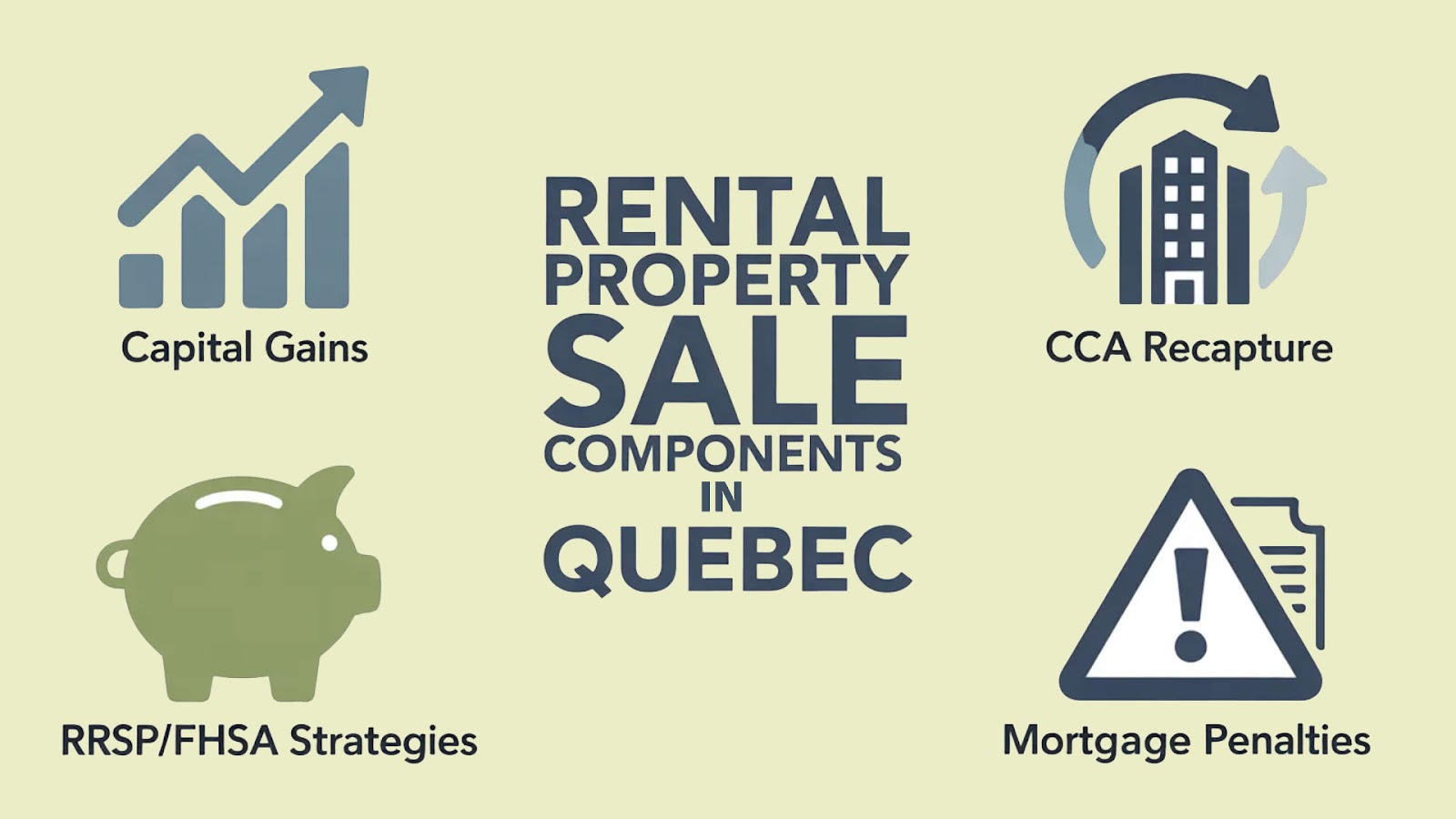
Capital gains tax is typically the largest cost when selling a rental property, especially in areas like Montreal where values have significantly increased. In Quebec, 50% of your capital gain is taxable. This taxable portion is added to other income and taxed at both federal and provincial rates.
Capital gains inclusion rate changes from 2026
Starting in 2026, recent federal tax changes increase the capital gains inclusion rate for individuals.
For individuals, the first $250,000 of net annual capital gains will continue to be taxed at a 50% inclusion rate, while any net capital gains above $250,000 in the year will be subject to a higher 66.67% (two‑thirds) inclusion rate.
Corporations and most trusts will generally be subject to the 66.67% inclusion rate on all of their taxable capital gains.
Quebec has indicated that it will harmonize its capital gains inclusion rules with the federal changes, while maintaining its own provincial income tax rates.
These rules may be updated in future federal or Quebec budgets, so it is essential to verify the current legislation and work with a tax professional before selling a rental property.

Calculating Capital Gains for Quebec Rental Properties
Your capital gain is calculated beyond just the sale price minus the purchase price. The basic formula is:
Capital gain = (Sale price – selling costs) – Adjusted cost base (ACB)
The ACB typically includes the purchase price, legal fees, land transfer tax (welcome tax), capital improvements, and some soft costs. A significant error is failing to include renovation invoices or major work in your ACB.
If capital cost allowance (CCA) was claimed over the years, recapture must also be accounted for separately. Recapture is taxed as regular income, not as a capital gain.
Principal Residence and Mixed-Use Property Considerations
Many Quebec owners lived in the property before renting it or occupied one duplex unit. For these cases, principal residence rules and "change of use" elections are crucial. Incorrect reporting can lead to underreported tax and audits years later.
Smart planning involves correctly designating principal residence years versus rental years. Documenting square footage and fair market values at the time of change of use supports your calculation.
Key takeaways:
- High marginal tax rates in Quebec mean that even a “paper” gain can translate into a very large tax bill if not planned properly.
- Small shifts in timing or income (for example, selling in a lower‑income year) can save thousands in combined federal and Quebec tax.
- Modeling your after-tax proceeds before listing gives you a clearer picture of what you actually keep from the sale.
Documentation and mixed-use essentials:
- Your adjusted cost base should include purchase costs, welcome tax, legal fees, and major renovations backed by receipts and records.
- Weak documentation of improvements artificially inflates your capital gain and tax payable.
- Mixed-use properties (for example, a duplex where you live in one unit) require careful principal residence and change-of-use reporting to avoid reassessments.
Impact of Rental Property Deductions on Sale
Deductions claimed on a rental property affect both ongoing cash flow and its tax treatment upon sale. Capital Cost Allowance (CCA), or depreciation, can lead to recapture.
In 2026, many Quebec landlords who accelerated CCA in prior years to reduce tax now face higher recapture income due to increased property values and rents. Understanding this interaction before listing helps prevent tax-time surprises.
Recapture of Capital Cost Allowance (CCA) on Sale
If CCA was claimed, and your sale price (allocated to the building portion) exceeds the undepreciated capital cost (UCC), the difference is "recapture." Recapture is fully taxable as regular income, not as a 50% taxed capital gain.
This can elevate your tax bracket in Quebec during the sale year. In some cases, stopping CCA claims in the years preceding an anticipated sale may be advantageous, especially with expected value increases.
Comparing Sale Scenarios for Your Quebec Rental
| Scenario | Tax impact (high level) | When it can make sense |
| Sell in one tax year | One large gain/recapture in a single year | Low other income year; retiring; big RRSP room |
| Staggered disposition (e.g. VTB) | Gain spread over years if conditions are met | Buyer needs financing help; income smoothing |
| Keep and refinance | No capital gains tax now, more debt instead | Strong rental cash flow; long horizon |
Key takeaways:
- Claiming CCA in prior years boosts past cash flow but can increase taxable recapture on sale.
- Recapture is fully included in income and can push you into a higher tax bracket.
- Stopping CCA in the years before a planned sale is sometimes more tax-efficient.
Quebec Tax Planning Strategies for Rental Property Sales
Tax planning for a sale focuses on your net proceeds, not just the selling price. The right combination of timing, RRSP, and other tools can significantly reduce your total tax bill while ensuring full compliance with Revenu Québec and the CRA.
For 2026, Quebec property owners should also consider how new federal and provincial housing and tax measures affect their plan, especially if they own multiple properties or are nearing retirement.
Leveraging RRSP and FHSA to Offset Capital Gains
Maximizing RRSP contributions in the year of sale is a highly effective tool to offset taxable capital gains and recapture. For clients with unused contribution room, we often project the after-tax effect of a large lump-sum RRSP contribution funded by sale proceeds.
Younger landlords saving for their first home can contribute part of the proceeds from selling a smaller rental or co-owned unit to a First Home Savings Account (FHSA). This creates an additional deduction, reducing their overall tax.
Key takeaways:
- Focus on after-tax proceeds, not just the sale price or the realtor’s commission.
- RRSP and FHSA contributions funded by sale proceeds can offset capital gains and recapture.
- Multi-year planning is usually more effective than last-minute moves in the year of sale.
Curious how much tax an RRSP lump sum could save you? Let us calculate your 2026 impact today.
Mortgage and Debt Considerations When Selling
Existing mortgages and other debts significantly influence the sale's timing and structure. Early termination of a fixed-rate mortgage in Quebec can incur substantial penalties. These must be weighed against expected price trends and interest rate forecasts.
In 2026, many landlords who secured low rates in 2020-2021 now face higher renewal rates. The decision to sell, hold, or refinance a rental property involves cash flow and risk analysis as much as tax implications.
Coordinating Mortgage Payout and Reinvestment Strategies
Upon sale, a portion of the proceeds covers the rental mortgage payoff, discharge fees, and potential prepayment penalties. We typically model two or three scenarios:
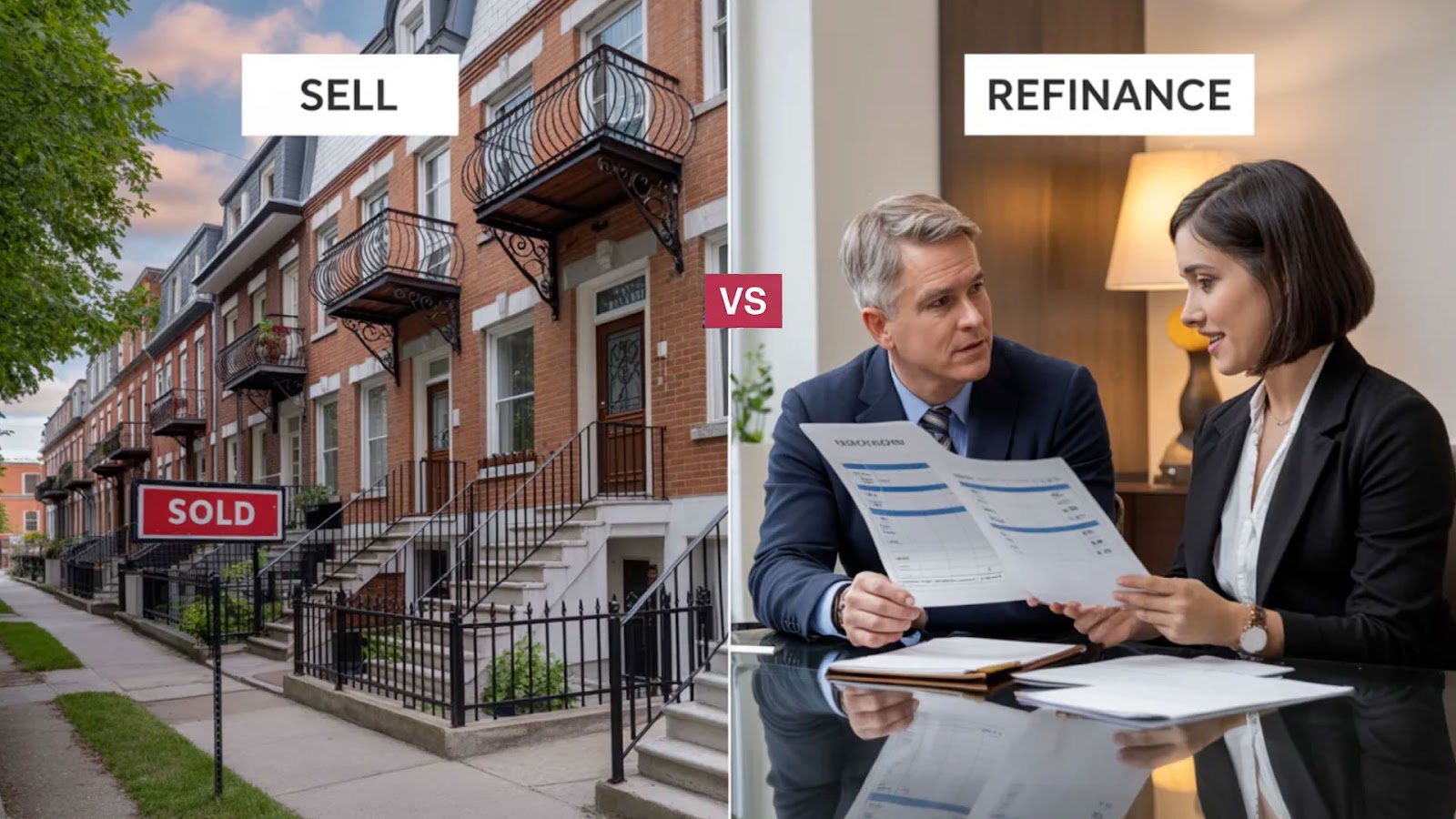
• Sell now, incur the penalty, and reinvest net proceeds.
• Wait until maturity to avoid penalties, accepting market and rate risks.
• Refinance instead of selling, to extract equity and retain the asset.
Aligning the sale's timing with other goals (retirement, children’s education, purchasing a principal residence or another rental) is crucial. This ensures the property sale supports your long-term financial plan.
Key Timing and Cash Flow Comparisons
| Timing option | Cash-flow effect | Risk/benefit trade-off |
| Sell before renewal | Penalty now, but remove rate risk | Good if worried about falling prices or vacancy |
| Sell at renewal | Lower penalty, more flexibility | Exposed to market shifts until then |
| Keep and refinance | Higher monthly payments possible | Maintain asset; potential for long-term growth |
Key takeaways:
- Mortgage penalties, discharge fees, and new interest rates can be as important as tax.
- Selling, waiting until renewal, or refinancing each has different cash-flow and risk trade-offs.
- Coordinating debt strategy with tax planning gives a clearer picture of your net wealth.
Common Pitfalls When Selling a Quebec Rental Property
Many Quebec landlords focus solely on the selling price and realtor commission. They often overlook technical traps that only surface at tax time, leading to reduced net proceeds or triggering audits and penalties.
With over 20 years of experience with Quebec investors and small landlords, I observe recurring issues. Most are avoidable with a planning meeting before listing the property.
Avoiding Top Mistakes for Quebec Landlords
Some common pitfalls include:
- Poor record‑keeping for renovations, which inflates capital gains.
- Ignoring recapture of CCA, leading to unexpected tax bills.
- Misusing principal residence rules for duplexes or mixed-use properties.
- Overlooking GST/QST implications for specific commercial or new-build rentals.
- Failing to coordinate the sale with other income (e.g., bonuses, business sales, RRSP withdrawals).
A detailed pre-sale review of your tax returns, depreciation schedules, and mortgage documents often reveals opportunities to legitimately reduce taxable income or prevent surprises.
Key takeaways:
- Weak record-keeping and ignoring CCA recapture are two of the most costly errors.
- Misusing principal residence rules for duplexes can trigger reassessments and penalties.
- A pre-sale review of tax returns, CCA schedules, and mortgage terms often uncovers savings.
Real Cases: How Planning Benefitted Quebec Landlords
Case 1: Montreal duplex sale before retirement
A 60‑year‑old client owned a Montreal duplex, living in the main unit and renting the upstairs for 18 years. He planned to retire in two years and sell the building to move closer to family.
Problem:
He was unsure how much of the gain qualified for the principal residence exemption, had claimed CCA on the rental unit and had no clear renovation records. Initial rough estimates suggested a six‑figure tax bill.
Solution:
We reconstructed his adjusted cost base with available invoices, bank records and municipal permits. We documented the split between his unit and the rental by square footage and years of use. Then we stopped claiming CCA in the final years and structured the sale in a year when his employment income was lower.
He also made a large RRSP contribution from the proceeds, using remaining room accumulated over his career.
Results:
• Reduced estimated tax by over $35,000 compared to his initial DIY calculation
• Avoided an audit risk by properly supporting principal residence designation
• Increased RRSP assets to support retirement income, instead of “leaking” value to tax
Case 2: Young investor selling a condo rental to buy a family home
A 34‑year‑old client owned a rental condo in Laval and wanted to sell it to buy a larger principal residence for his growing family. He had decent equity but was worried about capital gains tax reducing his down payment.
Problem:
He had never tracked improvements separately and had recently received a promotion that pushed him into a higher bracket. Selling in the same year would mean a high marginal tax rate in Quebec on the taxable half of his gain.
Solution:
We helped him gather renovation costs from old emails, contractor quotes and credit‑card statements to increase his ACB. We then planned the sale for early in the next calendar year, when his bonus would be smaller.
At the same time, he maximized RRSP contributions and opened a FHSA for himself and his spouse, using part of the sale proceeds to fund both accounts.
Results:
- Lower combined marginal tax rate by shifting the sale to a better year
- Created new deductions via RRSP and FHSA contributions
- Preserved a larger net down payment, allowing them to qualify for their target home
FAQ
1. How is capital gains tax calculated when selling a rental property in Quebec?
You generally pay tax on 50% of your capital gain, which is the sale price minus selling costs and your adjusted cost base, including purchase price, welcome tax, legal fees and major renovations. That taxable half is added to your other income and taxed at federal and Quebec provincial rates in the year of sale. From 2026, higher inclusion rates can apply on annual net capital gains above the federal threshold, so planning the timing of your sale becomes even more important.
2. Can I claim the principal residence exemption on a duplex I’m selling in Quebec?
You may be able to claim the principal residence exemption on the portion you occupied as your home, based on years of residence and your share of the property used personally. The rental portion generally remains taxable, and you must also consider change-of-use rules and any capital cost allowance claims made in prior years. Proper documentation of square footage, years of use, and fair market value at conversion is essential.
3. What is recapture of depreciation (CCA) on a rental property sale?
If you claimed capital cost allowance over the years and sell the property for more than its remaining undepreciated capital cost, the excess is called recapture. Recapture is fully taxed as regular income, not as a capital gain, which can significantly increase your tax bill in Quebec in the year you sell. In some situations, stopping CCA claims in the years before a planned sale can reduce future recapture.
4. How can I reduce tax when selling a rental property in Quebec?
Common strategies include improving your documentation to increase your adjusted cost base, timing the sale for a lower-income year, maximizing RRSP contributions, using First Home Savings Account contributions where relevant, and planning carefully around capital cost allowance and recapture. The optimal mix depends on your full financial situation, including other income sources, unused contribution room and your long-term goals.
5. Should I sell my rental or keep it and refinance instead?
This decision depends on your cash flow, interest rates, risk tolerance, and tax position. Selling triggers capital gains tax and possible recapture but can free equity for goals such as retirement or buying a principal residence. Refinancing avoids immediate tax but increases your debt and exposure to future rate changes. A full financial projection comparing both scenarios in the Quebec context helps you choose the option that best supports your long-term plan.
Ready to Optimize Your Rental Property Sale?
Free Consultation:
Phone: +1-514-834-5558
Email: contact@bkfinancialservices.ca
Book Free Consultation Today – Available in English, French, Russian, Hebrew.
We model the after-tax impact of selling your Quebec rental property. We integrate RRSP, FHSA, and mortgage strategies, helping you avoid costly tax mistakes before listing.