Most Canadians manage multiple debts concurrently, including mortgages, credit cards, car loans, and lines of credit. This complexity often makes management difficult without a clear plan.
The challenge extends beyond reducing balances. It involves distinguishing debts that foster long-term financial stability from those that hinder it. These detrimental debts often carry high interest, pressure credit scores, and reduce future borrowing power.
This guide explains the difference between good debt and bad debt in Canada. It outlines how interest and repayment structures influence this distinction. A practical method for prioritizing payments across credit cards, lines of credit, and car loans is also provided.
The aim is to help Canadians and Quebec residents make decisions that strengthen future financial outcomes, rather than simply reacting to short-term stress.
Quebec-Specific Considerations
While the core principles of good and bad debt are the same across Canada, there are a few practical nuances in Quebec:
- Personal lines of credit and car loans are widely used and often become the primary tools for financing major purchases.
- The tax burden and cost of living in Quebec can put additional pressure on the household budget when high‑interest credit cards and unsecured loans accumulate at the same time.
- For mortgage approval in Quebec, lenders pay particularly close attention to credit card and line of credit usage, as well as to overall debt levels.
The following sections of this guide apply across Canada, but the examples and emphasis reflect the realities of everyday life and borrowing in Quebec.
Understanding Good Debt in the Canadian Context
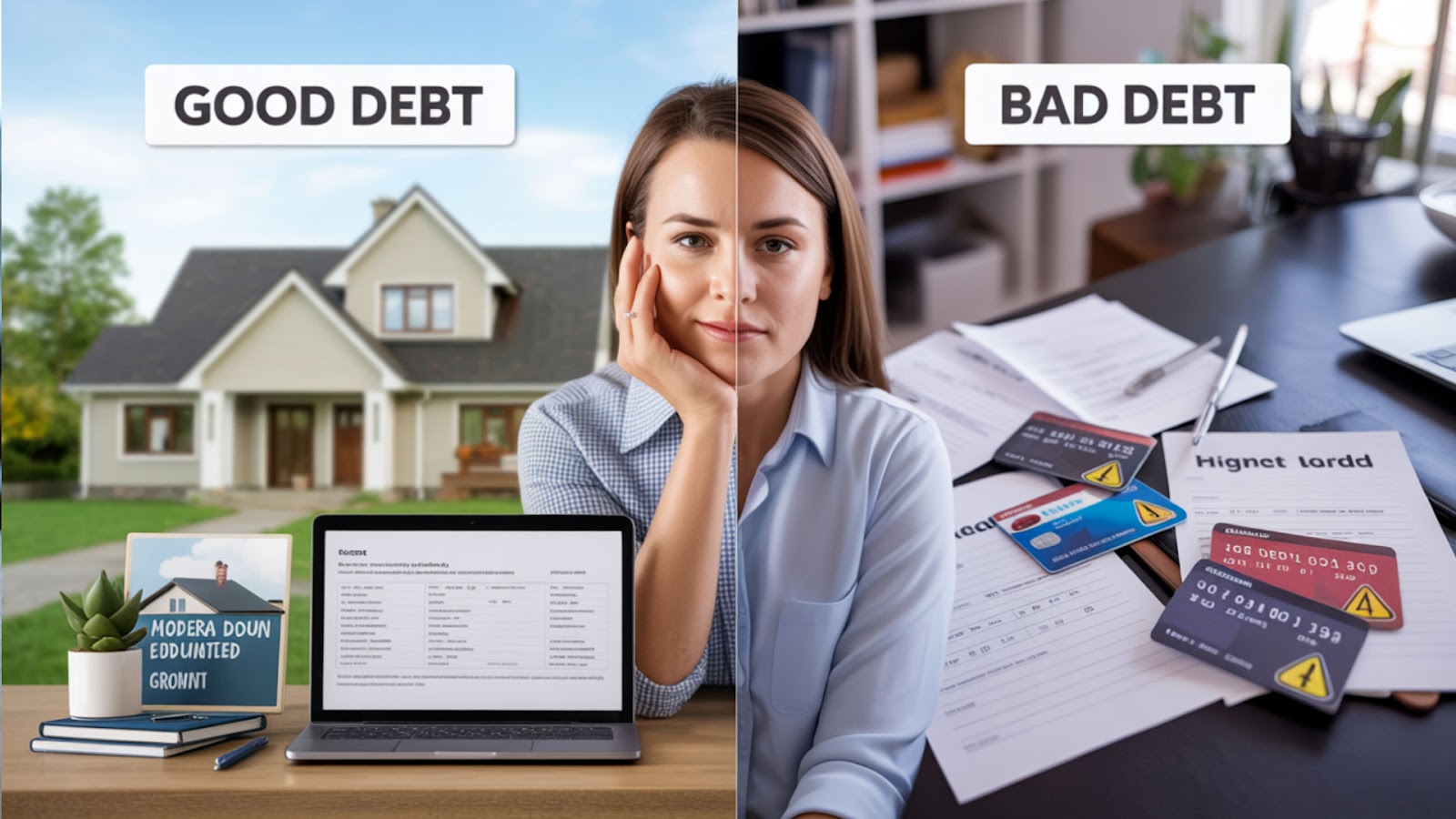
Good debt is borrowing that contributes to long-term growth, financial security or asset value. It typically shows one or more of the following traits:
• It helps acquire or build an appreciating asset.
• It increases earning potential or long-term cash flow.
• It carries a manageable rate relative to the benefit it provides.
• It supports long-term financial stability.
Examples in Canada:
- Mortgages on a primary residence: Real estate often holds long-term value, and mortgage rates are significantly lower than credit card or unsecured lending. Timely payments also support a strong credit score.
- Student loans: These improve earning potential and generally offer more favorable terms than consumer credit. Federal and provincial repayment programs provide additional flexibility. Note: The federal portion of student loans is currently interest-free, making this one of the lowest-priority debts to pay off early.
- Business or investment loans (RRSP leverage, professional growth): When carefully structured and advised, these loans can grow long-term assets or income. They involve risk and require proper planning. However, they qualify as good debt when tied directly to long-term financial benefit.
Good debt is ultimately defined by its ability to contribute to future value rather than by its interest rate alone.
Identifying Bad Debt and Its Financial Impact
Bad debt is borrowing that reduces financial stability over time. Signs include:
- High interest that grows faster than principal payments.
- No connection to asset growth or income improvement.
- A revolving structure that encourages long-term balances.
- A negative effect on credit score and borrowing power.
Common forms:
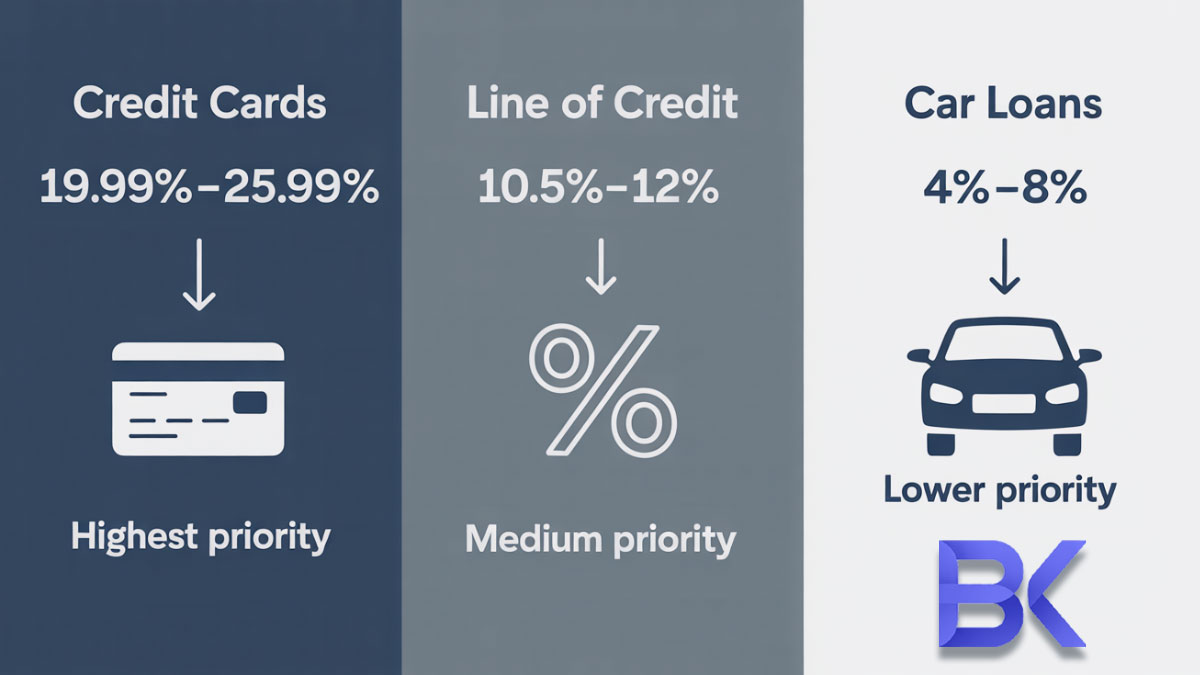
- Credit card balances: Typical Canadian APR for standard cards ranges from 19.99% to 25.99%, with some specialty products being higher. At these rates, debt accumulates quickly. High utilization also reduces your credit score.
- High-interest personal loans: Rates often range from the low teens up to 30%+ depending on credit history, particularly for riskier products. Payday-style products convert to even higher APRs if carried long enough.
- Overused lines of credit: Personal lines of credit are flexible, but rates in Quebec and across Canada can reach double digits, and minimum payments often cover only the interest, which means the principal balance barely goes down.
Bad debt drains resources without building long-term value, and it pressures credit score and monthly cash flow.
The Role of Interest and Loan Structure in Debt Classification
Two debts with identical balances can have completely different long-term effects based on how they are structured.
Interest Rates: How They Accumulate
- Credit cards compound interest daily.
- Lines of credit use variable rates tied to Prime; in Quebec and across Canada this often means a noticeable increase in borrowing costs when interest rates rise (in Quebec this often results in 10.5–12%).
- Car loans generally carry more moderate rates (in 2026 4–8% for new vehicles with strong credit and higher for used vehicles or weaker credit profiles), but they can still become a burden when the term is long and the loan amount is high.
Secured vs. Unsecured Debt Differences
Secured loans (mortgages, HELOCs) carry lower rates because they are backed by an asset. Unsecured credit is riskier for lenders and therefore more expensive.
Amortization: Principal vs. Interest
Installment loans (car loans, personal loans, mortgages) gradually reduce principal. Revolving credit (credit cards, lines of credit) reduces principal only when payments exceed interest.
Credit Utilization: Impact on Your Score
High utilization, especially above 30%, places downward pressure on credit score and affects future borrowing terms.
Understanding these mechanics is essential when deciding which debts to pay first.
How to Build Your Personal Debt Repayment Plan in Canada
To turn theory into concrete action, it helps to follow a few simple steps.
Step 1: List all your debts
Write down, for each debt: the type (credit card, line of credit, car loan, mortgage, etc.), current balance, interest rate, minimum monthly payment, and whether it is revolving or installment.
Step 2: Sort by interest rate and type
Sort your debts first by interest rate (from highest to lowest), then note which ones are revolving (credit cards, lines of credit) and which are installment (car loan, personal loan, mortgage).
Step 3: Choose your repayment method
Decide which approach suits you best:
- Avalanche (focus on the highest interest rate first to minimize total interest paid).
- Credit score improvement (prioritize revolving debts with high utilization).
- Consolidation (reduce your overall rate and simplify payments through a loan or HELOC).
Step 4: Protect your emergency fund
When planning accelerated repayment, make sure you do not completely deplete your emergency fund. It is usually wise to keep at least a basic liquidity buffer for unexpected expenses so you do not have to fall back on credit cards at the first sign of trouble.
Step 5: Review and adjust regularly
Revisit your plan when your income, interest rates, or family situation change, or when you are preparing for major goals such as a mortgage within the next 12–24 months.
Strategic Prioritization of Debts for Canadians
When several debts exist simultaneously, repayment planning should follow realistic financial logic rather than emotion. In Canada, prioritization usually relies on three principles:
- Reduce the highest interest first.
- Stabilize the debts that harm credit score the most.
- Protect cash flow tied to essential assets.
A typical repayment order becomes:
- Credit cards
- High-interest personal loans
- Lines of credit
- Car loans
- Mortgages
Individual goals, income variability and upcoming borrowing needs (for example, a mortgage application) also influence the final strategy.
Prioritizing Credit Card Debt: High Interest and Credit Impact
Credit cards are almost always the first priority because:
- Interest rates are the highest among mainstream credit products.
- Balances accumulate quickly through daily compounding.
- High utilization significantly reduces credit score.
- There is no amortization; principal decreases only through targeted payments.
Reducing credit card balances often provides the fastest improvement in monthly cash flow and credit score.
Managing Lines of Credit: Benefits, Risks, and Repayment Priority
A line of credit remains a useful financial tool when:
- It is used short-term,
- It is paid down consistently,
- And the balance remains low relative to the limit.
But the risks grow when:
- Minimum payments cover interest only,
- Borrowing becomes habitual,
- The rate reaches double digits, and the balance remains close to the limit for a long time. For example, the rate approaches 10.5–12%, which is common in Quebec for unsecured lines.
Lines of credit should be prioritized after credit cards but before car loans when they become long-term obligations.
Car Loans: Understanding Their Structure and Repayment Impact
Car loans are structured, amortized and at moderate interest rates in many cases. In Canada and Quebec in 2026:
- New car loans with strong credit often offer relatively competitive rates (average 4–8%).
- Used car loans or loans for weaker credit can be significantly more expensive.
- Depreciation often outpaces the decline in loan principal.
Negative equity becomes a risk if the borrower wants to sell or trade the vehicle before the loan matures.
Car loans usually rank below credit cards and lines of credit unless:
- The rate is unusually high,
- Payments strain cash flow,
- Or negative equity is already present.
Effective Debt Repayment Strategies for Canadians
Reliable strategies in Canada include:
Avalanche method
Focus on the highest APR overall. This reduces the total amount of interest paid.
Credit score improvement method
Reduce balances on revolving credit to improve utilization, which can help with refinancing or upcoming mortgage applications.
Consolidation
Through a personal loan or HELOC, borrowers may reduce overall interest and convert revolving debt into structured amortized payments.
Warning: Consolidation only works if you stop using the credit cards you just paid off. Otherwise, you risk ending up with a consolidation loan AND new credit card debt.
When consolidating through a HELOC, it is important to understand the additional risk: you are converting unsecured debt into secured debt backed by your home, and defaults can directly affect your home.
Cash flow planning with a financial advisor
A structured plan aligns repayment with income patterns and long-term goals, ensuring that debt elimination does not conflict with essential savings or risk management.
Debt's Influence on Mortgage Approval and Borrowing Power
Lenders in Quebec and across Canada assess:
- Credit utilization
- Payment history
- Total debt-to-income ratio
- The type of debt (revolving vs installment)
- Stability of monthly obligations
High credit card balances are particularly damaging, even when payments are current. Loan officers often view car loans, student loans and other amortized products as manageable if revolving debt is stable.
Eliminating bad debt improves borrowing power and strengthens access to favourable mortgage and refinancing options.
Real-Life Debt Prioritization Scenarios
Scenario 1: Family with a mortgage, car loan, and two credit cards. Priority: reduce credit card balances first, maintain mortgage payments, then review car loan terms if interest is high or cash flow is tight.
It makes sense to speak with an advisor if debt starts to strain the family budget or if a home purchase is planned within the next 12–24 months.
Scenario 2: New immigrant with a line of credit and a high-rate car loan. Priority: decrease line of credit utilization below ~30%, then accelerate payments on the car loan if the rate is above average.
Professional advice is especially valuable when you are building your credit history and preparing for major goals such as a future mortgage.
Scenario 3: Self-employed client with seasonal income and multiple credit cards. Priority: consolidate high-interest debt, build a repayment schedule aligned with seasonal cash flow, and avoid carrying revolving debt into slow months.
It is worth discussing a detailed strategy with an advisor if your income fluctuates significantly and it is difficult to maintain stable payments throughout the year.
Scenario 4: Young professional with student loans and a personal line of credit. Priority: reduce line of credit first if the rate is higher; maintain consistent student loan payments to preserve credit history.
Consulting a specialist is helpful when you need to balance debt repayment, saving for future goals, and building an investment strategy at the same time.
Canadian Debt Types: Interest, Risk, and Priority Comparison
| Debt Type | Typical Interest (2026) | Credit Score Impact | Long-Term Benefit | Repayment Priority | Typical Classification |
| Credit Cards | 19.99–25.99% | High | None | Highest | Typically bad debt |
| Personal Loans | 12–35% | Moderate | None | High | Often bad debt |
| Lines of Credit (QC) | Can reach 2‑digit rates (~10.5–12%) | High when overused | Moderate (flexibility) | Medium | Can become bad if misused |
| Car Loans (QC) | Often mid‑single digits (4–8%) | Low to moderate | Low to moderate | Lower | Usually neutral/necessary |
| Mortgages | Varies by term | Positive with consistent payments | High (housing stability) | Lowest | Usually good debt |
Conclusion
A strong financial plan requires understanding the amount owed, how each debt functions, how interest accumulates, and how repayment decisions affect long-term financial health. Proper prioritization reduces interest costs, protects credit scores, and improves access to better lending opportunities.
If you want to review your debt structure or build a personalized repayment plan, professional guidance can help you move forward with clarity and confidence.
Book a free consultation to discuss your financial goals and create a plan tailored to your situation.
FAQ
Q: What is the main difference between good debt and bad debt in Canada?
A: Good debt supports long-term goals such as housing, education or business growth and usually has relatively lower, manageable interest rates. Bad debt typically has high interest, does not build assets or income and often comes from revolving products like credit cards and overused lines of credit.
Q: Which debts should Canadians usually pay off first?
A: In most cases, high-interest credit cards come first, followed by high-rate personal loans and lines of credit. Car loans and mortgages are usually lower priority as long as payments are up to date and interest rates are reasonable.
Q: How does credit utilization affect my credit score?
A: When your balances are high relative to your limits—especially above about 30%—lenders see you as riskier. This can lower your score and make it harder or more expensive to qualify for future borrowing like a mortgage or refinance.
Q: Are car loans considered good or bad debt?
A: Car loans are usually considered neutral or “necessary” debt. They are amortized and often at moderate rates, but vehicles depreciate quickly, so they rarely build wealth. They become closer to bad debt when the rate is high, the term is very long or negative equity develops.
Q: When does a line of credit become a problem?
A: A line of credit becomes problematic when it is used as long-term financing instead of short-term support, when payments only cover interest or when the rate approaches double digits and the balance stays close to the limit.
Q: Can consolidation help manage multiple bad debts?
A: Yes. Consolidating higher-rate credit cards and lines of credit into a lower-rate personal loan or HELOC can reduce interest and create a fixed repayment schedule, as long as you avoid reusing the old credit once it’s paid down.
Ready to Understand Your Debt?
If you’re juggling credit cards, a line of credit and a car loan and aren’t sure which balance to tackle first, now is the time to build a clear, structured plan. Book a free consultation to review your current debts, understand how interest and utilization are affecting your credit and create a personalized repayment strategy that fits your income, goals and borrowing needs in Canada and Quebec.
Disclaimer: This article is for informational purposes only and does not constitute professional financial or tax advice.Rates are provided as an example as of January 2026 and are subject to update as the market changes.
For additional government guidance on assessing and repaying your debts, see the Financial Consumer Agency of Canada’s page on paying back your debt.