Essential Compensation Insights for Quebec Business Owners
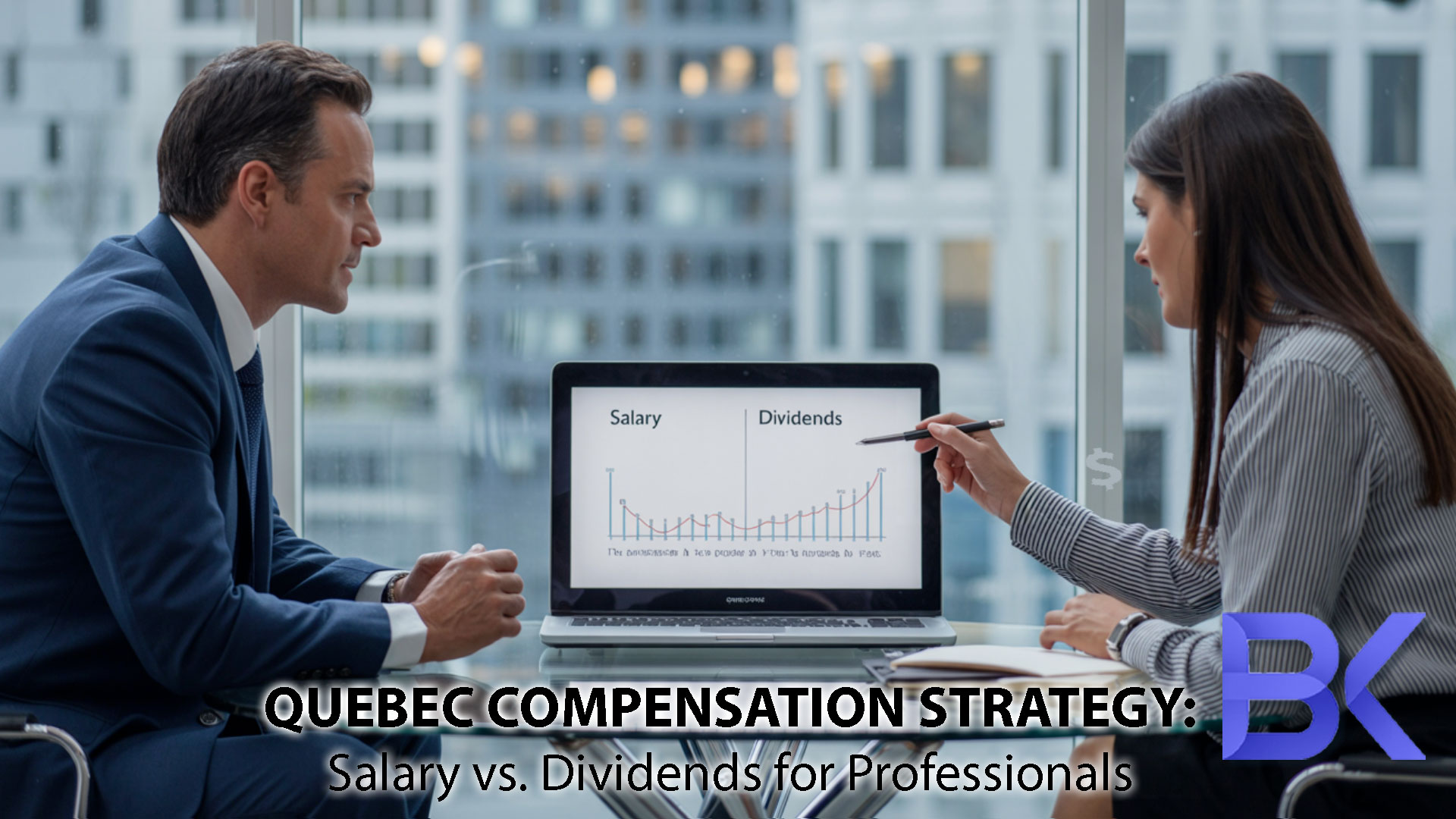
Incorporated professionals and business owners in Quebec face a crucial annual financial decision: how to pay themselves. The choice between salary, dividends, or a mix impacts tax, QPP (Quebec Pension Plan) contributions, RRSP room, mortgage qualification, corporate retained earnings, and retirement planning.
Compensation strategy has evolved over the past decade. While dividends were once the preferred low-tax option, recent updates to tax brackets, QPP calculations, and integration rules have shifted professional preferences.
Many high-income professionals now favor salary once total income approaches $100,000 to $120,000. The optimal choice still depends on individual and corporate structures.
This guide explains how salary and dividends function in Quebec, highlighting each option's advantages. It also demonstrates how most owners benefit from a combined compensation strategy, updated with 2026 tax rates and examples.
Understanding Salary as Compensation in Quebec
Salary is treated as employment income. The corporation deducts it as a business expense, and the owner pays regular federal and Quebec personal tax on the amount received.
Key characteristics
• Creates RRSP contribution room
• Requires QPP contributions, which build retirement and disability protection (2026 rate: 12.6% total on earnings between $3,500 and $72,800)
• Subject to Quebec employer payroll taxes (FSS and CNESST), which are deductible business expenses
• Considered stable and predictable income by lenders
• Requires payroll setup, monthly or quarterly remittances, and a T4 and RL-1 at year-end
• Reduces taxable corporate income
When salary is generally preferred
Accountants often recommend salary when an owner requires or desires:
• RRSP contribution room
• Easier mortgage or refinancing approval
• Consistent income for budgeting
• Higher QPP retirement benefits
• Lower retained earnings to limit passive income erosion of the small business rate
For many Quebec professionals, salary often becomes more efficient for both corporate and personal taxation once income reaches $100,000 or higher.
Understanding Dividends as Compensation for Quebec Businesses
Dividends are distributed from after-tax corporate profits. Owners pay tax on them at preferential rates, thanks to the dividend tax credit system. Dividends do not create RRSP room or require QPP contributions.
Key characteristics
• No payroll setup or monthly remittances
• Require a T5 and RL-3 slip, plus a corporate resolution
• Paid only when sufficient retained earnings exist
• Often produce lower administrative burden
• No tax withheld at source, which means many owners must make quarterly installments
• Do not reduce corporate taxable income
When dividends are often preferred
Dividends can be advantageous when an owner:
• Wants to minimize QPP contributions
• Prefers occasional payouts rather than a fixed monthly income
• Has low or flexible personal spending needs
• Receives income from passive investments and wants to manage the impact on the corporate tax rate
• Wants simpler year-end compensation without payroll obligations
At modest personal income levels, dividends may still result in lower combined tax compared to salary, depending on the specific corporate situation.

Quebec Tax Integration: Salary vs. Dividends
Understanding Quebec's Tax Integration Mechanics
In theory, Quebec’s tax system aims to equalize the final tax cost of income, whether earned as salary or paid out from corporate profits as dividends.
In practice, tax integration is rarely perfect. Advanced tax planning analyses consistently show that recent tax updates have created specific income ranges where salary offers a more favorable outcome.
This is especially true when considering RRSP room, QPP coverage, and lending requirements for incorporated professionals.
2026 Quebec Personal Tax Brackets
| Taxable Income | Rate |
| $54,345 or less | 14% |
| $54,346 to $108,680 | 19% |
| $108,681 to $132,245 | 24% |
| Over $132,245 | 25.75% |
2026 Federal Personal Tax Brackets
| Taxable Income | Rate |
| $58,523 or less | 14% |
| $58,524 to $117,045 | 20.5% |
| $117,046 to $181,440 | 26% |
| $181,441 to $258,482 | 29% |
| Over $258,482 | 33% |
Key Differences: Salary vs. Dividends in Quebec
| Aspect | Salary | Dividends |
| Reduces corporate taxable income | Yes | No |
| Generates RRSP room | Yes | No |
| Requires QPP contributions | Yes | No |
| Subject to Employer Tax (FSS) | Yes (Corporate expense) | No |
| Reported through | T4 & RL-1 | T5 & RL-3 |
| Paid from after-tax corporate income | No | Yes |
| Requires quarterly tax installments | No (Tax withheld at source) | Often Yes |
For Quebec owners, the optimal choice depends on corporate profits, personal tax brackets, passive income within the corporation, and long-term financial planning goals.
Passive Investment Income and Quebec's Small Business Deduction
Many Quebec owners overlook the impact of passive investment income. Significant passive income earned by a corporation can erode its access to the small business tax rate (3.2% Quebec rate on first $500,000 in 2026, combined federal-Quebec 12.2%).
Additionally, growing retained earnings may attract higher taxes on investment returns within the corporation.
Salary and dividends influence this environment differently:
• Paying salary reduces corporate profits and may help preserve the small business deduction.
• Paying dividends removes cash from the corporation without altering corporate taxable income.
For corporations with large investment portfolios, a carefully structured mix of salary and dividends can prevent the gradual loss of the lower small business tax rate. No major changes to passive income rules in 2026; the federal threshold remains $50,000, reducing the SBD limit above that.
Mortgage and Lending: How Compensation Impacts Approval
Why most lenders prefer salary
Lenders in Quebec almost always prefer stable T4 income for financing purposes. Salaries generate clean, predictable documentation that mortgage underwriters readily understand.
Dividends are acceptable, but typically require:
• a longer history of consistent payouts
• strong corporate financial statements
• additional scrutiny of retained earnings
If buying property or refinancing is a priority, incorporating salary into your compensation structure is almost always beneficial.
Unlocking Benefits: Pension, Disability, and Insurance Programs
Salary unlocks access to several programs that dividends cannot support. For example:
• QPP disability and retirement benefits grow only through salary-based contributions (2026 max pensionable earnings: $72,800)
• Salary allows participation in defined-benefit plans such as an Individual Pension Plan
• Most disability insurance policies use salary, not dividends, for coverage calculations
• Certain employer-style benefits can be paid through the corporation only when the owner is on payroll
Owners relying solely on dividends often underestimate the long-term pension value lost over time.

How to Choose the Right Mix for Your Quebec Corporation
When Salary Works Better
Salary tends to win when the owner:
• earns around one hundred thousand dollars or more
• needs RRSP room
• wants strong QPP retirement protection
• plans to buy a property
• wants predictable monthly income
• must manage retained earnings to limit passive income exposure
When Dividends Work Better
Dividends tend to win when the owner:
• wants fewer administrative tasks
• has low personal spending needs
• needs flexible payment timing
• wants to avoid QPP contributions
• uses dividends to distribute passive income efficiently
• prefers occasional rather than regular payouts
The Advantage of a Combined Salary and Dividend Strategy
Standard best practices in advanced wealth management emphasize that a blended compensation structure is usually the most efficient approach.
Rather than choosing "all-or-nothing," a hybrid model allows you to leverage the strengths of both systems while minimizing their weaknesses.
Implementing a Balanced Compensation Model
Pay sufficient salary to:
• maximize RRSP room
• satisfy mortgage requirements
• build QPP contributions for retirement
• manage corporate profit levels
• keep passive income within limits that preserve the small business rate
Distribute additional withdrawals as dividends to:
• simplify year-end distributions
• fine-tune personal tax brackets
• reduce payroll overhead
• extract surplus corporate cash efficiently
This balanced approach provides both tax efficiency and year-to-year financial flexibility.
Practical Example: A Quebec Incorporated Professional
A Montreal consultant with $200,000 in corporate net income seeks stable personal income, RRSP growth, balanced taxes, and mortgage approval. The corporation holds significant retained earnings.
An optimized structure might typically include:
• salary sufficient to maximize RRSP contribution room (e.g., $150,000 salary)
• controlled dividend distributions for additional cash flow
• monitoring of retained earnings to avoid passive income penalties
• appropriate QPP contributions for future support
For instance, at a $150,000 personal income level in 2026, opting for salary could result in approximately 2% lower overall tax burden compared to dividends, translating to savings of around $3,000 (based on 2026 rates, assuming no RRSP contributions and minimal passive income). This aligns with guidance from several Canadian wealth firms for high-income Quebec business owners.
Simple Tax Savings Scenario
Consider extracting $150,000 personally from your corporation in 2026:
– All Salary: Approximate combined tax (personal + contributions) ~$60,000, net ~$90,000 after taxes, but with RRSP room and QPP benefits.
– All Dividends: Approximate combined tax (corporate + personal) ~$63,000, net ~$87,000, no RRSP or QPP.
– Hybrid: Savings of ~$3,000 vs. all dividends, plus added benefits.
Case Study: Anonymized Client Success
A Quebec-based IT consultant with $180,000 corporate income switched from all dividends to a hybrid strategy in 2025. By allocating $120,000 as salary, they gained $21,600 in RRSP room, improved QPP benefits, and saved ~$8,000 in combined taxes for 2026 projections. This also facilitated a smoother mortgage approval for a home purchase.
Tailoring Your Compensation Mix and Annual Review
No universal formula exists. The optimal compensation structure depends on:
• corporate profit level
• personal income requirements
• mortgage and lending goals
• QPP preferences
• RRSP strategy
• passive investment income
• family income structure
• long-term retirement planning (corporate investing vs RRSP vs pension plans)
Review your compensation strategy annually, especially when income fluctuates or personal goals shift. Reference official sources like Revenu Québec or CRA for the latest updates.
FAQ
Q1: As an incorporated professional in Quebec, is it better to pay myself only salary or only dividends?
A1: For most higher-earning Quebec professionals, a mix of salary and dividends is usually best. Salary helps with RRSP room, QPP benefits, and mortgage approval, while dividends can provide flexible, tax-efficient cash flow from retained earnings.
Q2: At what income level does salary typically become more attractive than dividends?
A2: Many Quebec professionals find that once total income reaches roughly $100,000–$120,000, salary often becomes more efficient when you factor in QPP, RRSP room, and lending requirements. The exact tipping point depends on your corporate profits and personal situation.
Q3: How does my compensation choice affect my ability to get a mortgage in Quebec?
A3: Lenders strongly prefer consistent T4 salary income because it’s easier to document and underwrite. Dividend-only income is possible but usually requires more years of history and stronger supporting corporate financials.
Q4: Do dividends help me build RRSP or QPP benefits?
A4: No. Only salary generates RRSP contribution room and QPP contributions. If RRSP savings or stronger QPP retirement and disability protection are priorities, you generally need some salary.
Q5: How does passive investment income in my corporation affect my salary vs. dividend decision?
A5: Significant passive income can erode the small business deduction in Quebec. Paying salary can reduce corporate taxable income and help preserve the small business rate, whereas paying dividends removes cash without lowering taxable income, which may accelerate the loss of that lower rate.
Q6: How often should I review my compensation strategy?
A6: At least annually, and any time your income, retained earnings, borrowing needs, or retirement goals change. A yearly review helps adjust the salary–dividend mix as tax rules and your personal situation evolve.
Q7: Can you help me design a personalized compensation strategy for 2026 and beyond?
A7: Yes. A tailored review of your corporation, cash needs, passive income, and retirement objectives can identify the right combination of salary and dividends for your situation.
Q8: What if I'm part of a family with multiple income earners?
A8: A hybrid strategy can optimize income splitting. For example, paying salary to one spouse for RRSP/QPP while using dividends for lower-bracket family members may reduce overall family tax. Consult for personalized splitting rules.
Q9: What if I'm approaching retirement?
A9: Prioritize salary to maximize QPP and RRSP for pension bridging. Dividends can then draw down retained earnings tax-efficiently in lower brackets post-retirement.
Need a Personalized Plan?
Compensation planning is among the most impactful decisions for a Quebec business owner. Schedule a consultation if you desire a clear, tailored approach based on your corporation, cash needs, and long-term financial strategy.
The first meeting is free and available in English, French, Russian, and Hebrew.
Phone: (514) 834-5558
Email: contact@bkfinancialservices.ca
Disclaimer: This article is for informational purposes only and does not constitute professional financial or tax advice. Tax rules can change, and individual circumstances vary. Information is current to January 2026 and based on publicly available data from Revenu Québec and the CRA. Consult a qualified financial advisor or tax professional to tailor strategies to your situation and ensure compliance with current laws.