

Quebec's high combined tax rates heavily impact top earners. Many professionals feel a significant portion of their extra income goes straight to Revenu Québec and the CRA. However, proper planning allows you to legally retain more of your wealth while fully complying with tax rules.
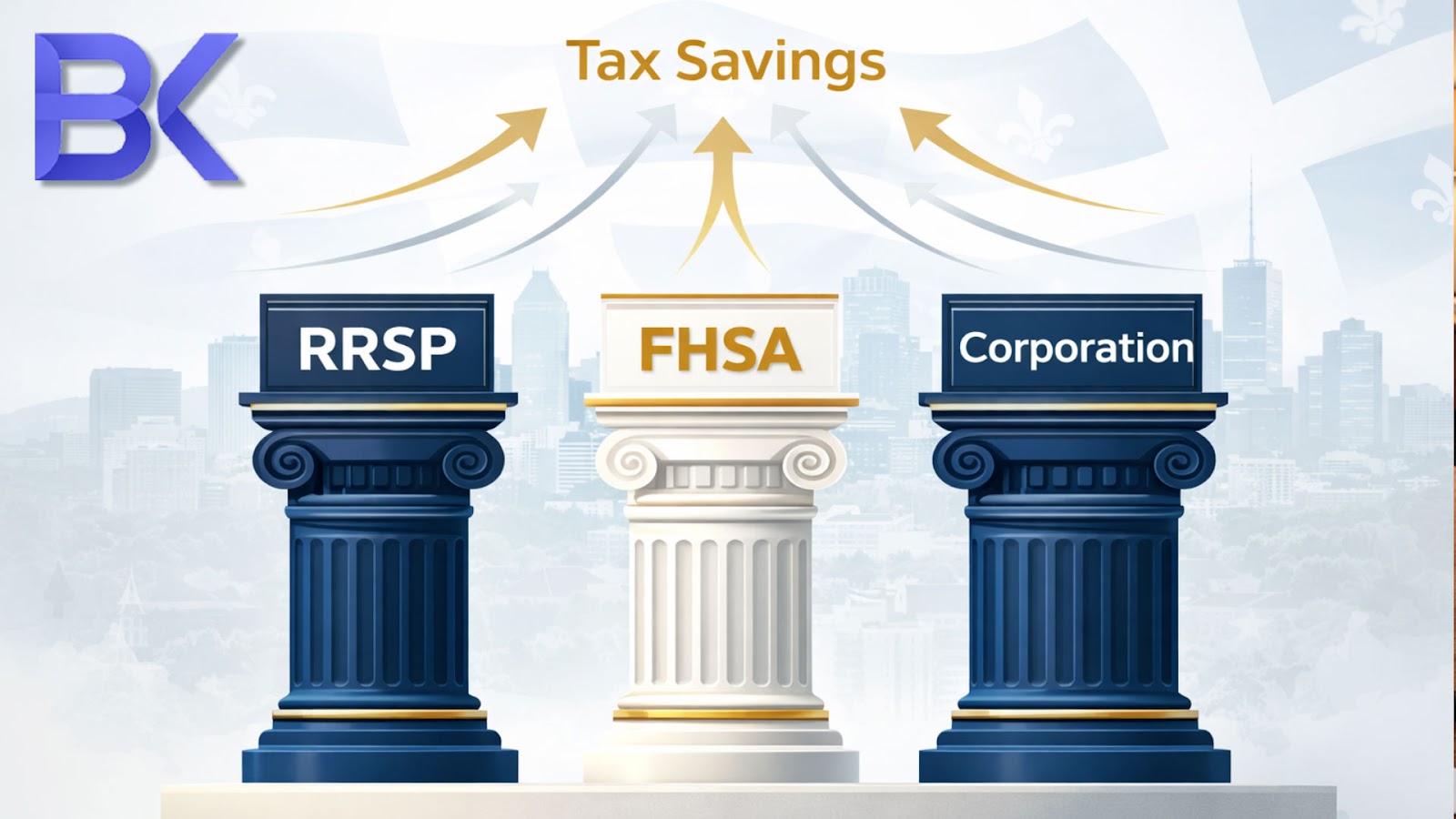
Coordinated strategies involving RRSPs, FHSAs, professional corporations, deductions, and income splitting are essential. As a Financial Planner and Financial Security Advisor, I’ve worked with Quebec professionals for over 20 years and consistently see individuals paying excessive taxes. This guide explains how you can optimize your finances and legally reduce your tax burden in 2026 and beyond.
Understanding Quebec's Tax Landscape for High-Income Earners
Understanding Quebec taxes is the first step to reducing your overall tax bill. In 2026, professionals earning over $120,000 face a combined marginal tax rate approaching 50%. The highest combined marginal rate in Quebec surpasses 53.3%, affecting top brackets reached by many specialists, executives, and business owners.
Without optimization, every extra $10,000 earned could mean losing over $5,000 to taxes. Smart planning shifts income from high-tax years and brackets to lower-tax situations. You can lower your tax exposure by spreading income across time, eligible family members, and tax-advantaged accounts. It is crucial to know which deductions and structures apply specifically to your status as an employee, self-employed individual, or incorporated professional.

Marginal Tax Rates and Bracket Management
Managing marginal tax rates is a powerful tool. When your income enters a higher bracket, tax deductions and deferrals become exponentially more valuable because each dollar saved reduces tax at that top, punishing rate.
Strategies include maximizing RRSP contributions, claiming all eligible employment deductions, and deferring bonuses or professional billings. Incorporated professionals can use a calculated mix of salary and dividends to keep their personal income out of the highest brackets.
Timing is key: early contributions, structured bonuses, and planning around major liquidity events (like selling property or cashing out stock options) help smooth your income. Forecasting your annual earnings allows you to fill lower brackets with salary and shift the rest into more tax-efficient vehicles.
Federal vs Quebec Tax Coordination
Federal and Quebec rules don't always align, creating both challenges and opportunities. A credit or deduction that is highly beneficial federally may have a completely different provincial impact, and vice versa.
For instance, the combined effect of RRSP deductions, childcare expenses, and professional fees must be calculated across both systems (governed federally by the
Income Tax Act). Similarly, capital gains, dividends, and interest income are taxed differently in Quebec compared to other provinces.
To achieve optimal net results, you must coordinate strategies across both tax layers. This often requires modeling various scenarios: salary vs. dividend, personal vs. corporate investment, and transaction timing. An advisor knowledgeable in both federal and provincial systems helps you avoid unexpected balances due in April.
| Strategy Type | Who It Fits Best | Main Tax Benefit |
| RRSP & FHSA Contributions | High-income employees & self-employed | Immediate tax deduction, long-term tax-deferred growth |
| Professional / Private Corporation | Doctors, dentists, consultants, other specialists | Income deferral, flexible compensation, income splitting |
| Employee & Business Deductions | Employees with T2200, self-employed | Reduces taxable income at top marginal rate |
| Family Income Splitting Tactics | Married/common-law couples, families with kids | Shifts income to lower-tax family members |
| Investment & Capital Gains Planning | Investors, business owners | Lower tax on growth, capital gains planning |
Leveraging RRSP Strategies for Quebec Tax Optimization
RRSP contributions remain the most powerful legal tax reduction tool for top earners. With a marginal rate above 45%, a $10,000 contribution can save you $4,500–$5,300 in combined taxes today. To maximize this benefit, discover 3 smart ways to use your RRSP tax refund to accelerate your wealth.
Beyond annual limits, many professionals have accumulated unused RRSP room. Utilizing this carryforward room during your peak earning years can dramatically slash your tax bill. Some clients even opt for short-term RRSP loans to accelerate contributions during periods of high cash flow.
The ultimate goal is to coordinate RRSP contributions with your bonus income, incorporation decisions, and retirement planning. You reduce your current year tax at a 50%+ rate, with the aim of withdrawing the funds later at a much lower combined rate in retirement.

Spousal RRSPs for Future Income Splitting
Spousal RRSPs are drastically underused by Quebec professionals. If one partner anticipates significantly higher retirement income, contributing to a spousal RRSP helps equalize future taxable withdrawals between spouses.
The contributing (higher-earning) spouse receives the tax deduction at their top rate today. Years later, the withdrawals are taxed in the lower-income spouse’s hands, subject to CRA attribution rules. This offers massive long-term tax savings, especially for couples where one partner has a strong defined-benefit pension or a large corporate portfolio.
FHSA and Home Ownership: Maximizing Tax Benefits in Quebec
The First Home Savings Account (FHSA) is an incredible tool for high-earning Quebecers, offering both tax savings and support for property purchases. Contributions are tax-deductible (like an RRSP), but qualifying withdrawals for a first home are tax-free (like a TFSA).
For renters planning a home purchase within 5–15 years, FHSA contributions generate immediate, high-value tax savings while building a down payment. When combined with the Home Buyers’ Plan (HBP) from an RRSP, this significantly increases your tax-efficient purchasing power. To see how these accounts work together, read our comprehensive FHSA Guide for First-Time Home Buyers.
Even if your home purchase plans change, the FHSA can be rolled into an RRSP under certain conditions, preserving your tax benefits without consuming your existing RRSP room.
Layering FHSA, RRSP, and TFSA
For top earners, the choice between RRSP, FHSA, or TFSA contributions is a matter of sequencing. If a home purchase is likely within 15 years, the FHSA usually takes priority due to its "double-dip" tax advantage.
RRSPs make the most sense during peak earning years, while TFSAs remain incredibly valuable for flexible, tax-free growth and withdrawals without future tax consequences—ideal for funding future business ventures or major family expenses. A coordinated strategy layers these accounts so that each new dollar is directed where it produces the strongest long-term after-tax result.

Strategic Use of Professional Corporations for Tax Deferral
Many specialists—such as physicians, dentists, IT consultants, and engineers—can benefit immensely from incorporating a professional or business practice.
Corporate tax rates on active business income in Quebec are typically much lower than top personal rates. If you don't need all your earnings to cover personal living expenses, you can retain a portion of the profits inside the corporation, invest it, and decide precisely when to pay it out to yourself as salary or dividends in the future.
Using a corporation allows you to smooth your income over time and build robust corporate investment portfolios. Because these details are highly complex and subject to strict CRA and Revenu Québec rules, professional guidance is essential.
Salary vs Dividends and Income Splitting
Once incorporated, how you extract money from the business is a crucial tax planning decision. Salary creates personal RRSP room and QPP contributions, while dividends are taxed at different rates and do not generate RRSP room.
A balanced approach often works best: drawing sufficient salary to maximize RRSP contributions and secure desired pension benefits, with additional income paid as dividends when it is more tax-efficient.
Recent tax changes (such as the Tax on Split Income, or TOSI) have tightened avenues for paying dividends to family members. The CRA now applies strict "reasonableness tests." This makes careful documentation and proactive planning critical to complying with the rules while still legally optimizing your family's tax burden.
Key Deductions, Credits, and Practical Tax Planning for Professionals
Beyond utilizing registered accounts and corporations, many smaller but vital deductions and credits are often overlooked. In Quebec, these can include employment expenses (with a T2200), professional dues, continuing education costs, and certain home office expenses.
For self-employed professionals, a well-documented expense structure is non-negotiable. Portions of vehicle costs, technology, rent, insurance, and even certain travel can legally reduce your taxable income when properly recorded. Remember: the higher your marginal tax rate, the more each legitimate expense dollar saves you.
A detailed review of your Notice of Assessment and past tax returns by a professional often reveals missed opportunities for charitable giving optimization and credit usage.
Two Real Cases from Quebec Professionals
Case 1: Senior IT Consultant in Montreal
Problem: A 42-year-old IT consultant operating as a sole proprietor earned about $220,000 annually, facing over 50% marginal tax on a large portion of his income. He had minimal RRSP savings and no clear plan.
Solution: We incorporated his consulting practice and established a structured mix of salary and dividends. We created an aggressive RRSP and FHSA contribution plan and properly optimized his business expenses (home office, travel, equipment).
Results: His combined federal/Quebec tax bill dropped by approximately $18,000 in the first year. Within three years, he accumulated significant balances for a property purchase while investing surplus cash inside his corporation for long-term growth.
Case 2: Medical Specialist with High Income and No Time
Problem: A 50-year-old medical specialist earning over $400,000 through a professional corporation was drawing almost all profits as a personal salary. Despite her high income, she felt "cash poor" due to massive tax installments, a large mortgage, and private school fees.
Solution: We restructured her compensation to a tax-efficient mix of salary and dividends. RRSP and Spousal RRSP contributions were maximized, and we implemented a strategy for tax-efficient investments within the corporation.
Results: Her personal tax bill significantly decreased in year one, freeing up over $25,000 in annual cash flow. Simultaneously, her corporation began building a dedicated investment portfolio, supporting a much more flexible path to semi-retirement.
FAQ
How can top earners in Quebec reduce their tax bill legally without getting audited? By utilizing established, legal tools like RRSPs, FHSAs, professional corporations, and legitimate business expenses. Proper documentation and working with qualified financial planners and tax accountants significantly reduce your audit risk.
Are Quebec taxes really higher for top earners than in other provinces? Yes. Combined federal and Quebec top marginal rates are among the highest in North America. This makes proactive tax planning exceptionally valuable for specialists and executives living or working in the province.
Should I prioritize RRSP, FHSA, or TFSA to lower my tax bill? If you qualify as a first-time home buyer, the FHSA usually comes first. Otherwise, prioritize RRSPs during your peak earning years to secure massive tax deductions, and use TFSAs for flexible, tax-free growth.
When does it make sense for a business owner to incorporate for tax reasons? Incorporation is most beneficial when your business earns more than you need for personal living expenses. The excess funds can be retained inside the corporation at a much lower tax rate, enabling tax deferral and faster compounding.
How often should I review my tax strategy? You should review your tax plan at least annually, ideally in the fall before year-end, to allow time for adjustments. Major life changes—such as marriage, property purchases, business sales, or significant promotions—also necessitate a fresh review.
Ready to put these strategies to work in your own situation?
If you’re a high-income professional in Quebec – doctor, dentist, IT consultant, executive, engineer, or business owner – now is the time to align your tax planning with your income, family, and retirement goals.
Contact me, a Certified Financial Planner specializing in Quebec high-income tax optimization, for a personalized 2026 tax planning review:
Phone: +1-514-834-5558
Email: contact@bkfinancialservices.ca
Website: https://bkfinancialservices.ca
Book your free, no-obligation consultation (available in English, French, Russian, and Hebrew) and discover how much unnecessary tax you might be paying – and how to legally reduce it.
Disclaimer: This article is provided for general informational purposes only and does not constitute personalized tax, legal, or financial advice. Tax laws, marginal rates, and corporate regulations in Quebec and Canada are complex and subject to change. The strategies discussed (such as incorporation and income splitting) require careful legal and accounting structuring to ensure compliance with Revenu Québec and the CRA. Always consult with a qualified financial planner, tax accountant, or legal professional before implementing these strategies.