
Each March, Canadians receive various tax slips like T4s, RL-1s, T5s, and RL-3s. In Quebec, both federal and provincial versions often arrive for the same income, adding complexity.
Filing without reviewing these slips can lead to overpaying tax, missing deductions, or triggering CRA or Revenu Québec reviews. A quick, systematic review can prevent most issues.
As a Quebec financial planner, I frequently observe similar errors. This guide clarifies key March tax slips, explains each box, and outlines what to verify before submitting your 2026-2027 tax return.
Understanding T4 Slips: Essential Checks for Quebec Employees
The T4 is a core federal tax slip for most Canadian employees, reporting employment income and payroll deductions. In Quebec, it’s paired with an RL-1 slip, and both must be consistent. CRA and Revenu Québec automatically match this data, quickly catching errors.

Important T4 Boxes to Verify for Federal Income
When your T4 arrives, check these points:
- Box 14 – Employment income
Confirm this matches your final December pay stub (year-to-date gross). If not, request an explanation or an amended T4 from payroll.
- Box 22 – Income tax deducted
Compare this to your year-to-date federal and provincial tax on your pay stub. This impacts your refund or balance owing. Under-reported tax can result in unexpected bills.
- CPP/QPP and EI amounts (Boxes 16, 17, 18, 26, etc.)
Verify you haven't exceeded annual maximums. Over-contributions may be refunded through your tax return.
- Pension, union dues, taxable benefits (Boxes 20, 40, 44, etc.)
Ensure employer RRSP or pension contributions and union dues are correct. Taxable benefits (e.g., group insurance, car, parking) should align with your employment terms.
A missing or incorrect T4 can delay your refund. It may also trigger a reassessment once CRA receives corrected employer information.
T4 and RL-1 Slips: Understanding Their Interaction
Quebec payroll integrates fully with Revenu Québec. This means:
- T4 is the federal report for employment income.
- RL-1 is the Quebec report for essentially the same income, but with provincial-specific codes and boxes.
Before filing, confirm consistency between both slips:
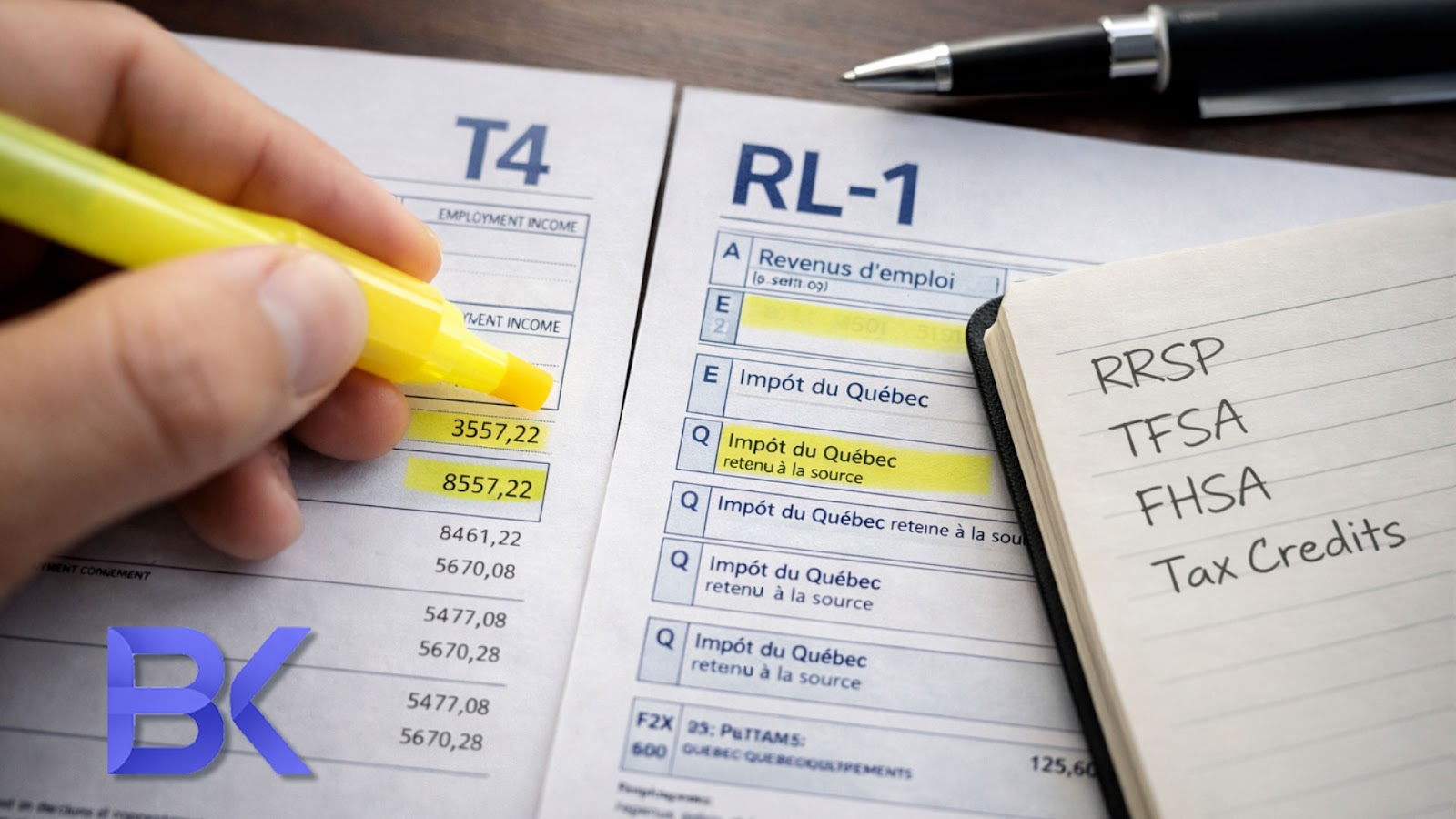
- Similar gross income (T4 Box 14 vs. RL-1 Box A)
- Similar tax withheld (T4 Box 22 vs. RL-1 Boxes E and L combined)
- Comparable RRSP/pension contributions, benefits, and union dues
A mismatch between your T4 and RL-1 can cause differing income on federal and Quebec returns, leading to processing delays or audits.
Navigating RL-1 Slips for Quebec Provincial Income
Quebec employers and payers issue the RL-1 slip for employment income, certain commissions, and various benefits. For anyone living or working in Quebec, the RL-1 is as crucial as the T4.
Key RL-1 Boxes and Details to Verify
Before filing, pay attention to these RL-1 elements:
- Box A – Employment income
This should match your total gross pay for the year. Compare it with T4 Box 14 and your final pay stub.
- Boxes E and L – Income tax withheld
These display Quebec provincial tax and sometimes additional provincial amounts. Combined with T4 Box 22, they should reflect total income tax deducted.
- Box J – Union or professional dues
Ensure regular union or association dues are reported. These are usually deductible, reducing your Quebec taxable income.
- Box G, I, other letters – Pension plans and RRSP contributions
These affect your RRSP deduction room and future retirement benefits. Errors can trigger RRSP over-contribution warnings.
- Taxable benefits
Group insurance, employer-paid premiums, and other benefits often have specific RL-1 codes. Confirm these align with your HR or benefits statements.
If you worked for multiple Quebec employers, expect an RL-1 from each. A missing RL-1 means under-reported income on your Quebec return, potentially leading to reassessment and interest.
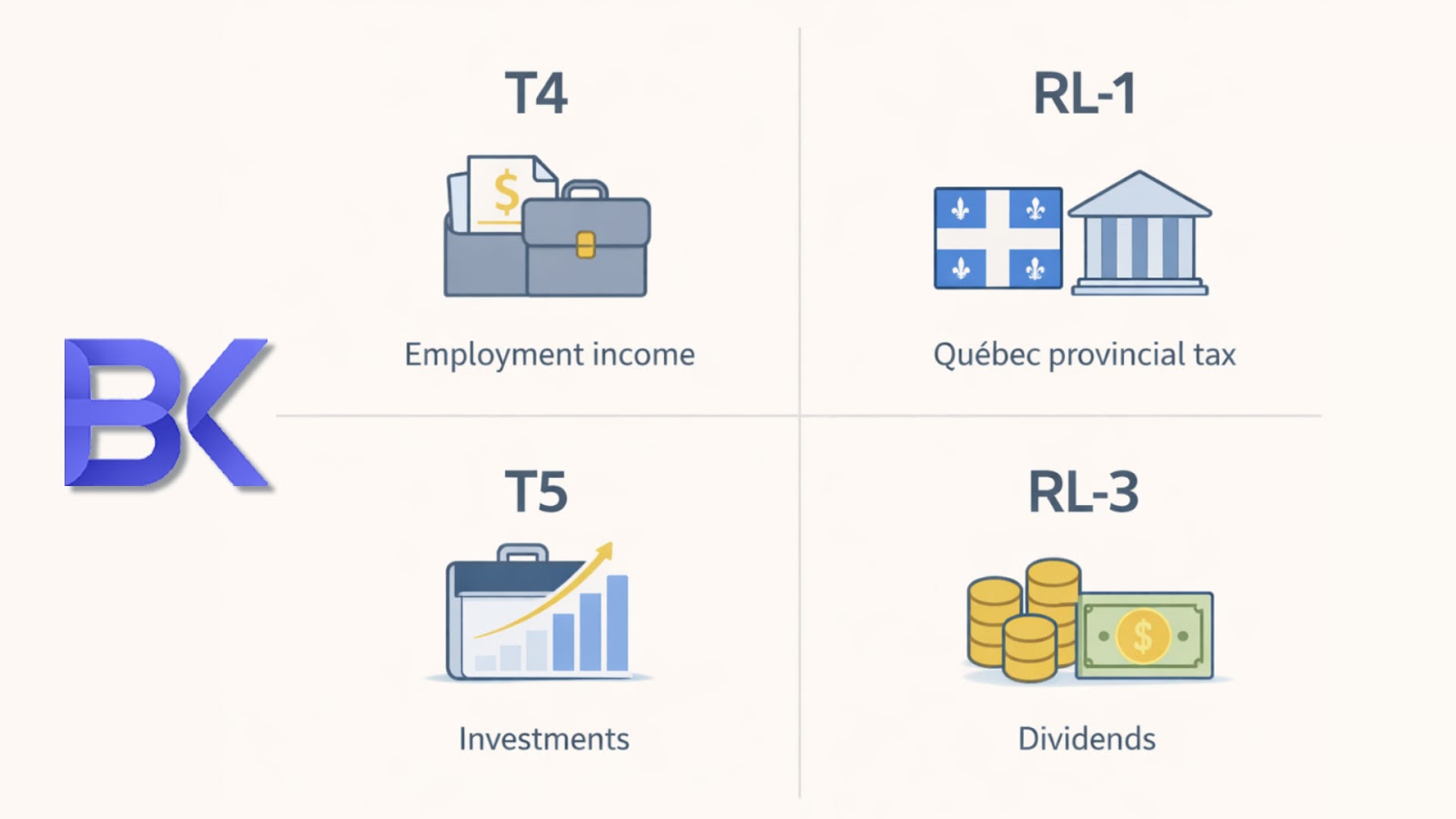
Comparison table: T4 vs RL-1 vs T5 vs RL-3
| Slip type | Main purpose | Who typically receives it |
| T4 | Federal employment income & payroll | Employees across Canada |
| RL-1 | Quebec employment/provincial income | Employees and some contractors in QC |
| T5 | Federal investment income | Investors with interest/dividends |
| RL-3 | Quebec investment income | Quebec residents with investments |
Decoding T5 Slips: Federal Investment Income
A T5 slip reports federal investment income like interest, eligible and non-eligible dividends, and some foreign income. If you hold non-registered savings, you likely receive T5s in March.
Essential Checks for Your T5 Investment Slips
Review each T5 slip carefully:
- Box 13 – Interest from Canadian sources
This includes bank accounts, GICs, and some bonds. Compare it with your December account statements for accuracy.
- Box 24 / 25 – Eligible and non-eligible dividends
These impact federal and Quebec dividend tax credits. Confirm the dividend type matches your brokerage or company reports.
- Box 15 – Foreign income and Box 16 – Foreign tax paid
These calculate the foreign tax credit, preventing double taxation. Even small amounts matter if you hold U.S. or international stocks.
- Multiple institutions and accounts
Many clients overlook small savings or old investment accounts, resulting in unreported income. Confirm you received T5s for:
- All bank branches
- Discount brokerage accounts
- Corporate or trust accounts in your name
If you earned over $50 in interest from a source but lack a T5, you must still report that income.
Understanding RL-3 Slips: Quebec Investment Income
For Quebec residents, the RL-3 slip is the provincial equivalent of the T5. Revenu Québec uses it to calculate provincial tax and credits on interest, dividends, and certain capital gains.
Key RL-3 Details for Your Quebec Tax Return
Before submitting your Quebec return, verify your RL-3:
- Box A – Interest and other income
This should largely match T5 Box 13 for the same account. Small rounding differences are acceptable, but significant gaps need explanation.
- Box B/C – Dividends (eligible and non-eligible)
These determine your Quebec dividend tax credit. Ensure values correspond to your investment statements and the T5.
- Foreign income and tax paid
The RL-3 sometimes provides extra detail for foreign income, relevant for Quebec’s foreign tax credit calculation.
- Joint accounts
In Quebec, joint account investment income may require splitting between spouses based on actual contributions. Often, only one spouse receives the RL-3, necessitating manual income allocation in your tax software.
If CRA and Revenu Québec receive T5 and RL-3 data you didn't report, their systems typically send an "unreported income" letter within 12-24 months. Proactive checking avoids this.
Comparison table: what to check on each March tax slip
| Slip | Top boxes to verify | Key risk if wrong or missing |
| T4 | 14, 22, CPP/QPP, EI, benefits | Under/over-reported employment income |
| RL-1 | A, E, L, J, pension/RRSP boxes | Quebec income mismatch vs federal |
| T5 | 13, 15-16, 24-25 | Unreported interest/dividends/foreign tax |
| RL-3 | A, dividend boxes, foreign income/tax | Lost credits, reassessment from RQ |
Integrating Tax Slips into Your Quebec Financial Planning
Your March slips do more than populate tax software; they form the basis for broader Quebec tax planning. Employment and investment income determine RRSP room, FHSA eligibility, and the impact of various deductions and credits.
Optimizing RRSP, FHSA, and Deductions with Your Slips
After gathering all March slips (T4, RL-1, T5, RL-3):
- Calculate your true marginal tax rates
Knowing your combined federal-Quebec tax bracket helps decide between immediate RRSP contributions or saving for FHSA/TFSA.
- Check RRSP deduction vs. contribution room
Use your 2026 Notice of Assessment plus Box 20/50-type pension data from your T4/RL-1. Over-claiming the RRSP deduction can incur penalties. Box 20/50-type pension data from your T4/RL-1 determines your 2026 RRSP limit (~$33,810 for many professionals).
- Plan spousal income splitting
If one spouse has significant T5/RL-3 income and the other has lower income, consider adjusting non-registered investment ownership over time, adhering to attribution rules.
- Review investment structure
High T5/RL-3 amounts may warrant moving interest-producing investments into RRSPs or TFSAs, while holding more tax-efficient assets in taxable accounts.
An experienced planner can analyze your slips like a financial X-ray, revealing cash flow, debt, savings habits, and tax opportunities you might miss.

Real-World Examples from Quebec Clients
Case 1 – Missing RL-3 led to reassessment
A Montreal client with several small investment accounts filed his 2023 return using only the T5 slips he found. An RL-3 for a joint account never arrived, and he assumed it held "not much."
In 2025, Revenu Québec sent a reassessment for unreported investment income, plus interest. We reconstructed his slips using bank records and corrected both federal and Quebec returns.
Result: We reduced penalties, claimed the missing foreign tax credit, and restructured his investments. Most interest-bearing assets moved into his RRSP and TFSA. His annual tax bill dropped by hundreds of dollars, and slip review is now a yearly checklist item.
Case 2 – T4/RL-1 error changed a family’s refund
A Laval family noted their 2024 refund was unexpectedly small. We discovered the employer had mistakenly double-reported a taxable benefit on the RL-1, but not the T4. This caused higher Quebec taxable income.
We requested corrected T4 and RL-1 slips from the employer and filed adjustments with CRA and Revenu Québec. Their Quebec tax dropped, and they qualified for a larger solidarity tax credit.
Result: The family received over $1,200 in additional refunds and credits. With accurate slips, we designed a plan to use part of this refund for RRSP and FHSA contributions towards their future first home.
For reference, the federal rules underpinning how income is calculated and taxed are set out in Canada’s Income Tax Act: https://laws-lois.justice.gc.ca/eng/acts/I-3.3/
FAQ
1. Do I need both a T4 and an RL-1 to file my taxes in Quebec?
Yes. Quebec employees typically receive a T4 for federal purposes and an RL-1 for provincial purposes. Your software requires both for correct Canada and Quebec tax calculations.
2. What if I have not received a T5 or RL-3 by the end of March?
Contact your bank or brokerage first. If a slip remains missing, estimate and report the income from your statements. You must report all investment income, even without a slip.
3. My T4 and RL-1 show different income amounts. Is that normal?
Small differences can occur due to provincial rules and rounding. However, large discrepancies are a red flag. Ask your employer or payroll department for an explanation and amended slips if needed.
4. Do I have to report investment income inside my TFSA or RRSP on T5/RL-3?
No. Income earned within RRSPs and TFSAs is generally not reported on T5-RL-3 slips and is non-taxable while held within the plan. Only non-registered accounts generate these slips.
5. Can a financial planner help with tax slips, or do I need only an accountant?
A qualified financial planner familiar with Quebec tax can review your T4, RL-1, T5, and RL-3, identify errors, and integrate them into a comprehensive tax and investment strategy. For complex cases, planners often collaborate with accountants for optimal compliance and long-term planning.
Ready to Optimize Your Quebec Tax Filing?
Free Consultation:
Phone: +1-514-834-5558
Email: contact@bkfinancialservices.ca
Website: https://bkfinancialservices.ca
Book Free Consultation Today – Available in English, French, Russian, Hebrew
Disclaimer: This guide is intended for general informational purposes only and does not constitute personalized tax, accounting, or legal advice. Tax slips, box numbers, and reporting requirements under the CRA and Revenu Québec are subject to change. Always review your tax slips carefully and consult with a qualified tax professional or financial planner before filing your return to ensure accuracy and compliance.