
Being self-employed in Quebec offers incredible freedom, but it creates unique financial pressures. Without an employer to automatically withhold your taxes, you are entirely responsible for managing your income tax, Quebec Pension Plan (QPP) contributions, GST/QST, deductible expenses, and highly variable income.
This requires proactive planning that goes far beyond just handing a shoebox of receipts to your accountant at year-end.
After the June instalment deadline and the traditional Quebec "Construction Holiday" summer slowdown upon us, July is a good time to review your year-to-date cash flow. Proper tax planning and cash flow forecasting reduce stressful surprises, prevent expensive government penalties, and ultimately maximize your take-home pay before the next major deadline hits in September.
This 2026 guide offers practical insights for freelancers, consultants, and small business owners to master Quebec taxes and achieve lasting financial stability.
Understanding Quebec Taxes for the Self-Employed
Unlike salaried employees, tax isn't automatically withheld from your client invoices. You must manage your own monthly tax planning.
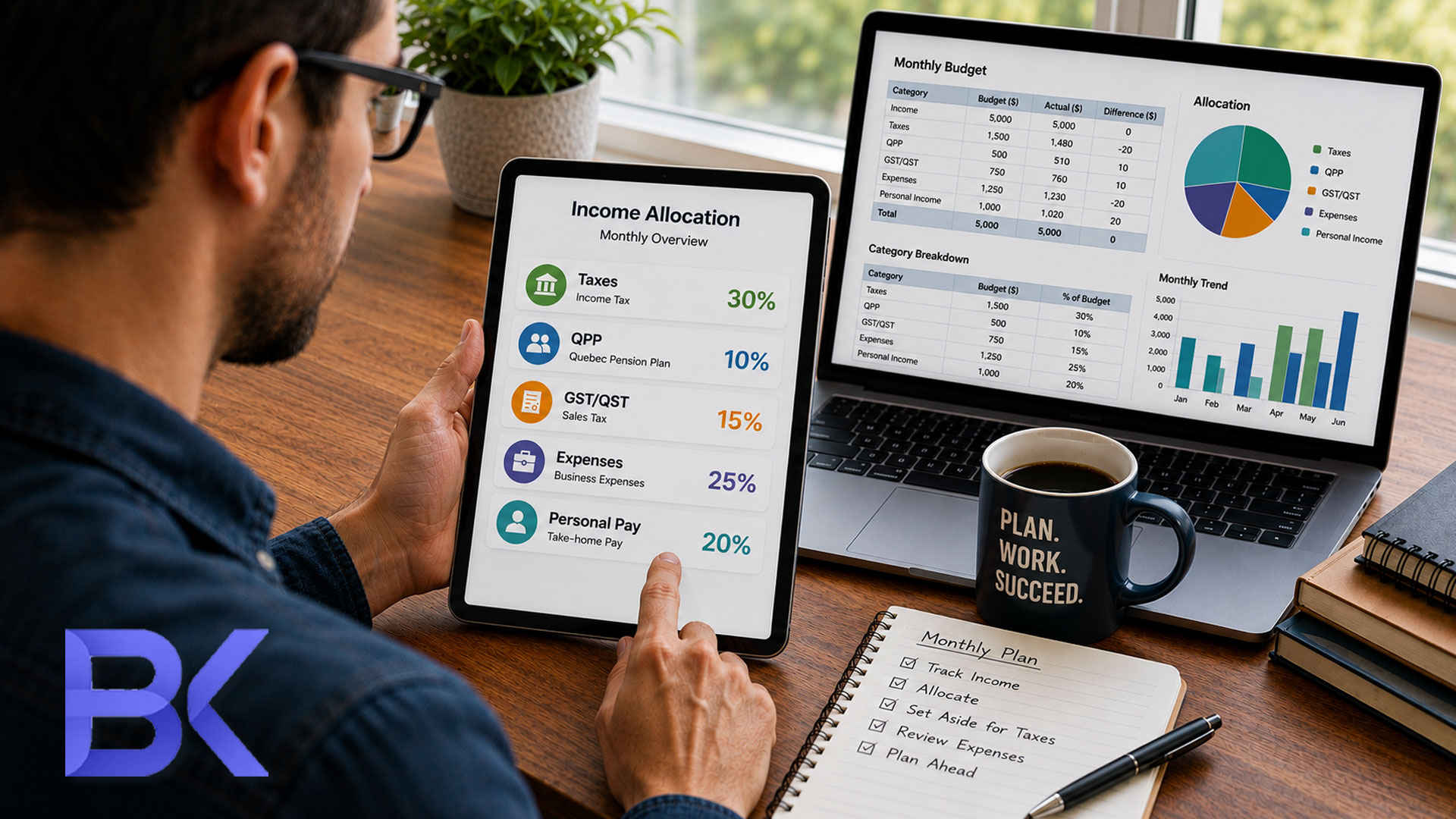
Rising living costs and variable client payments make under-saving for taxes a massive risk. The most effective strategy is setting aside a strict percentage of every single payment you receive into a dedicated tax savings account. While the exact percentage depends on your tax bracket and deductions, many freelancers start by setting aside 30% to 40% of their gross revenue to cover income tax and sales tax.
The "Double Burden" of the QPP
Quebec self-employed workers owe taxes to both the CRA and Revenu Québec. Furthermore, you must budget for the Quebec Pension Plan (QPP). When you are self-employed, you are considered both the employee and the employer. This means you pay both the employee and employer portions of QPP contributions on self-employment earnings, up to the annual maximum. This catches many new freelancers completely off guard in April.
| Self-Employed Obligation | What it Covers | Expert Planning Tip |
| Income Tax | Federal + Quebec tax on net income | Move a set percentage from every invoice into a separate tax account immediately. |
| QPP Contribution | Mandatory retirement funding | Do not forget to calculate the "employer" half in your tax estimates. |
| GST/QST | Sales tax collected on taxable sales | This is not your money. Keep it strictly separate from operating cash. |
Tax Deductions for Quebec Freelancers
Tax deductions are your best tool for reducing your taxable business income. However, missing legitimate expenses—or claiming them without proper records—can trigger painful audits from Revenu Québec.
Eligible expenses vary by your profession, but common deductions include software, advertising, professional fees, phone and internet use, and reasonable meals and entertainment (typically limited to 50%).
- Home Office Expenses: If you work from home, you may deduct a portion of your rent, hydro, home insurance, and maintenance. This is strictly based on the square footage of your dedicated workspace relative to your total home.
- Vehicle and Operating Costs: Accurate mileage logbooks are non-negotiable if you use a personal car for business. You can deduct fuel, insurance, repairs, and financing costs, but only for the exact percentage of kilometers driven for business purposes.
Pro Tip: Using a dedicated business credit card and cloud storage for receipts simplifies your bookkeeping and gives you a much clearer view of your true monthly profitability.
Quebec Tax Instalments: Preparing for September 15
Tax instalments are mandatory quarterly prepayments of your expected income tax. In Quebec, you may be required to pay instalments federally and provincially if your net tax owing exceeds $1,800 in the current year and either of the previous two years.
A highly profitable year can lead to a large tax bill in April, immediately followed by instalment notices requiring prepayments for the next year.
Quarterly Instalment Dates and Estimation Methods
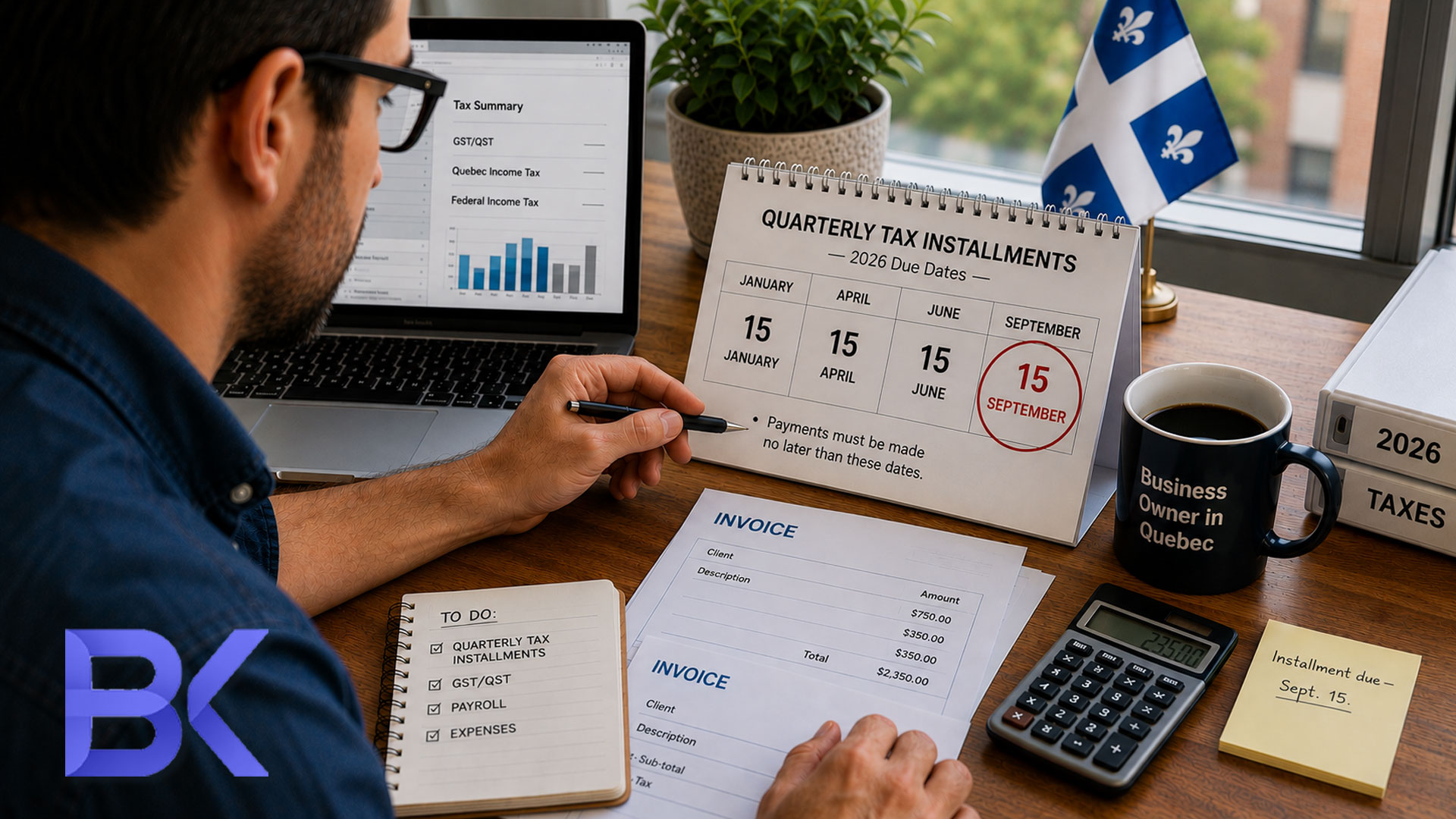
Instalments are due four times annually: March 15, June 15, September 15, and December 15. If you drained your bank accounts to pay your June 15 instalment, you must start forecasting now to ensure you have cash ready for September.
Instalments can be based on prior-year tax amounts, current-year income projections, or official CRA/RQ reminders. For those with fluctuating income, projecting your current-year income is more accurate, but it demands active financial tracking. Misusing the current-year estimate can lead to heavy interest penalties if you forecast too low and underpay.
| Instalment Method | Best For | Risk Factor |
| Prior-Year Amount | Highly stable, predictable income | You may overpay your taxes if your income drops this year. |
| Current-Year Estimate | Variable, fluctuating income | If you forecast too low and underpay, you will be hit with interest penalties. |
| CRA/RQ Reminders | Ultimate simplicity | Safe from penalties, but may drastically drain cash flow during slow months. |
Cash Flow Management: Revenue is NOT Income
The single biggest error in Quebec self-employed finances is confusing revenue with spendable income. A $10,000 revenue month does not mean you have $10,000 available for personal use.
Your actual net income must account for business expenses, income tax, QPP, GST/QST reserves, and future irregular costs. After these deductions, your personal disposable income may be much lower.
The single biggest error in Quebec self-employed finances is confusing revenue with spendable income. A $10,000 revenue month does not mean you have $10,000 available for personal use. After business expenses, GST/QST collected, tax reserves, and QPP obligations, your real owner’s draw may be far lower than expected. A clear system should separate business revenue, operating expenses, GST/QST, tax reserves, emergency savings, and personal pay.
Build a Monthly Cash Flow Plan
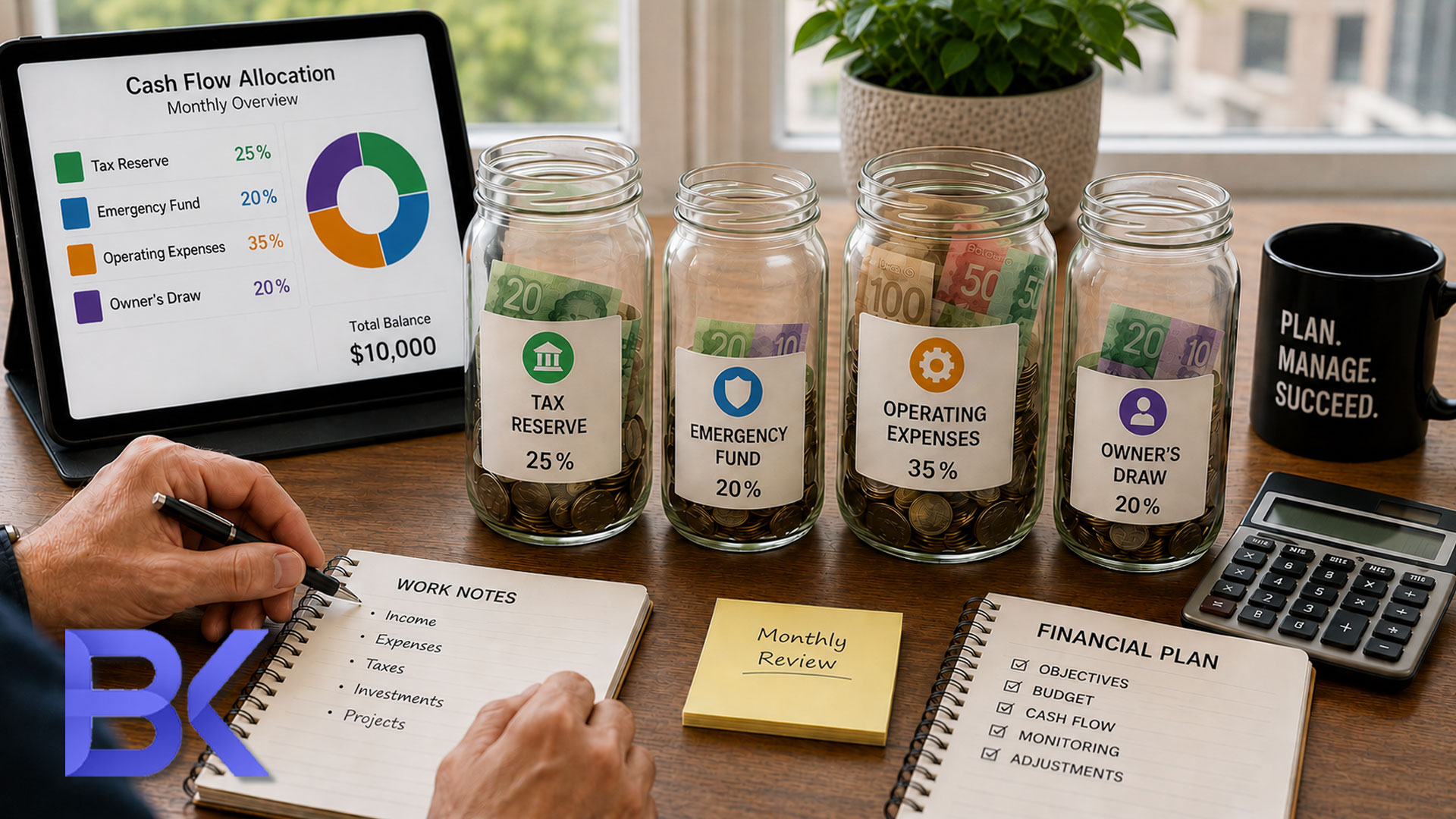
A simple cash flow system is far more effective than a complex spreadsheet budget. When an invoice gets paid, immediately allocate the incoming revenue into distinct bank accounts: Tax Reserve, GST/QST Reserve, Operating Expenses, an Emergency Fund, and finally, Owner's Pay.
Create Stability from Irregular Income
If your income varies wildly, pay yourself a consistent, modest "salary" every month based on a conservative average of your earnings. Leave the surplus in your business account during boom months. Many Quebec entrepreneurs benefit from keeping one to three months of business operating costs in reserve, while also maintaining a separate personal emergency fund for household needs. A stronger reserve provides a buffer against slow-paying clients, seasonal downturns (like the summer holidays), or unexpected tax adjustments.
This strategy aids mortgage applications, stabilizes household budgeting, and eliminates the stressful freelance "feast-or-famine" cycle during the slower summer months.
Strategic Financial Planning for Entrepreneurs
Self-employment should align with your long-term wealth-building goals, not just month-to-month survival. Without payroll deductions or employer matching programs, self-employed individuals require a deliberate plan.
- Retirement Saving: RRSP contributions can reduce your personal taxable income while helping you build retirement assets. For eligible first-time homebuyers, the FHSA can be a powerful tool because it combines tax-deductible contributions with tax-free withdrawals for a qualifying home purchase, but it still depends on contribution room and eligibility rules.
- Risk Protection: Because your income relies entirely on your ability to work, disability insurance and life insurance are important. Coordinating these tax strategies with personal protection creates a resilient financial foundation that a sudden illness or accident cannot destroy.

2 Real Cases: Self-Employed Planning in Action
Case 1: Consultant with Rising Income and Tax Shock
A Quebec consultant experienced a massive income year but hadn't saved enough for her taxes or her double QPP obligations. She was hit with a huge tax bill and immediate instalment requirements. BK Financial analyzed her income and established a strict percentage-based savings system using multiple bank accounts. By reorganizing her cash flow, she met her June 15 instalment on time, eliminated the risk of late penalties, and finally enjoyed a predictable monthly paycheck.
Case 2: Contractor with Commingled Finances
A newcomer contractor mixed his personal and business expenses in a single checking account. He had no idea what his true profit was. BK Financial assisted in separating his accounts, identifying missed eligible deductions, estimating his upcoming GST/QST obligations (as he approached the $30,000 threshold), and implementing a simple receipt tracking system. This led to strong records, a much lower tax bill, and a more manageable tax filing season.
FAQ
1. Do self-employed people in Quebec pay tax instalments?
Yes. You are legally required to pay quarterly instalments if your net tax owing exceeds $1,800 for the CRA and/or Revenu Québec in the current year and one of the two previous years.
2. Do I need to charge GST and QST?
Once your taxable supplies exceed the small supplier threshold of $30,000 over four consecutive calendar quarters, GST/QST registration generally becomes required.
3. What expenses can I deduct as self-employed in Quebec?
Common deductions include office supplies, software, advertising, phone, internet, professional fees, a percentage of home office costs, and business-use vehicle expenses. You must maintain receipts and logs to prove they were incurred to earn business income.
4. How much should I save for self-employed taxes in Quebec?
It depends on your tax bracket, deductions, and sales tax obligations. While many use a baseline of 30% to 40% of gross revenue, a customized projection by a financial planner is the most accurate way to establish a savings rate.
5. How can I manage irregular freelance cash flow?
Stop paying your personal bills directly from your business revenue. Use separate bank accounts, establish dedicated tax reserves, pay yourself a fixed monthly salary, and keep 1 to 3 months of operating costs in reserve to cover the slower summer months.
Take Control of Your Business Cash Flow Today
You went into business for freedom, not to stress over tax deadlines and cash flow crunches. Whether you need help projecting your upcoming September tax instalments, separating your business and personal finances, or setting up a retirement plan, BK Financial can help.
Book Your Free Consultation Today:
- Phone: +1-514-834-5558
- Email: contact@bkfinancialservices.ca
- Website: https://bkfinancialservices.ca
(Consultations available in English, French, Russian, and Hebrew. Let's build a profitable, stress-free financial strategy for your business.)
Disclaimer: This article is provided for general informational and educational purposes only and should not be interpreted as individualized financial, tax, legal, or accounting advice. Tax legislation, instalment thresholds ($1,800), GST/QST rules ($30,000), and QPP rates are subject to change. Always consult with a qualified financial planner or tax professional before making major decisions regarding your self-employed business finances.