The fall semester bill has landed, and the RESP you have been funding for years finally has a job to do. But an RESP is not a regular savings account — you cannot simply move money out whenever a payment is due.
When an RESP is used to fund post-secondary education, withdrawals generally fall into two main categories — contributions and Educational Assistance Payments (EAPs). They are taxed differently, subject to different limits, and reported differently for tax purposes. Getting the split wrong when submitting a withdrawal request can delay a payment right when tuition is due.
This guide covers what you can withdraw in the first weeks of school, who pays tax on it, where Quebec’s own program fits in, and what happens if your child’s plans change.

Two kinds of money in an RESP
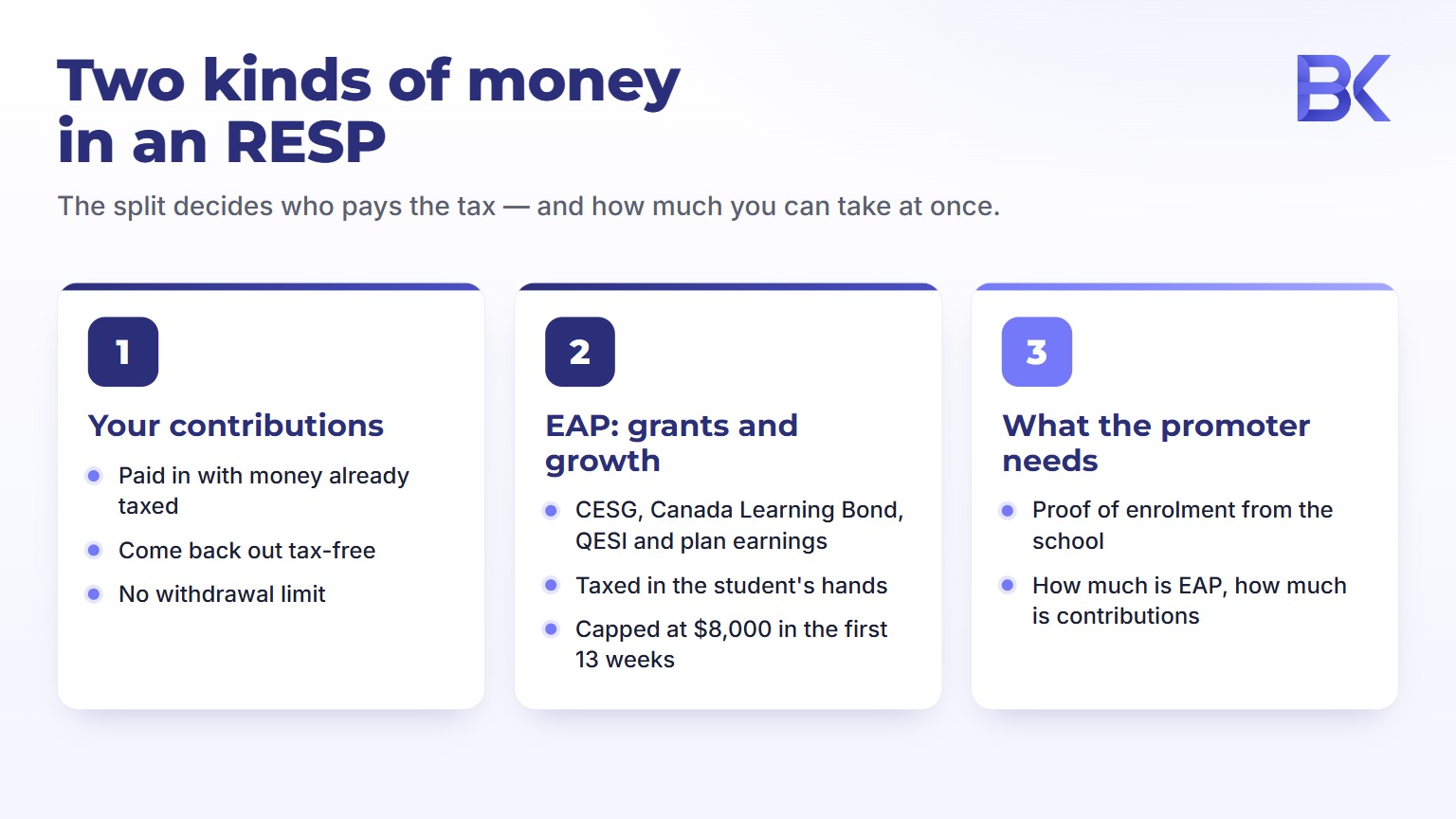
When an RESP is being used to fund a beneficiary’s post-secondary education, withdrawals generally fall into two main categories: a refund of contributions and an Educational Assistance Payment (EAP). The distinction matters because one is generally tax-free, while the other is taxable to the student and subject to specific eligibility and payment rules.
A refund of contributions is the money originally contributed to the RESP. Because RESP contributions are made with after-tax dollars, they can generally be returned tax-free. Depending on the terms of the plan, the promoter may return the contributions to the subscriber or pay them tax-free to the beneficiary. When contributions are withdrawn while the beneficiary is eligible for an EAP — that is, while they are enrolled — most promoters process the request as a post-secondary education (PSE) withdrawal, and no grant money has to be repaid.
Outside a study period, the same request is treated differently. If contributions are withdrawn while no beneficiary in the plan is eligible for an EAP, that can trigger repayment of the CESG attached to them, and the beneficiary can lose access to the Additional CESG for the rest of the calendar year and the next two — which matters mainly when a younger sibling in a family plan is still collecting grants. Ask your promoter before pulling contributions out outside a study period.
Educational Assistance Payments (EAP) are everything else: the Canada Education Savings Grant (CESG), the Canada Learning Bond, amounts paid under a designated provincial program — in Quebec, that includes QESI — and any investment growth the plan has earned. As the CRA describes it, an EAP “consists of the Canada education savings grant (CESG), the Canada Learning Bond (CLB), amounts paid under a designated provincial program and the earnings on the money saved in the RESP.”
| Refund of contributions (PSE) | Educational Assistance Payment (EAP) | |
| What it includes | Money your family contributed | CESG, Canada Learning Bond, QESI, and investment growth |
| Who receives it | Subscriber or beneficiary, as directed | The student (beneficiary) |
| Who pays the tax | No one — already-taxed money | The student, on their own return |
| Where it’s reported | Not reported on a T4A | T4A box 042, reported on line 13000 |
| Is there a limit | No | Yes — $8,000 in the first 13 weeks of full-time study; $4,000 per 13-week period part-time |
Because the promoter tracks which bucket money comes from, a withdrawal request has to specify contributions, EAP, or both — families don’t get to blend the two without saying so.
How much you can withdraw in the first 13 weeks
There’s a limit, but it applies only to EAP — not to the money your family contributed.
During the first 13 consecutive weeks of full-time study, the maximum EAP a student can receive is $8,000. For part-time study in a specified educational program, the limit is $4,000 for each 13-week period.
These figures are maximums, not automatic entitlements. An EAP must still be reasonable in relation to the beneficiary’s post-secondary education. The promoter is responsible for determining whether the requested amount is reasonable and may ask for supporting information about tuition, books, housing, transportation or other education-related expenses.
These amounts were raised from $5,000 and $2,500 by the 2023 federal budget, effective March 28, 2023. After the first 13 weeks of continuous enrolment, there is no cap on how much EAP can be paid.
If there has been a 12-month stretch where the student wasn’t enrolled for 13 consecutive weeks, the $8,000 limit applies again the next time studies begin. A request above $8,000 in the first 13 weeks can, in limited cases, be approved on an exception basis by the responsible minister.
For 2026, the CRA’s annual EAP threshold is $29,459. This is not a statutory annual withdrawal limit. Rather, it is an administrative guideline: below the threshold, promoters generally are not expected to assess the reasonableness of every individual expense as long as the EAP conditions are met. Above the threshold, the promoter must assess whether the expenses are reasonable and may request additional documentation. Refund-of-contribution withdrawals are not subject to this EAP threshold.
What counts as school
The 13-week clock only starts once the program itself qualifies — and that trips up more families than the dollar limits do.
Full-time study, a qualifying educational program in CRA terms, means at least three consecutive weeks with at least 10 hours of instruction per week. Part-time study, referred to as a specified educational program, applies to beneficiaries age 16 or older. The program must be at the post-secondary level, last at least three consecutive weeks, and require at least 12 hours of coursework per month.
The institution has to be a university, college, or other designated educational institution in Canada — the definition also covers institutions certified by Employment and Social Development Canada as offering occupational-skills courses. That includes CEGEP: for RESP purposes, CEGEP is recognized as post-secondary study, which is often the first question Quebec parents ask.
For programs outside Canada, the minimum is 13 weeks, or three consecutive weeks for university-level programs.
Depending on the terms of the RESP, an EAP may still be paid for up to six months after the beneficiary stops being enrolled, provided the payment would have qualified as an EAP immediately before enrolment ended.
Where QESI fits in
Quebec’s own program adds a layer most national RESP guides skip.
The Québec Education Savings Incentive (QESI, or IQEE) is administered by Revenu Québec, not the CRA. It’s a refundable tax credit that Revenu Québec pays into the plan on the subscriber’s behalf, through the plan’s trustee.
At withdrawal, QESI doesn’t show up as a separate line item — it’s folded into the EAP bucket, right alongside the CESG, Canada Learning Bond, and investment growth. That means it counts toward the same $8,000 / $4,000 limits, and it’s taxed to the student the same way the rest of the EAP is.
The lifetime maximum amount of EAP attributable to QESI for a beneficiary is $3,600. If QESI amounts paid out as EAP exceed that cumulative maximum, the beneficiary may have to pay a Quebec special tax on the excess.
Families still building up contributions and grants, rather than withdrawing yet, may find our CESG and QESI strategy guide for Quebec families useful background.
Who actually pays tax on RESP withdrawals
This is the part that surprises parents used to thinking of an RESP as “their” account.
EAP income is taxed to the student, not to whoever contributed the money. The promoter reports the annual EAP amount in box 042 of a T4A slip issued in the student’s name, and the student reports that figure on line 13000 of their own return.
For a Quebec resident, the EAP must also be reported on the Quebec return. Federally, the promoter reports the EAP in box 042 of the T4A, and the student includes it on line 13000. For Quebec purposes, RESP educational assistance payments are reported in box O of the RL-1 slip using code RU and are included on line 154 of the Quebec income tax return. Unlike qualifying scholarships, RESP educational assistance payments do not qualify for Quebec’s scholarship deduction on line 295.
For 2026, the maximum federal basic personal amount is $16,452, while Quebec’s basic personal amount is $18,952. A student with relatively little other income may therefore pay little or no income tax on an EAP after available personal and tuition tax credits are considered. The actual result depends on the student’s total income and credits for the year.
Refund-of-contribution withdrawals don’t enter this calculation at all, since they were never taxed and never appear on a T4A.

The order you withdraw in matters
The order you draw from the two buckets is worth planning rather than leaving to chance. As a general rule, it tends to make sense to use EAP while the student is enrolled and their income is still low, rather than leaving grants and growth untouched “for later.” Waiting has a real cost.
EAP can only be paid while the student is enrolled, plus the six-month window after enrolment ends. If the plan is eventually wound up without those amounts being used, unused CESG, Canada Learning Bond, and QESI generally have to be repaid, and the remaining growth comes out as an Accumulated Income Payment taxed to the subscriber — more on the conditions for that below.
There’s no fixed ratio that fits every family, and no one can promise a specific amount saved by sequencing withdrawals a certain way. What holds across cases is the logic: use the EAP bucket while the tax rate on it is likely low.
The right order depends on the student’s other income, how much grant money is sitting in the plan, and how many years of study are still ahead — which is exactly the kind of thing worth mapping out before the first withdrawal request, especially if you have been automating contributions for years and the plan has grown.
What if your child doesn’t go to school
Plans change, and an RESP is built to handle that — just not for free.
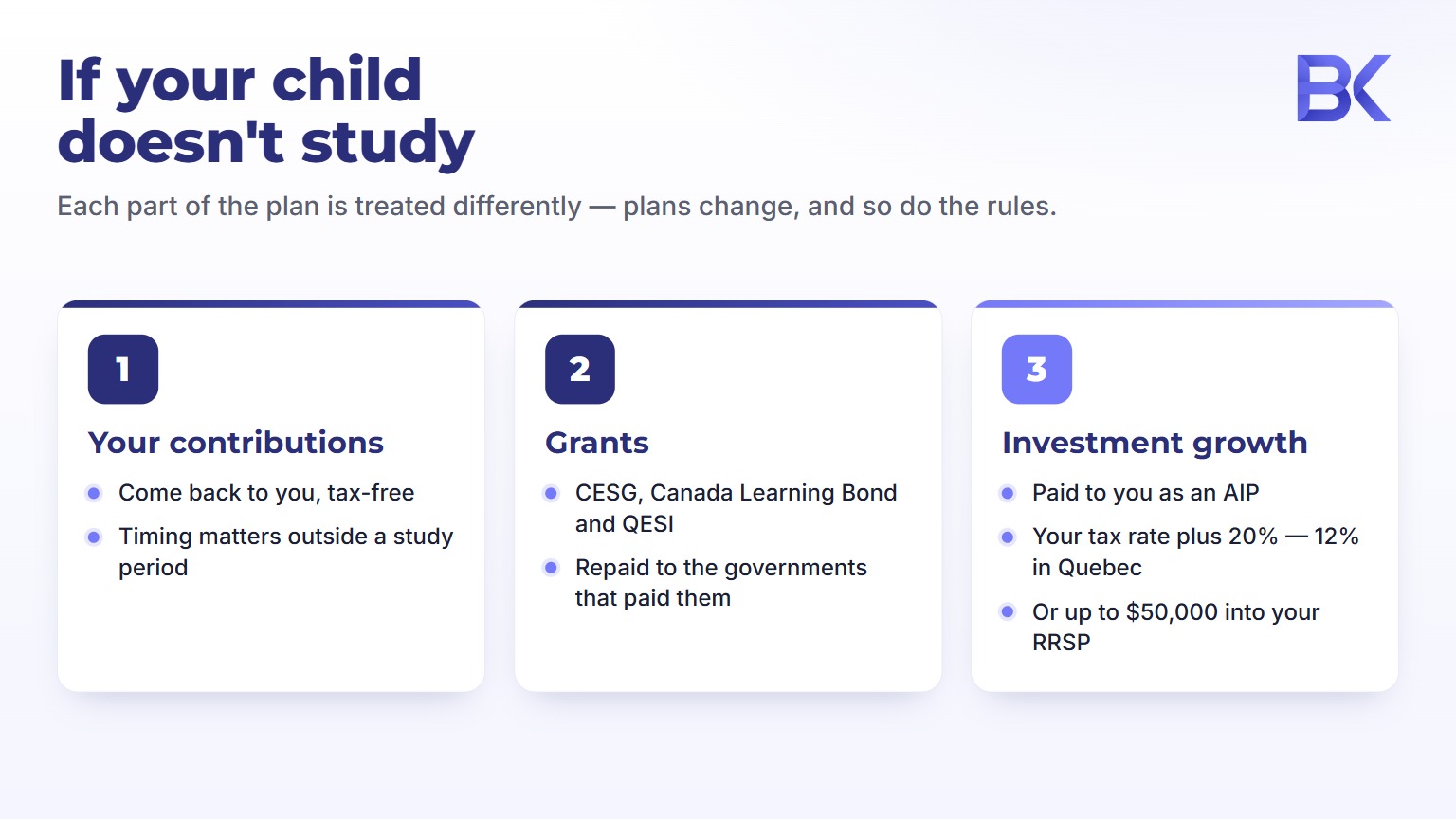
If a beneficiary never enrolls, or doesn’t use all the money in the plan, government grants that were never paid out as EAP — CESG, Canada Learning Bond, and QESI — generally have to be returned to the government that provided them. Any CESG that was never paid out as an EAP has to go back; the lifetime CESG a child can receive is capped at $7,200, and whatever part of that is still sitting in the plan is returned.
Investment growth is handled differently, through an Accumulated Income Payment (AIP) paid to the subscriber, not the student. An AIP becomes available once one of these is true, according to the CRA:
- the payment falls after the year that includes the plan’s 9th anniversary, and every beneficiary is at least 21 and no longer eligible for an EAP;
- the payment falls in the year that includes the plan’s 35th anniversary;
- every named beneficiary has died.
For a Quebec subscriber, an AIP can be expensive if no rollover strategy is available. The payment is included in the subscriber’s regular taxable income and is also subject to additional taxes. For Quebec residents, the federal additional AIP tax is 12%, calculated using Form T1172. Quebec imposes a separate 8% special tax, generally calculated using Form TP-1129.64-V. Together, these represent a 20% additional tax on top of the subscriber’s regular federal and Quebec income tax, subject to any available rollover reduction.
Subject to the CRA’s conditions, up to $50,000 of AIP over a recipient’s lifetime may be offset by a deductible contribution to an eligible RRSP or certain related registered plans. Sufficient RRSP deduction room is required, and the deduction must be claimed for the year in which the AIP is received in order to reduce the additional AIP tax. A direct transfer may also be arranged using Form T1171 when the applicable conditions are met.
Another possibility may be a transfer to another RESP. Transfers can often be completed without immediate tax consequences when the two plans have a common beneficiary or when the beneficiaries are siblings and the applicable CRA age and plan-type conditions are met. In other situations, a transfer can create excess-contribution issues or require repayment of government benefits, so the transfer should be confirmed with both RESP promoters before it is made.
An RESP has to close no later than the end of the 35th year after the year it was opened (the 40th year for a specified plan).
| Scenario | Contributions | Grants (CESG / CLB / QESI) | Investment growth |
| Continues studying | Withdrawn tax-free as needed | Paid as EAP, taxed to the student | Paid as EAP, taxed to the student |
| Takes a pause, returns later | Stay in the plan, available later | Stay in the plan, subject to enrolment rules | Stay in the plan, keeps growing |
| Doesn’t go to school at all | Returned to the subscriber, tax-free | Unused CESG, CLB and QESI repaid to the government (lifetime CESG per child is capped at $7,200) | Paid as an AIP to the subscriber; regular income tax applies, plus a combined 20% additional tax in Quebec (12% federal + 8% Quebec) |
| Transferred to a sibling | Stay in the receiving plan | May remain in the receiving RESP, subject to the CRA transfer rules, beneficiary relationship, age and plan type | Stay in the receiving plan, keeps growing |
Paperwork and timing
Before releasing any EAP, the promoter needs proof of enrolment from the school. This is how it works with virtually all promoters, and it’s the step that most often delays a withdrawal request when it’s left to the last week of the semester.
Exactly who the funds are paid to, and how long processing takes, depends on your plan promoter — there’s no single federal turnaround time, so it’s worth asking your promoter directly rather than assuming.
Before you send the request in:
- ask the school for proof of enrolment — this is what most often holds a payment up;
- tell the promoter exactly how much is EAP and how much is a refund of contributions;
- check whether you are still inside the first 13 weeks, where EAP is capped at $8,000;
- ask your promoter how long processing takes — turnaround is set by the plan, not by a federal rule.
A short conversation before your first withdrawal request goes in — as part of broader investment planning — can prevent a scramble once tuition is due.
2 Real Cases: RESP Withdrawals in Action
The following cases are based on actual client situations. Names and certain identifying details have been changed to protect confidentiality. Individual outcomes will vary.
Case 1: A CEGEP student, first semester. Situation: The Tremblay family had an RESP for their daughter, starting her first semester at a Montreal CEGEP. They weren’t sure CEGEP qualified, or how much they could withdraw right away for tuition, books, and residence costs.
Strategy: Boris confirmed CEGEP counts as post-secondary study for RESP purposes, then walked through the $8,000 EAP limit for the first 13 weeks and helped the family separate their contributions from the EAP portion, so the request to the promoter was accurate from the start.
Result: The family withdrew enough to cover the first semester, correctly split between contributions and EAP, with proof of enrolment ready before the request went in — no back-and-forth with the promoter.
Case 2: An unplanned gap year. Situation: The Lévesque family’s son deferred university after high school to work for a year. His RESP held years of CESG and QESI, and his parents worried the grants would simply be lost.
Strategy: Boris explained the six-month EAP window, the enrolment rules, and that grants aren’t lost the moment studies pause — they are repaid only when they are never paid out as an EAP, and the plan itself can stay open for years.
Result: The family left the RESP untouched during the gap year. When their son started university the following fall, the grants were still in place, and EAP withdrawals began normally once he was enrolled.
Frequently Asked Questions
1. Can I withdraw from an RESP if my child doesn’t go to school?
Yes, but the rules differ by type of money. Your own contributions come back to you tax-free at any time — though timing matters: if they are withdrawn while no beneficiary is eligible for an EAP, that may trigger repayment of part of the CESG attached to them, so ask your promoter first. Grants like CESG, CLB, and QESI generally have to be repaid to the government if they’re never used for EAP, and investment growth may eventually be paid as an Accumulated Income Payment (AIP), subject to regular income tax plus, for Quebec residents, a combined additional tax of 20% (12% federal and 8% Quebec), once the plan meets the applicable AIP conditions.
2. How much can I take out of an RESP at once?
Your own contributions have no withdrawal limit. EAP is capped at $8,000 in the first 13 consecutive weeks of full-time study ($4,000 per 13-week period for part-time study); after that, there’s no limit on EAP as long as the student stays enrolled.
3. Does the student pay tax on RESP withdrawals?
The student pays tax on EAP amounts, reported on a T4A and included on line 13000 of their return. Refund-of-contribution withdrawals aren’t taxed, to the student or anyone else, since they were made with already-taxed money.
4. Does CEGEP count for RESP withdrawal purposes?
Yes, in the normal case. CEGEPs are designated educational institutions for RESP purposes, and a standard full-time CEGEP program meets the qualifying-program test — at least three consecutive weeks with at least 10 hours of instruction a week. Very short or low-hour continuing-education courses may not.
5. What happens to QESI when I withdraw from an RESP?
QESI is paid into the plan by Revenu Québec, and at withdrawal it comes out inside the EAP rather than as a separate payment — so it is capped and taxed in the student’s hands like the rest of the EAP. If it is never used for studies, the QESI left in the plan goes back to Revenu Québec, not to the family.
6. What is the annual EAP threshold for 2026?
For 2026, the CRA’s administrative annual EAP threshold is $29,459. It is not an absolute annual withdrawal cap. Above this threshold, the RESP promoter must assess whether the requested education expenses are reasonable and may request supporting documentation.
Disclaimer: This article is for general informational purposes only and does not constitute personal financial, tax, or legal advice. RESP rules, limits, and tax figures are set by the CRA, Revenu Québec, and ESDC, and are subject to change. Speak with a qualified advisor about your specific situation before making withdrawal decisions.
Planning an RESP Withdrawal for CEGEP or University?
Before submitting the request to your RESP promoter, it can be worth reviewing how much to withdraw as EAP, how much to take from contributions, and how the timing may affect taxes, grants and the money left for future years of study.
Boris Kolodner, MBA, Financial Planner & Licensed Financial Security Advisor, can help you build a withdrawal strategy around your child’s education costs, income and remaining RESP balance.
Book a free consultation to review your RESP withdrawal plan before you make the request.
Phone: +1-514-834-5558 Email: contact@bkfinancialservices.ca Website: bkfinancialservices.ca
Consultations available in English, French, Russian, and Hebrew.