
You saved for the down payment. You got pre-approved. You closed on the home. For a lot of first-time buyers in Quebec, that feels like the finish line — it isn’t.
Part of the real cost of buying shows up on closing day itself, in cash, outside the mortgage. And what is often the biggest of those bills — the welcome tax — doesn’t even show up then. It arrives from your municipality months later, as a separate invoice you cannot fold into your loan.
For scale: the median price of a single-family home across Quebec reached $523,250 in the second quarter of 2026, according to the province’s real estate brokers’ association. On a purchase near that level, the costs sitting outside your down payment run into thousands of dollars.
One change makes the 2026 math different from what you may have read: the province now refunds a large share of that welcome tax to first-time buyers — up to $5,875, retroactive to January 1, 2026. This guide walks through what you’ll actually pay, when, and how much of it comes back.
What the Quebec Welcome Tax Really Is
“Welcome tax” is the common name for droits de mutation immobilière — property transfer duties. It’s charged by your municipality, not your bank and not the province, and every municipality in Quebec is required to collect it under the Loi concernant les droits sur les mutations immobilières.
Why a welcome tax calculator can give you the wrong number
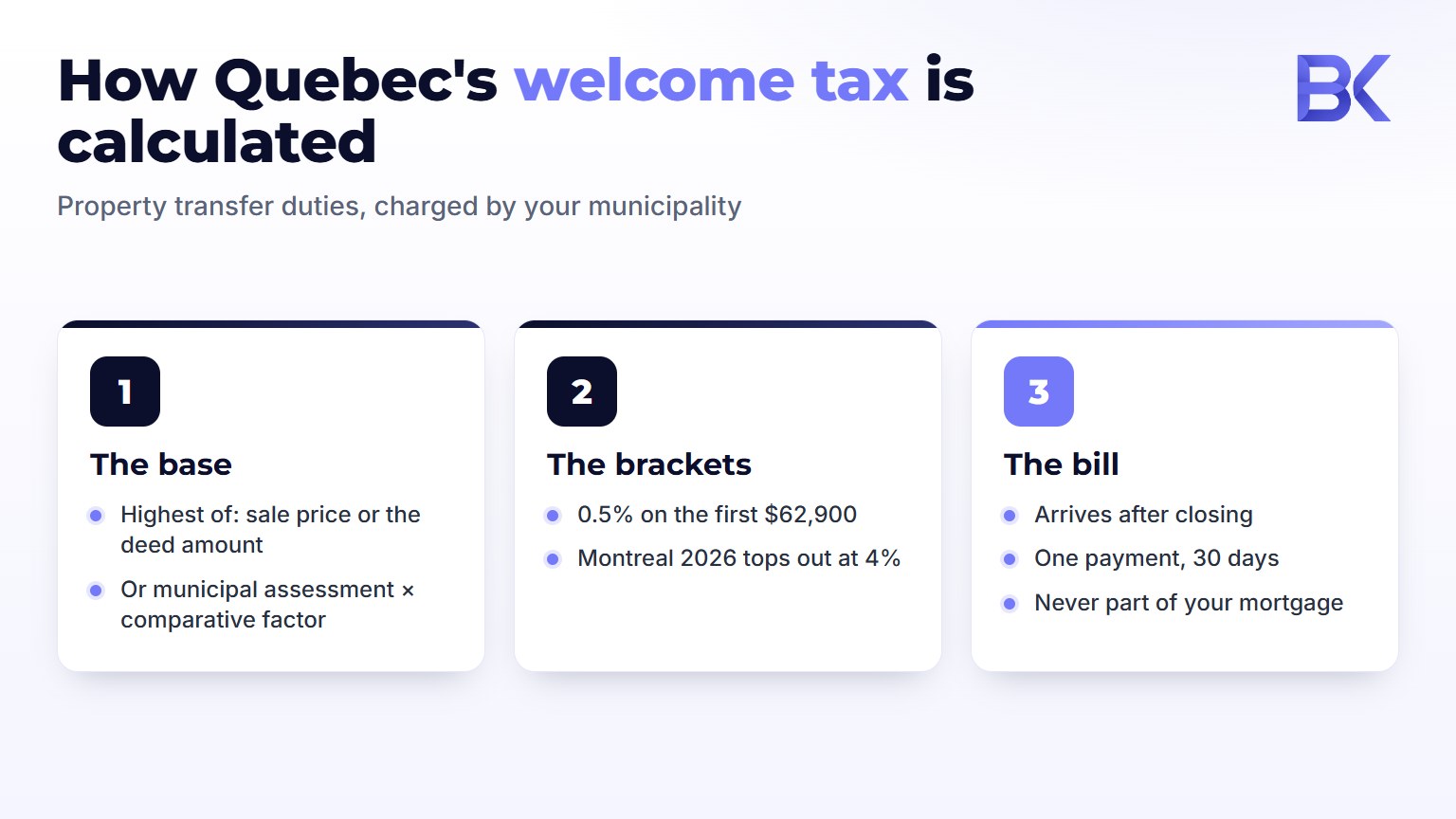
The tax base isn’t automatically your purchase price. It’s the largest of three amounts: the consideration paid for the transfer (usually the sale price, excluding GST/QST), the amount stated in the deed of sale, or the property’s market value — calculated as the municipal assessment roll value multiplied by a comparative factor set each year. That’s why a simple welcome tax calculator that just multiplies your offer price by a flat rate can get the number wrong.
Montreal’s comparative factor for 2026 is 1.00 — back to parity after multipliers of 1.08 in 2025 and 1.10 in 2024. The factor resets annually, so it’s worth checking the current one before you assume your assessment and your purchase price land in the same place.
Every Quebec municipality applies a base provincial scale, with thresholds indexed each year to Quebec’s consumer price index: 0.5% up to $62,900, 1% from $62,900 to $315,000, and 1.5% above that. Municipalities may charge a higher rate on the portion above $500,000 — up to a cap of 3% — except Montreal, which is allowed to go higher still.
Montreal’s own 2026 scale, in effect since January 1, looks like this:
| Portion of the tax base | Rate |
| Up to $62,900 | 0.5% |
| $62,900 – $315,000 | 1% |
| $315,000 – $552,300 | 1.5% |
| $552,300 – $1,104,700 | 2% |
| $1,104,700 – $2,136,500 | 2.5% |
| $2,136,500 – $3,113,000 | 3.5% |
| Above $3,113,000 | 4% |
The City of Montreal’s own worked example shows how the brackets stack on a $700,000 base: $62,900 × 0.5% = $314.50, the next $252,100 × 1% = $2,521, the next $237,300 × 1.5% = $3,559.50, and the remaining $147,700 × 2% = $2,954 — a total of $9,349.
The bill comes from the municipality separately after the purchase is completed. Under Quebec rules, property transfer duties are generally payable before the 31st day following the municipality’s mailing of the bill. However, a municipality may adopt rules allowing the amount to be paid in instalments. Montréal currently requires payment in one instalment within 30 days.
The timing of the bill itself can vary by municipality, so it is important to keep the expected amount available after the purchase rather than treating it as part of the down payment. The transfer duty is billed separately from the mortgage transaction.
Some transfers may qualify for an exemption from property transfer duties, including certain transfers between spouses, relatives in the direct ascending or descending line, and other situations defined by law. For exempt transfers, a municipality may adopt a resolution requiring a smaller substitute duty (droit supplétif) of up to $200. There is no general exemption from property transfer duties simply because the purchaser is a first-time buyer; instead, eligible first-time buyers may now qualify for Quebec’s refundable tax credit.
The 2026 Change: Quebec Now Refunds the Welcome Tax for First-Time Buyers
The measure is called the Crédit d’impôt remboursable pour l’accès à la propriété, announced April 17, 2026 in Bulletin d’information 2026-2 from Quebec’s Ministry of Finance. It’s a provincial program — not federal or municipal — introduced for the 2026 tax year, which is why it doesn’t appear in most guides written before then.
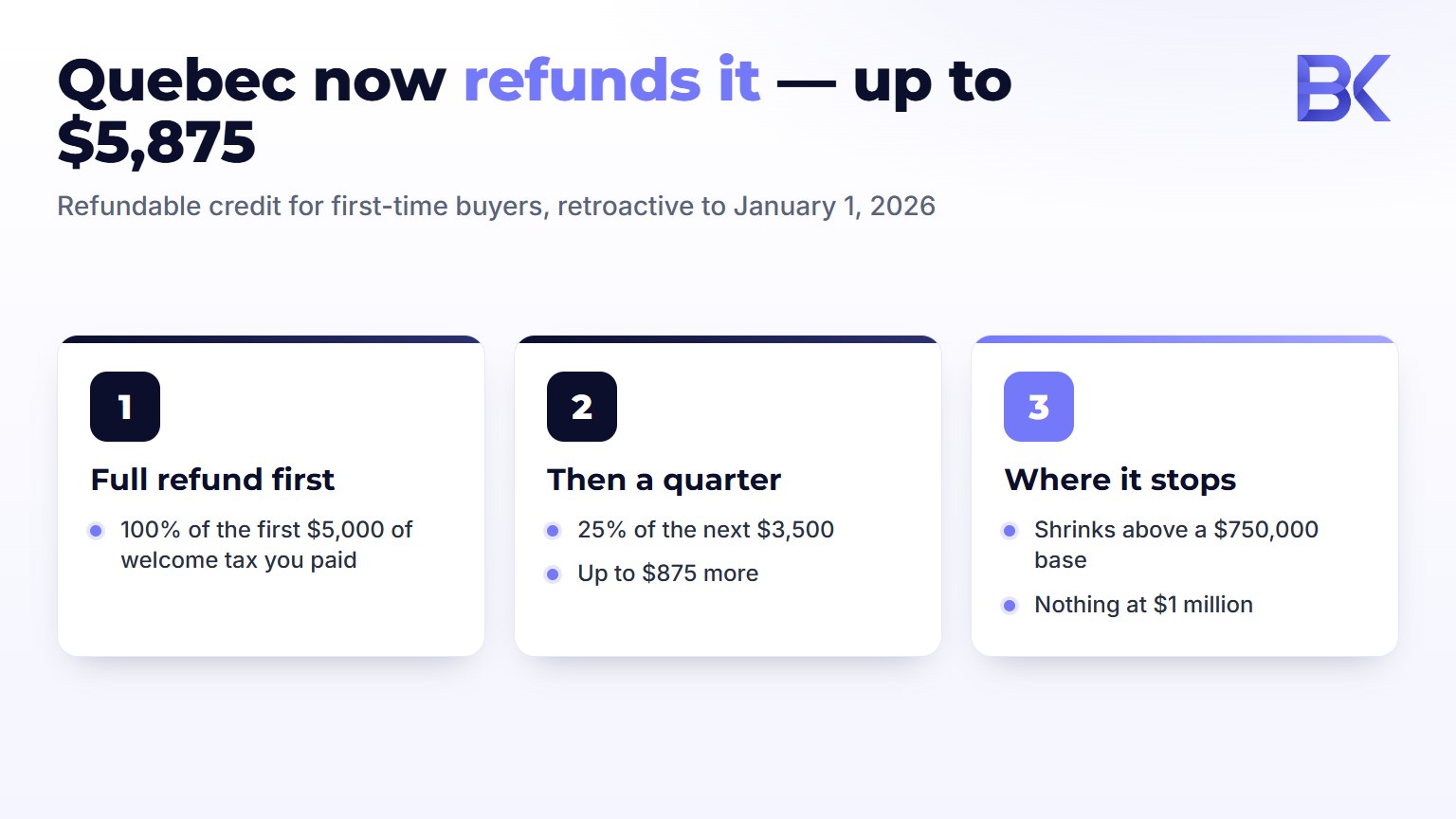
The credit refunds 100% of the first $5,000 of property transfer duties paid, plus 25% of the next $3,500, for an additional refund of up to $875 and a maximum total credit of $5,875. If the property’s tax base exceeds $750,000, the credit is reduced by 2.35% of the amount above that threshold and reaches $0 once the tax base is $1 million or more.
You generally qualify as a first-time buyer if you did not own a home that you occupied at any time from the beginning of the fourth preceding calendar year through the day before the purchase. Your spouse’s ownership can also affect eligibility where you lived in a home owned by your spouse during your marriage, civil union, or common-law relationship. Separate rules are available for certain individuals with a severe disability and for people buying a home intended for a related person with a disability.
A few conditions matter in practice: the home must be acquired after December 31, 2025; you must intend to make it your principal residence within the applicable period; the acquisition occurs for purposes of the credit once your ownership right is published in the registre foncier and the home is habitable; and the property transfer duties must actually have been paid by you or your spouse.
If more than one eligible person owns the property, the combined credit still cannot exceed the amount that would have been available if only one person had claimed it. The credit does not apply to a substitute duty (droit supplétif) charged instead of property transfer duties on an exempt transfer.
You claim the credit on your Quebec income tax return, and you generally need to be a Quebec resident at the end of the tax year to qualify.
Advance Payment Option
Quebec has also provided for an advance-payment option, so eligible buyers may not necessarily have to wait until their tax return is processed. To qualify, the buyer must meet the applicable conditions, including having paid the property transfer duties, having a tax base of no more than $1 million, expecting a credit of more than $1,000, and agreeing to receive the payment by direct deposit. If several owners are eligible, only one person can request the advance payment. The request must be submitted no later than December 1 of the applicable year.
As of August 17, 2026, Revenu Québec still states that the procedures for submitting an advance-payment request will be communicated later. The government has indicated that the mechanism is expected to be introduced by the end of summer 2026, with the first payments planned for the fall. Buyers should therefore confirm that the application process is open before relying on a specific payment date.
The credit is available for qualifying first homes acquired beginning in 2026. The province estimates that approximately 38,000 first-time buyers per year will benefit from the measure, at a cost of more than $140 million annually.
The Ministry of Finance’s own examples show the range: a $292,000 home in Rimouski gets a full refund of $2,606; a $427,000 home in Lévis gets $4,516 back in full; a $616,000 home in Laval hits the $5,875 cap, which works out to 65% of the $9,091 in duties actually paid.
One thing worth clearing up directly: if you’ve read that Montreal offers its own rebate to first-time buyers, that program — the Programme d’appui à l’acquisition résidentielle — stopped accepting new applications on July 7, 2026, with no exceptions. Applications submitted before that date are still being processed through the end of 2026, but for anyone buying now, it’s the provincial credit above that applies, not the old city program.
Three Tax Credits That Stack for First-Time Buyers
Subject to the separate eligibility rules for each program — and sufficient tax payable to fully use the two non-refundable credits — a qualifying first-time buyer may receive up to $8,444 in combined direct tax assistance:
| Credit | Level | Maximum |
| Refundable credit for home ownership access | Quebec | $5,875 |
| Non-refundable first-home tax credit | Quebec | $1,400 |
| Home Buyers’ Amount | Federal | $1,169 |
| Total | $8,444 |
The two non-refundable credits both use a $10,000 base, but they don’t produce the same dollar amount. Quebec’s version is worth $10,000 × 14% (Quebec’s lowest tax bracket rate) = $1,400. The federal version, for a Quebec resident, works out to $10,000 × 11.69% = $1,169 — lower, because the Quebec abatement reduces the federal tax the credit offsets. Residents of other provinces get a different federal number entirely.
The distinction between refundable and non-refundable matters more than the dollar figures. The $5,875 refundable credit pays out even if you owe no tax, and it’s tied directly to welcome tax you actually paid. The two non-refundable credits simply reduce tax you’d otherwise owe, recognizing the broader costs of buying — inspection fees, notary fees, moving — rather than the welcome tax specifically.
Down Payment and Mortgage Loan Insurance
The federal minimum down payment scales with the purchase price, per Canada’s Financial Consumer Agency:
| Home price | Minimum down payment |
| $500,000 or less | 5% of the price |
| Over $500,000 to under $1.5 million | 5% on the first $500,000 + 10% on the remainder |
| $1.5 million or more | 20% of the price |
For a $600,000 home, that works out to $25,000 (5% of the first $500,000) plus $10,000 (10% of the remaining $100,000), for a minimum down payment of $35,000.

Put down less than 20% and you’ll generally need mortgage loan insurance — it protects the lender, not you. Even at 20% down, a lender may still require it in certain situations, such as for self-employed applicants or borrowers with a thin credit history.
For an insured mortgage with a down payment below 20%, a maximum amortization of up to 30 years is available if you are a first-time buyer and/or are purchasing a new build. Other insured mortgages generally have a 25-year maximum. With a down payment of 20% or more, the lender determines the maximum amortization it is prepared to offer. A longer amortization can lower the monthly payment, but it also increases total interest over the life of the mortgage.
The right structure depends on your income, your down payment, and your overall plan — worth reviewing before you shop for a rate. If the vocabulary of terms, rates, and penalties is still unfamiliar, our guide to decoding mortgages in Quebec covers the basics first.
What Else You Pay at Closing
Beyond the down payment, there’s a shorter list of costs due on closing day itself, in cash.
The notary and the paperwork
For a financed residential purchase in Quebec, the notary plays a central legal role. An immovable hypothec must be created by notarial act, and residential sales are normally completed through a notarized deed of sale. The notary reviews the title, handles the funds and publishes the relevant rights in the land register.
There is no mandatory fee schedule imposed on Quebec notaries. Their professional fees must be fair and reasonable and depend on factors such as the work involved, the complexity of the file and the notary’s expertise. Ask for an estimate before the transaction.
The certificat de localisation — the survey certificate confirming the property matches its legal boundaries — is the seller’s responsibility to provide, and typically already exists. If you want a new or additional one on your own initiative, that’s on your dime.

Inspection, adjustments, and insurance
A building inspection is a market service you arrange and pay for before closing. It’s money spent regardless of whether the deal closes, which is exactly why skipping it to save cash is rarely worth the risk.
On closing, you’ll also cover adjustments (répartitions) — reimbursing the seller for municipal and school taxes they already prepaid for the rest of the year, and sometimes for fuel left in a tank. Your home insurance has to be active from the day of closing, since your lender will require proof before releasing funds.
The Quebec Tax on Your Mortgage Insurance Premium
If your down payment is under 20%, the mortgage loan insurance premium can usually be added to the mortgage. The Quebec tax charged on that insurance premium, however, cannot normally be added to the mortgage and should be budgeted as part of the cash needed for the transaction. CMHC states it directly: “Premiums in Quebec, Ontario and Saskatchewan are subject to provincial sales tax. The provincial sales tax cannot be added to the loan amount.”
In 2026, this is not QST. Quebec imposes a separate 9% tax on insurance premiums, and GST and QST do not apply to insurance premiums. The rate of this separate tax will increase to 9.975% for premiums paid after December 31, 2026. For a home purchase completed in 2026, budget 9% of the mortgage-insurance premium for this tax.
What you pay, and when
Put together, the timing matters as much as the amounts — some of this is due before you get the keys, and the biggest of the bills that fall outside your mortgage lands well after:
| Cost | Who bills you | When you pay | In the mortgage? |
| Building inspection | The inspector | Before closing | No |
| Down payment | Held by your notary for closing | At closing | No |
| Notary fees | Your notary | At closing | No |
| Adjustments (prepaid taxes, fuel) | Settled through your notary | At closing | No |
| Quebec tax on mortgage-insurance premium (9% in 2026) | Your lender, generally through the closing process | At closing | No |
| Welcome tax | Your municipality | Usually a few months after closing, within 30 days of the notice | No |
| Refundable credit, up to $5,875 | Revenu Québec pays you | At tax time, or in advance from October 2026 | — |
A workable order of operations looks like this:
- Ask your notary for a written quote before you sign anything, so the closing-day figure isn’t a surprise.
- Calculate the welcome tax from the tax base, not from your offer price — check the municipal assessment and the current comparative factor.
- Set that amount aside separately from your down payment — and separately from your emergency fund. Closing costs and the welcome tax shouldn’t come out of the reserve that covers a job loss or a broken furnace; those are different dollars.
- Once your right is published in the registre foncier and you’ve paid the duties, apply for the advance payment of the credit — the deadline is December 1 of the year.
- If the city’s notice hasn’t arrived — or the duties aren’t paid yet — before December 1, the advance isn’t available for that year. Claim the credit on your Quebec income tax return instead.
Saving for It: FHSA and the Home Buyers’ Plan
Two federal savings tools, both available to Quebec residents, do most of the heavy lifting for a first home.
The FHSA — CELIAPP in French, the same federal account under its French name — lets you contribute up to $8,000 a year, plus any unused room carried forward from a previous year, to a lifetime maximum of $40,000. Contributions reduce your taxable income, and withdrawals for a first home come out tax-free with no repayment required. That combination of a deduction, a tax-free withdrawal and no payback is unique to the FHSA. Our FHSA and CELIAPP guide walks through how the contribution room builds.
The Home Buyers’ Plan (HBP / RAP) lets you withdraw up to $60,000 from your RRSP per person — up to $120,000 combined for a couple — tax-free at the time of withdrawal, as long as you repay it over 15 years. Any amount you don’t repay in a given year is added to your taxable income for that year: the HBP is a loan from your own RRSP, not a free withdrawal.
The HBP repayment rules were extended again in 2026. Temporary repayment relief now applies to individuals whose first HBP withdrawal is made between January 1, 2026 and December 31, 2028. Instead of beginning in the second year following the year of the first withdrawal, the 15-year repayment period begins in the fifth year following that year. For example, if your first HBP withdrawal is made in 2026, your first required repayment year will generally be 2031.
FHSA and HBP can be used together on the same qualifying home, as long as the conditions of both programs are met. If you make a new RRSP contribution shortly before an HBP withdrawal, be careful with the 89-day rule: contributions made during the 89 days immediately before the withdrawal may not be fully deductible, depending on the value remaining in the RRSP after the withdrawal.
A caution worth repeating: each program sets its own first-time buyer test. Quebec’s refundable credit, the FHSA and the HBP don’t use identical wording, so confirm your eligibility program by program rather than assuming one definition covers all three.
Buying New Construction? Here’s What Changes
Many first-time buyers in the Montreal area buy resale, where GST and QST generally don’t apply. New construction is different.
If you buy a qualifying new home from a builder, build your own home, or substantially renovate a home, you may qualify for the new federal First-Time Home Buyers’ GST Rebate if you meet the program conditions. The rebate can reach $50,000, effectively refunding up to 100% of the GST on an eligible home priced at $1 million or less. It is gradually reduced between $1 million and $1.5 million and is generally eliminated at $1.5 million. Additional timing, occupancy and first-time-buyer conditions apply.
A separate existing GST/QST new-housing rebate may also be available in some situations, subject to its own eligibility requirements and much lower property-value thresholds. Quebec has not harmonized the QST with the new federal first-time-buyer GST relief, so the provincial QST rebate remains a separate program. For a Quebec property, confirm which rebates apply with Revenu Québec and your notary before signing a new-construction purchase agreement.
What the Full Bill Looks Like for Two Buyers
Two examples show how the welcome tax and the refund land in practice — one in Montreal, one in a municipality on the base provincial scale.
The following cases are based on actual client situations. Names and certain identifying details have been changed to protect confidentiality. Individual outcomes will vary.
2 Real Cases: First-Time Buyer Costs in Action
Émilie and Marc, Montreal condo, $700,000. They’d saved carefully for a down payment and put down $70,000 — 10% — comfortably above the federal minimum of $45,000 for a home at this price. What they hadn’t budgeted for was the welcome tax bill: using Montreal’s 2026 scale, their $700,000 base works out to $9,349, due to the city as one payment, separately, months after they’d already moved in.
At 10% down, their mortgage was insured, so the 9% Quebec tax on the mortgage-insurance premium was another amount they needed in cash for the transaction. That tax could not be added to the mortgage. Reviewing the file with Boris, they moved the welcome tax money into a separate account before closing and left it there until the city’s notice arrived.
When Boris reviewed their file, the number that changed their outlook wasn’t the bill — it was the refund. Because their tax base was under the $750,000 reduction threshold, they qualified for the full $5,875 credit: 100% of the first $5,000 paid, plus 25% of the next $3,500. The lesson wasn’t that the welcome tax disappears — it’s that they still needed $9,349 in cash ready when the city’s notice arrived, with the credit following afterward rather than offsetting the bill in the moment.
Nadia, semi-detached house outside Montreal, $400,000. A newcomer buying her first home in a municipality that follows Quebec’s base provincial scale rather than Montreal’s higher brackets, her welcome tax came to $4,110.50: $314.50 on the first $62,900, $2,521 on the next $252,100, and $1,275 on the remaining $85,000 above $315,000.
Because that total sits under $5,000, Nadia qualifies for a full refund of everything she paid. Working with Boris, she combined her FHSA savings with an HBP withdrawal from her RRSP and planned to use the advance-payment option once the Revenu Québec application process became available, provided she met all of the conditions. That allowed her to plan for the welcome-tax bill while also accounting for the refund expected later.
Frequently Asked Questions
1. If I qualify for the refund, do I still have to pay the welcome tax?
Yes. The credit is tied to duties you or your spouse have actually paid, so the city’s bill comes first and the refund follows. That’s why the money needs to be set aside even by buyers who will get all of it back.
2. Does the new provincial credit replace Montreal’s old first-time buyer rebate?
Yes, in practice. Montreal’s own Programme d’appui à l’acquisition résidentielle stopped accepting new applications on July 7, 2026. The provincial refundable credit, worth up to $5,875, now applies to first-time buyers across Quebec regardless of which municipality they buy in.
3. How much is the welcome tax on a $500,000 home in Quebec?
On the base provincial scale, a $500,000 tax base gives $314.50 on the first $62,900, $2,521 on the next $252,100, and $2,775 on the remaining $185,000 — $5,610.50 in total. A first-time buyer would get $5,152.63 of that back: the full first $5,000, plus 25% of the $610.50 above it.
4. When will the refund actually reach me?
If you apply for the advance payment — available where the tax base is $1 million or less and the expected credit exceeds $1,000 — Quebec planned the first direct deposits for October 2026, with applications due by December 1. Otherwise the credit arrives when your Quebec tax return for the year is processed.
5. Can I use my FHSA and the Home Buyers’ Plan together?
Yes, both can be applied to the same first home purchase. Just remember RRSP contributions generally need to sit for at least 90 days before an HBP withdrawal, and repayment terms differ depending on when you withdraw.
Disclaimer: This article is for general informational purposes only and does not constitute personal financial, tax, legal, mortgage, or investment advice. Rules, thresholds, and program details for the welcome tax, the refundable tax credit, and related savings programs may change, and individual circumstances vary. Speak with Boris Kolodner or another qualified professional before making decisions based on this information.
Planning Your First Home Purchase in Quebec?
The down payment is only one part of the budget. Before making an offer, it helps to understand how the mortgage, FHSA and HBP withdrawals, welcome tax, notary costs, mortgage-insurance premium and available tax credits fit together. Talk to BK Financial’s mortgage brokerage before you make an offer.
Boris Kolodner, MBA, Financial Planner & Licensed Financial Security Advisor, can help you review the full financial picture and plan how much cash you will actually need before, during and after the purchase.
Book a free consultation before you make an offer.
Phone: +1-514-834-5558 Email: contact@bkfinancialservices.ca Website: bkfinancialservices.ca
Consultations available in English, French, Russian, and Hebrew.