

The mortgage renewal letter arrives, and the payment on it is different from what you have paid for five years. For many Quebec households whose mortgage was signed in 2020 or 2021, at some of the lowest rates on record, that difference is real money.
It helps to know two things before you react. First, Bank of Canada research shows that most homeowners who have already renewed have managed the increase, and some are seeing their payment go down. Second, you have more room to negotiate at renewal than most people use — including a rule that changed in your favour in 2024.
This guide walks through what your lender owes you in writing, how much payments are typically moving, what changed for borrowers switching lenders, and what a move actually costs once you factor in Quebec’s notarial system.
What your lender must send you — and when
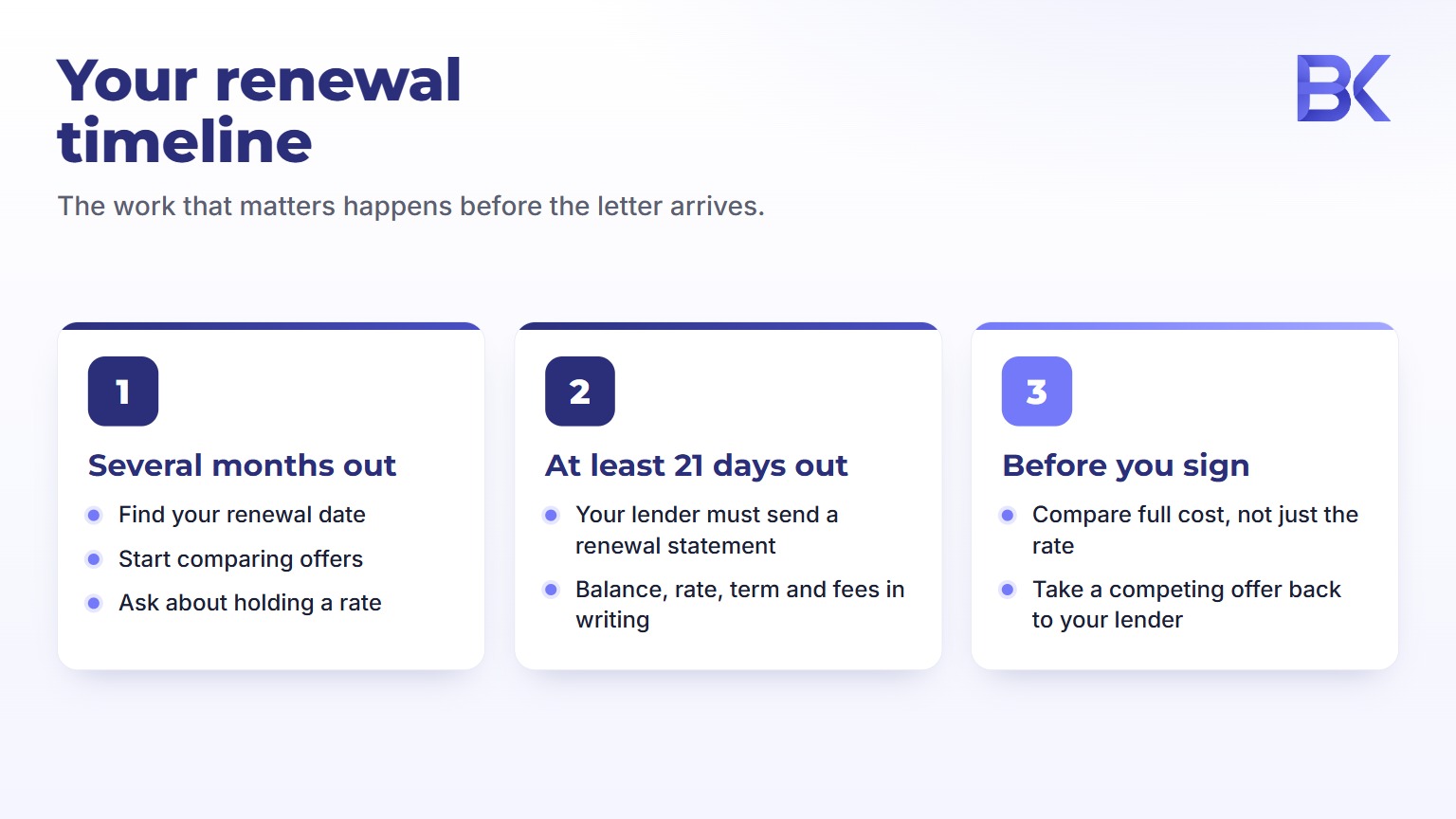
If your mortgage is with a federally regulated financial institution, such as a bank or federal credit union, federal rules require the lender to provide a renewal statement at least 21 days before the end of your current term. The lender must also give at least 21 days’ notice if it does not intend to renew the mortgage.
Quebec also has its own 21-day protection. Under the province’s Consumer Protection Act, a lender must generally notify a consumer in writing at least 21 days before the expiry of a money-loan contract secured by an immovable hypothec whether it intends to renew the loan. This is important for Quebec borrowers using provincially regulated institutions such as caisses. The exact disclosure requirements are not identical to the federal rules, so the applicable framework depends on the lender.
The renewal statement has to include your outstanding balance as of the renewal date, the proposed interest rate, the payment frequency, the new term, and any applicable fees. It also has to confirm that the rate quoted will not increase before your renewal date, so the rate in that statement cannot be raised on you while you compare it against other offers.
Twenty-one days is a legal minimum, not a target to wait for. FCAC recommends starting to shop for a rate several months before your term ends, while you still have time to compare offers and, if it makes sense, negotiate with your current lender.
How much mortgage renewal payments are actually going up in 2026
Mortgage renewal rates in 2026 sit well above the 2020–2021 lows most of this cohort locked in. As of August 14, 2026, the Bank of Canada’s policy rate is 2.25%. The Bank maintained that rate at each of its 2026 decisions through July 15. The Bank announces the rate on a fixed schedule eight times a year, so check where it stands on the day you compare offers. In its 2025 Financial Stability Report, the Bank estimated that roughly 60% of all outstanding Canadian mortgages were set to renew across 2025 and 2026 — largely the last wave of five-year mortgages signed during the pandemic at very low rates.
The Bank has been direct about the effect this is having: many mortgage holders faced higher payments at renewal in 2025 and in the first half of 2026, but most have been able to manage the increase.
The 2026 Mortgage Consumer Survey from Canada Mortgage and Housing Corporation (CMHC), based on more than 4,100 respondents, found that homeowners who renewed saw their payment rise by an average of $375 a month, and 35% said they felt more financial pressure because of the change in rate.
A Bank of Canada staff analytical note published in July 2025 projected an average payment increase of about 20% for five-year fixed mortgages renewing in 2026, with the top 10% of variable-rate borrowers on fixed payments potentially seeing increases above 40%.
The range is unusually wide for variable-rate mortgages with fixed payments: while the most exposed 10% were projected to face increases above 40%, roughly one-quarter were projected to see their payment fall by at least 7%.
That is not the whole picture, though. The same note projected that some borrowers — depending on when their term started and how rates have moved since — will actually see their payment go down at renewal. Where you land depends heavily on which type of mortgage you have and when you signed it.
| Mortgage type | What’s happening at renewal |
| Five-year fixed, originated or last renewed around 2021 | Many are moving from pandemic-era lows to higher 2026 rates; Bank of Canada analysis projects the largest average payment increase for this group. |
| Variable rate with a fixed payment | The payment did not adjust while rates moved, so it can jump at renewal; the most exposed borrowers in this group — the top 10% in the Bank of Canada analysis — could see increases above 40% |
| Shorter-term mortgage originated or renewed in 2022–2023 | Rates were already higher when the term started; renewal changes tend to be smaller, sometimes a decrease |

You don’t have to take the first offer
FCAC states this plainly: you don’t have to renew your mortgage with the same lender. The offer in your renewal statement is a starting point, not a final answer, and FCAC has warned that lenders count on inertia, because most homeowners simply sign whatever letter shows up.
Comparing offers generally costs nothing but your time, and switching on the renewal date itself usually does not trigger a prepayment penalty. You can compare rates from other federally regulated lenders, ask your current lender to match a better offer, or work with a mortgage broker to do the comparison for you. FCAC recommends starting this process several months ahead of your renewal date, not the week it lands in your inbox.
A workable order for the months before renewal:
- Find your renewal date and mark it — if your term ends this fall, you are already inside the window where comparing offers is worth doing.
- Start comparing offers several months ahead, while you still have time to act on what you find. Many lenders will also hold a quoted rate for you ahead of the renewal date, which is worth asking about early.
- Read the renewal statement when it arrives, at least 21 days before the term ends.
- Compare the full cost of each option, not the headline rate alone — fees, and in Quebec the notarial costs of a move, belong in the comparison.
- Take a competing offer back to your current lender before you decide.
The stress test rule that changed in 2024
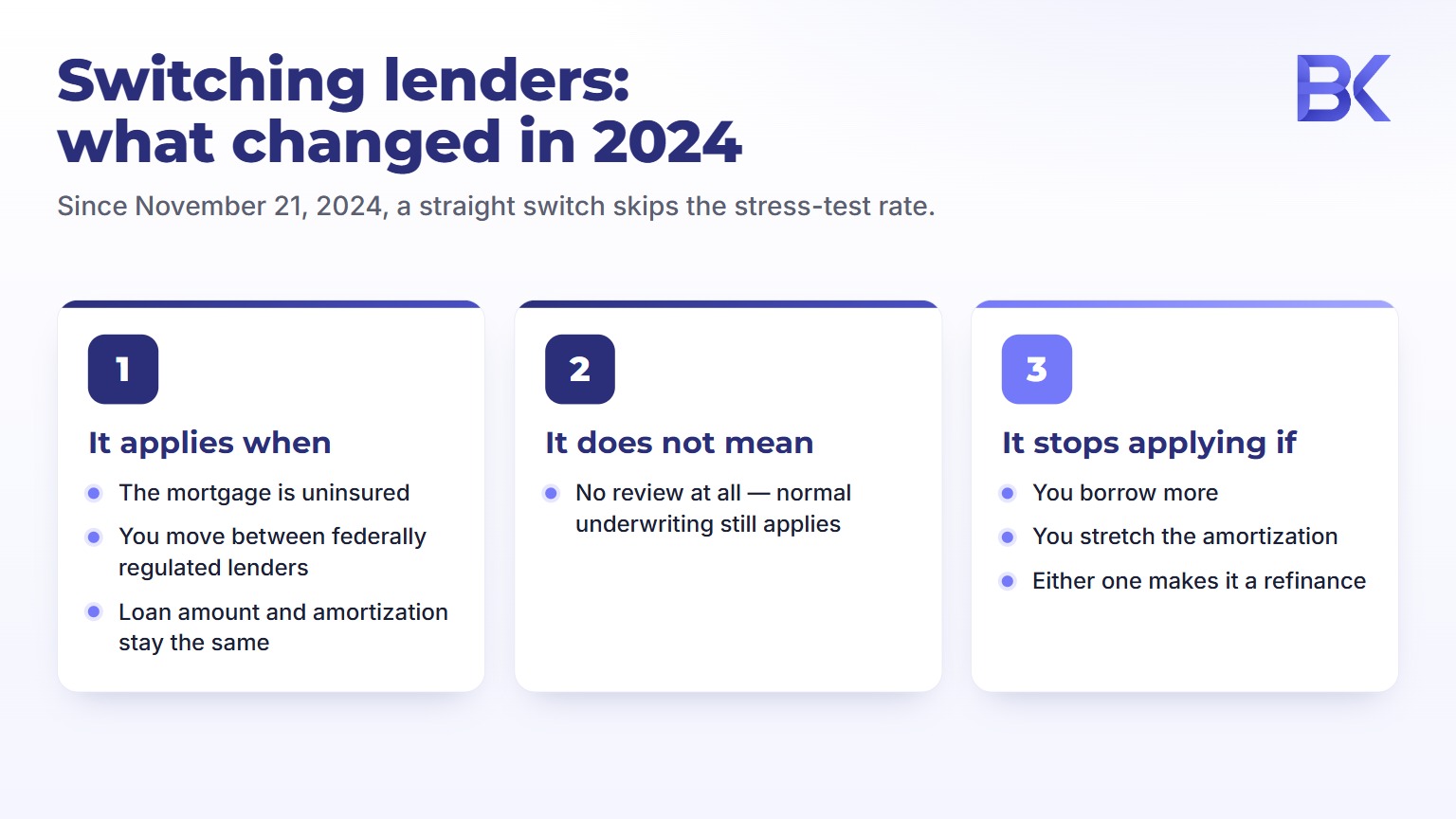
For years, one reason people stayed with their current lender at renewal — even when a competitor’s rate was better — was the fear of not qualifying somewhere else. On November 21, 2024, the Office of the Superintendent of Financial Institutions (OSFI) removed that barrier for a specific group of borrowers.
OSFI’s own language: “Effective today, OSFI will no longer prescribe the minimum qualifying rate (MQR) that it expects federally regulated financial institutions to apply when uninsured mortgage borrowers switch to a new institution at renewal.” In practice, this applies to what OSFI calls a “straight switch” — moving an existing, standalone uninsured mortgage from one federally regulated lender to another, without increasing the remaining amortization or the loan amount.
This does not mean the new lender skips due diligence. It still assesses your application as any new mortgage, under the same residential mortgage underwriting standards (OSFI Guideline B-20) — income, credit, and the property are all reviewed. What disappeared is the requirement to qualify at an inflated stress-test rate simply because you are switching institutions.
There are several important limits to understand. OSFI’s November 2024 change applies specifically to uninsured straight switches between federally regulated financial institutions when the loan amount and remaining contractual amortization are not increased.
Insured mortgage holders also have greater switching flexibility: under the strengthened Canadian Mortgage Charter, an insured mortgage can generally be switched to another lender at renewal without another minimum-qualifying-rate stress test, provided the applicable transfer conditions are met.
Federal mortgage-insurance rules were also amended effective December 16, 2024 for certain low-ratio mortgages switching from a federally regulated lender to a new lender. These rules have their own eligibility criteria, including maintaining the existing contractual amortization schedule and prohibiting equity take-out.
None of these changes guarantees approval. The receiving lender still assesses income, credit, the property and its own underwriting criteria.
As a general rule, taking additional equity out of the property or extending the contractual amortization means the transaction is no longer a straight switch and may require full qualification under the standard mortgage rules. A narrow exception may apply under certain federal mortgage-insurance rules for limited transaction costs, so the exact structure should be confirmed before the transfer is submitted.
A renewal with your existing lender, without switching, was never subject to requalification in the first place; these changes concern moving a mortgage to another institution. If a larger loan is what you actually need, our guide to refinancing and HELOCs in Quebec explains how that process differs.

What switching actually costs in Quebec
Switching lenders on your actual renewal date does not usually trigger a penalty — that is the point of waiting for the term to end. Leaving before your term is up is different. Depending on your mortgage contract and lender, the prepayment penalty is often calculated as the higher of three months’ interest or the Interest Rate Differential (IRD). Your lender should explain how the penalty is calculated, so ask for the amount in writing before deciding whether an early switch is worthwhile.
For a closer look at how penalties, terms, and rates work together in Quebec, see our guide to mortgage rates, terms, and penalties.
Quebec adds an important legal and administrative layer. An immovable hypothec must be created by notarial act, and a lender change may involve a new hypothec, a discharge, a transfer or assignment, or subrogation, depending on how the transaction is structured. These rights must also be properly registered in the land register.
As a result, switching lenders in Quebec can involve notarial, registration, discharge, assignment, appraisal or administrative costs. Ask the new lender exactly which costs apply and which ones it is prepared to cover before comparing the net savings from a lower rate.
Since May 1, 2020, mortgage brokerage in Quebec has been regulated by the Autorité des marchés financiers (AMF). A mortgage broker must gather the information needed to understand the client’s needs and financial situation, provide appropriate advice, and ensure that a proposed mortgage is suitable for the client’s circumstances and needs.
Ways to lower the payment — and what each one costs you
A few levers exist besides simply accepting the number on the renewal statement, and each one trades something away.
| Option | What it does | What it costs you |
| Extend amortization | Lowers the monthly payment | More total interest over the life of the loan; if done while switching lenders, it alone ends straight-switch treatment and triggers full requalification |
| Blend-and-extend | Softens the rate jump without switching lenders | Blended rate still higher than your current one; only offered by your existing lender |
| Extra payments before renewal | Shrinks the balance the new rate applies to | Ties up cash you could use elsewhere; limited by your prepayment privilege; for most households, higher-interest debt and a cash buffer come before extra mortgage payments |
| Switch to a new lender at renewal | Access to a potentially better rate, no stress-test barrier for a straight switch | Notarial act and registration costs in Quebec; some lenders help cover them |
| Choose a shorter or longer term | A shorter term gets you back to the market sooner; a longer one fixes your payment for longer | Neither is safer in every case — the trade-off depends on how much change your budget can absorb at the next renewal |
If the new payment doesn’t fit
If the new payment genuinely does not work for your budget, FCAC’s guideline on existing consumer mortgage loans sets out that federally regulated lenders are expected to consider individual relief measures for borrowers in serious financial difficulty before the file heads toward default. That can include a temporary reduction or skip of payments, extending the amortization, or waiving prepayment penalties and certain internal fees.
These are not guaranteed entitlements to a specific form of relief, but FCAC expects federally regulated institutions to assess the borrower’s circumstances and consider appropriate, individualized measures. If your mortgage is with a caisse or another AMF-supervised lender, ask what relief options are available under that institution’s own framework.
The earlier you reach out, before any payment is missed, the more options are typically available; waiting until after you have fallen behind narrows what a lender can realistically offer.
2 Real Cases: Mortgage Renewals in Action
Case 1 — The offer that wasn’t actually competitive
A family in Laval had a five-year fixed mortgage from 2021 come up for renewal. Their bank’s letter offered a rate that, once Boris compared it against other federally regulated lenders, sat noticeably above what competitors were quoting for a similar profile.
Strategy: Boris put together a comparison of offers and brought a competing rate back to the family’s existing lender before their term ended, rather than after.
Result: In this case, the lender adjusted its offer once a genuine competing rate was on the table; a lender is not obliged to match, and some will not. The family renewed with a rate closer to market, without changing institutions or going through a full switch.
Case 2 — The switch that didn’t need a stress test
A self-employed borrower in Montreal had an uninsured mortgage from 2020 and assumed that switching lenders at renewal meant requalifying at a much higher stress-test rate, the same hurdle that applied when the mortgage was first issued.
Strategy: Boris walked through the straight-switch rule that took effect in November 2024. Because the borrower wasn’t increasing the loan amount or extending the amortization, the new lender wasn’t required to apply the old minimum qualifying rate — the application still went through normal underwriting, just without that extra hurdle.
Result: The borrower was able to compare offers and move to a new federally regulated lender at renewal, instead of defaulting to their existing lender out of an assumption that had stopped being true two years earlier.
Frequently Asked Questions
1. When should I start shopping for a mortgage renewal?
FCAC recommends starting several months before your term ends, as soon as you know your renewal date. That gives you time to compare offers from other lenders — banks and caisses alike — and negotiate with your current one before the 21-day renewal statement even arrives.
2. Can I switch lenders at renewal without a penalty?
Switching exactly on your renewal date typically does not trigger a prepayment penalty — that is one of the main reasons to wait for the term to end rather than break it early. Leaving before the term ends can trigger a penalty equal to the greater of three months’ interest or the Interest Rate Differential.
3. Do I need to requalify at a higher rate to switch lenders?
If you are moving an existing uninsured mortgage between federally regulated lenders without increasing the loan amount or amortization, OSFI no longer requires the receiving lender to apply the old minimum qualifying rate, effective November 21, 2024. The lender still reviews your application under normal underwriting standards — the extra stress-test hurdle is what’s gone, not the review itself.
4. What happens if I do nothing at renewal?
Depending on your lender and mortgage agreement, the renewal may be automatic if you take no action. If your lender plans to renew automatically, this should be stated in the renewal notice. The risk is that an automatic renewal may not offer the most competitive rate or terms available to you.
5. What does it cost to switch mortgage lenders in Quebec?
Beyond any prepayment penalty for leaving early, switching in Quebec means a new notarial act and registration, since mortgages here are tied to notarial deeds rather than a simple administrative transfer. There can also be discharge, assignment, or appraisal fees depending on the lenders involved. Some lenders will cover part or all of these costs to win your business, so ask each one directly what it covers — that answer can matter more than a small difference in rate.
6. Does the 21-day mortgage renewal notice rule apply to a Quebec caisse?
Quebec has its own consumer-protection rule requiring a lender to generally notify a consumer in writing at least 21 days before the expiry of a money-loan contract secured by an immovable hypothec whether it intends to renew the loan. Federally regulated lenders are also subject to federal 21-day disclosure rules, although the required information is not identical.
7. Do I need a notary to switch mortgage lenders in Quebec?
A lender change in Quebec often involves notarial and land-registration work. A new immovable hypothec must be created by notarial act, while other transactions may involve a discharge, assignment, transfer or subrogation. The exact documents and costs depend on how the switch is structured.
Disclaimer: This article is for general informational purposes only and does not constitute personal financial, tax, legal, or mortgage advice. Rules, rates, and lender practices referenced here may change, and your specific renewal terms depend on your mortgage agreement and lender. For guidance tailored to your situation, consult a licensed mortgage professional.
Mortgage Renewal Coming Up? Compare Before You Sign.
Your renewal rate is only one part of the decision. A lower rate from another lender may look attractive until you account for qualification requirements, notarial and transfer costs, amortization, prepayment options and the effect of the new payment on your overall cash flow.
Boris Kolodner, MBA, Financial Planner & Licensed Financial Security Advisor, can help you compare your renewal options in the context of your broader financial plan and coordinate the next steps when mortgage-brokerage support is required.
Book a free consultation before accepting your renewal offer.
Phone: +1-514-834-5558 Email: contact@bkfinancialservices.ca Website: bkfinancialservices.ca
Consultations available in English, French, Russian, and Hebrew.