
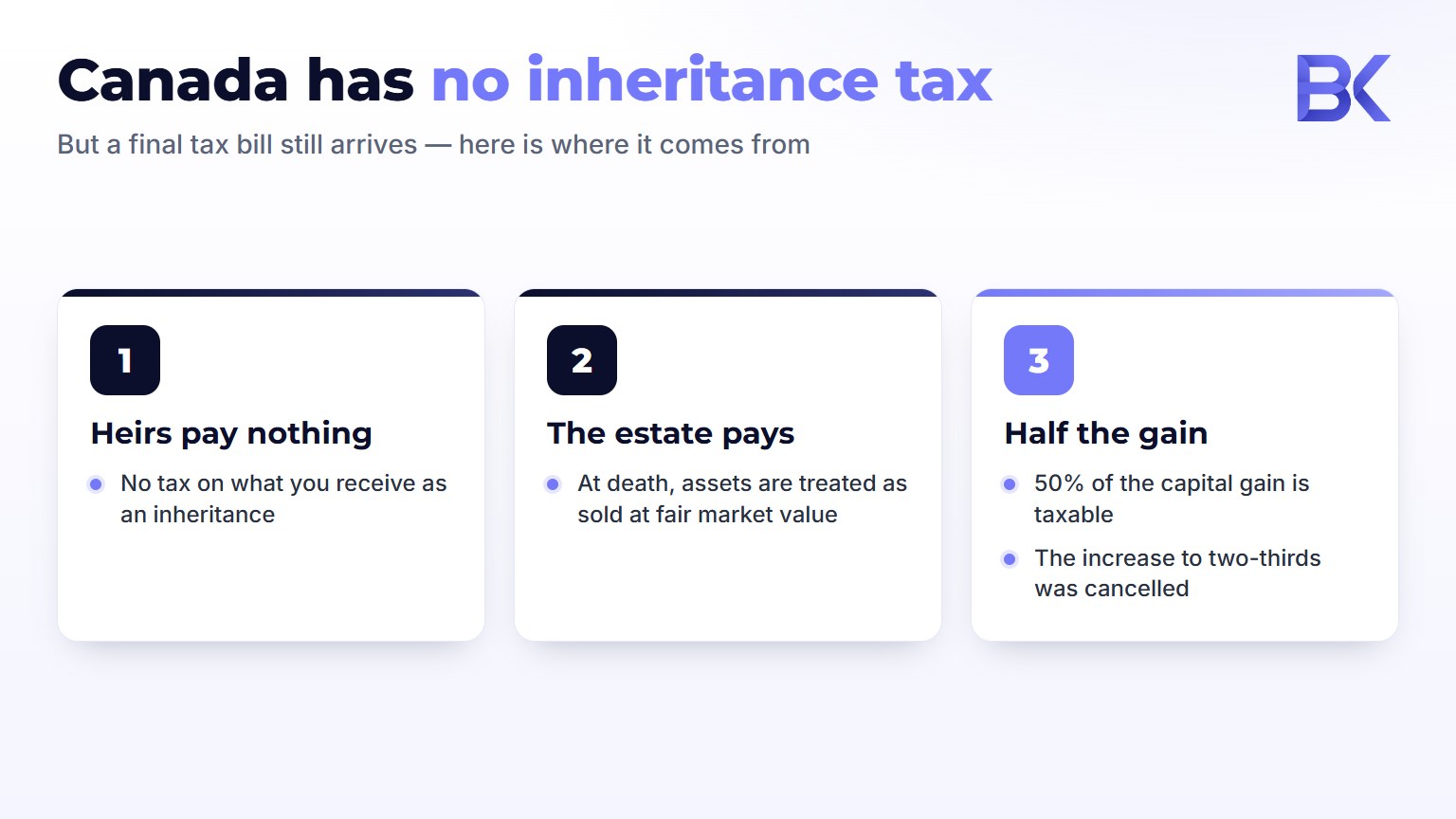
Canada does not have an inheritance tax — in Quebec or any other province. If someone leaves you money or property, you don’t pay tax simply for receiving it. That part is true, and you’ll see it repeated everywhere.
What often gets left out is that the estate itself still owes tax before anything is distributed, and that Quebec’s civil law runs on its own rules for wills, beneficiaries, and who inherits when there’s no will. Someone who moved here from another province, or who learned the basics from a friend in Ontario, can end up planning around rules that don’t apply here.
This guide walks through what estate planning in Quebec actually involves, and what happens at death: the tax bill that replaces the “inheritance tax” myth, the beneficiary trap that catches even careful savers, how a will works (and doesn’t), who settles the estate, and where the money to pay the tax bill is supposed to come from.
There’s No Inheritance Tax — But There Is a Final Tax Bill
Instead of taxing what heirs receive, the Income Tax Act uses a rule called deemed disposition. Immediately before death, a person is treated as having sold all their capital property at fair market value, even if nothing was actually sold. Any resulting gain is reported on their final tax return.
The Canada Revenue Agency describes it this way: “Capital property … owned by the person who died is considered to be disposed of by that person immediately before their death at fair market value, and may result in a capital gain or a capital loss.” This applies to investments, business interests and real estate, including a principal residence. A principal residence is also subject to deemed disposition at death, but all or part of the resulting gain may be sheltered by the principal residence exemption.
For 2026, the taxable share of a capital gain — the inclusion rate — is 50%. You may have seen articles claiming this rate was set to rise in 2026. That increase was announced in 2024, delayed in January 2025, and formally cancelled on March 21, 2025.
There is no threshold and no two-tier system in effect: the 50% inclusion rate applies to the whole gain. The lifetime capital gains exemption for qualified small business shares and qualified farm or fishing property is still available, and the limit is indexed to inflation each year.
In Quebec, the liquidator — Quebec’s term for the estate representative — also has to deal with Revenu Québec directly. The main provincial return covers the period from January 1 of the year of death to the date of death, and the liquidator can choose to file up to three additional optional returns to claim certain deductions and credits more than once. Similar optional returns exist federally, and the Quebec return is filed separately from the federal one.
What’s Deferred or Exempt
Deemed disposition doesn’t apply the same way to everything. Three situations commonly reduce or delay the tax.
A spousal rollover applies when capital property passes to a surviving spouse (including a common-law partner under the tax definition) or to a qualifying spousal trust. The property transfers at its adjusted cost base, so there’s no gain to report on the final return — the tax is deferred until the spouse eventually sells or dies.
The principal residence exemption can shelter all or part of the gain on a qualifying home. Federally, the legal representative generally reports the deemed disposition on Schedule 3 and uses Form T1255 to designate the property as the deceased’s principal residence, unless a qualifying spousal rollover applies. Quebec has its own reporting requirement: Form TP-274 is generally filed with Schedule G to designate the property as a principal residence.
RRSPs and RRIFs receive special treatment at death. Their fair market value is generally included in the deceased’s income, but tax-deferred treatment may be available when qualifying amounts ultimately pass to a surviving spouse or common-law partner, or in certain cases to a financially dependent child or grandchild. The exact reporting and transfer rules depend on who receives the proceeds and how the transfer is structured.
Quebec adds an important estate-planning wrinkle: beneficiary designations made directly in an ordinary RRSP or RRIF contract are generally not effective here except in limited circumstances. That does not necessarily prevent a spousal rollover. If the proceeds are paid to the estate and the surviving spouse is entitled to receive them from the estate, the legal representative and the spouse may be able to make the required election and transfer qualifying amounts on a tax-deferred basis. This is why the will and the registered-plan strategy need to be coordinated rather than treated separately.
One more distinction worth holding on to: “spouse” carries two different meanings in this article. For the tax rules above, it includes a common-law partner. For who inherits under Quebec law, it doesn’t — only marriage, civil union, and union parentale count. A common-law partner can therefore be a spouse for the rollover and still inherit nothing by default.
| Asset | What happens at death |
| Non-registered investments (stocks, funds, rental property) | Deemed disposition; any capital gain or loss is reported on the final return |
| Principal residence | Also subject to deemed disposition, but the gain may be sheltered by the principal residence exemption |
| RRSP / RRIF | Generally rolls over tax-deferred to a surviving spouse; otherwise, the full value is taxed as income on the final return |
| TFSA | The value at death is not taxed. Post-death growth is generally taxable, although since 2026 a surviving spouse or common-law partner may, if the conditions are met, designate certain amounts — including eligible post-death earnings accrued during the rollover period — as an exempt contribution to their own TFSA. Quebec does not recognize successor-holder designations or beneficiary designations for deposit or trust TFSAs. |
| Life insurance proceeds | If someone other than the estate is named, paid directly to that person, outside the estate, and not taxed as income. If the estate is named, the money falls into the estate |
For the fuller picture of how retirement income sources interact once someone stops working, our guide to Quebec retirement income planning covers RRIF withdrawals, QPP, and the OAS clawback.
The Quebec Trap: Naming a Beneficiary on Your TFSA or RRSP
Here’s the part that catches people off guard, especially newcomers who set up accounts elsewhere. In most provinces, you can name a beneficiary directly on a TFSA (Tax-Free Savings Account) or RRSP (Registered Retirement Savings Plan) and the money passes to that person outside the estate. Quebec generally doesn’t work that way for ordinary deposit accounts.
The CRA states it plainly for TFSAs: “Quebec does not recognize the designation of beneficiary for deposit TFSAs or arrangements in trust.” A separate CRA page adds: “Quebec does not recognize the designation of successor holder for TFSAs.” For RRSPs, the CRA notes that a beneficiary designation made in the contract or in a will “is not valid except in limited circumstances” in Quebec.
In practice, this means the beneficiary form your bank or brokerage asks you to fill out often has no legal effect on a standard TFSA or RRSP held in Quebec. If it isn’t recognized, the money doesn’t go directly to the person named — it becomes part of the estate and is distributed according to the will, or according to the legal rules of succession if there is no will.
There’s an exception worth knowing about: a direct beneficiary designation is recognized in Quebec when the product is structured as an insurance contract, such as a segregated fund policy or an annuity issued by an insurer. That’s a different legal structure from a bank-held TFSA or RRSP, and it’s part of why insurance-based products come up in estate planning conversations.
One mistake worth naming directly: moving to Quebec from a province like Ontario or British Columbia and assuming the beneficiary form filled out there still applies. It often doesn’t. Whether to restructure an account, rely on a will, or use an insurance-based product depends on your accounts, your family situation, and your goals — the kind of question worth reviewing individually rather than guessing. Our guide to TFSA strategies in Quebec covers the contribution side of the same account.

Your Will: Three Forms, One Big Difference
Quebec’s Civil Code recognizes three forms of will: notarial, holograph (written and signed entirely in the testator’s own hand), and one made before witnesses.
The practical difference comes down to what happens after death. A notarial will does not need to go through vérification — Quebec’s process for confirming that an informal will is authentic, what English speakers usually call probate — because a notarial will is an authentic act: the notary confirmed identity, capacity and the required formalities at signing. The original stays with the notary, and its existence is recorded in a register.
A holograph will or a will made before witnesses must go through *vérification*, either through the courts or a notary, before it can legally be used to settle the estate. That’s an extra step, and it takes time that a notarial will skips. Notarial fees for drafting a will aren’t set by regulation and vary by notary and complexity, so it’s worth asking for an estimate rather than assuming a figure.
| Form of will | Verification (vérification) required? | Where the original is kept |
| Notarial will | No | With the notary; recorded in the notarial register |
| Holograph will (entirely handwritten and signed) | Yes, before it can be used | Wherever the testator kept it |
| Will made before witnesses | Yes, before it can be used | Wherever the testator kept it |
There are two registers that track wills in Quebec: one kept by the Chambre des notaires du Québec and one kept by the Barreau du Québec. Neither register stores the actual will — only a record of who holds it. Searching both isn’t optional: Article 803 of the Civil Code of Québec requires the liquidator to determine whether the deceased left a will before doing much else.
If You Die Without a Will
When there is no valid will, Quebec’s rules of legal succession determine who inherits. Before the remaining estate is divided, the surviving spouse first receives any rights arising from the family patrimony or parental-union patrimony and, where applicable, the matrimonial or civil-union regime.
| Who survives | Spouse’s share of the estate | Others’ share |
| Spouse and children (or other descendants) | 1/3 | Children — 2/3 |
| Spouse, no children, parents alive | 2/3 | Parents — 1/3 |
| Spouse, no children or parents, siblings alive | 2/3 | Siblings — 1/3 |
| Children, no spouse | — | Everything to the children |
| No spouse, no descendants | — | If parents and siblings (or their representatives) survive, the estate is generally divided between those groups under Quebec’s statutory rules; if only one group remains, that group may receive the estate. More distant relatives inherit only if the closer classes are absent. |
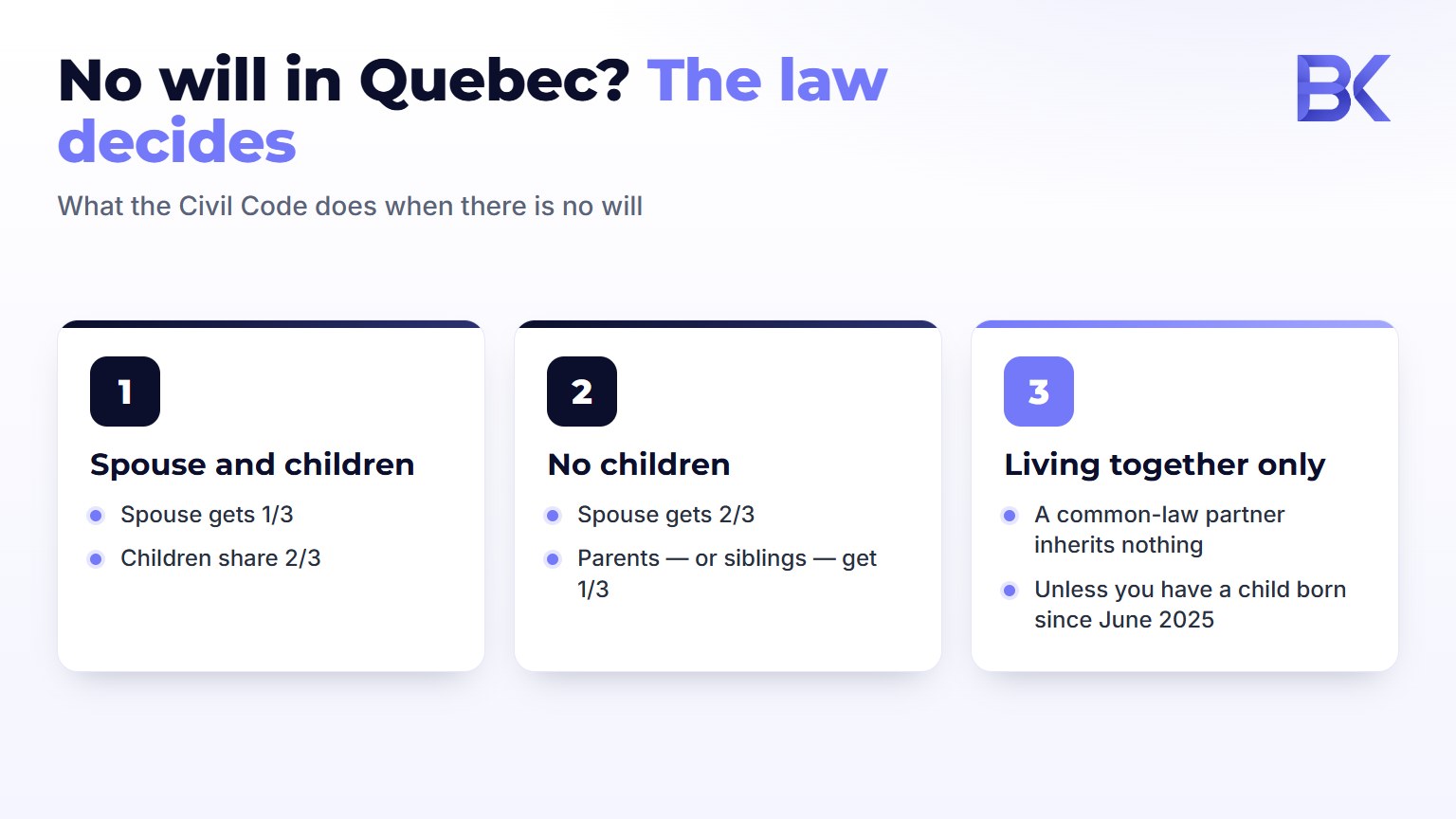
For these purposes, “spouse” means a married spouse, a civil union partner, and — since June 30, 2025 — a partner under Quebec’s union parentale regime. Simply living together, on its own, does not qualify.
Union parentale took effect on June 30, 2025. From that date, a de facto couple with a shared child born or adopted on or after that date is automatically covered by it, and couples with earlier children can opt in by agreement. A surviving partner in this regime inherits by law the same way a married spouse would — for example, the one-third share shown above when there are children.
The regime has been in force since June 30, 2025, but it doesn’t cover everyone. Common-law partners without children still do not inherit from each other under the rules of legal succession, no matter how many years they’ve lived together. Without a will or a union parentale relationship, a surviving partner in that situation can be left with nothing from the estate by default.
Family patrimony (patrimoine familial) applies to marriage and civil union, not to ordinary cohabitation. It covers a defined list of assets — the family residence, household furnishings, family vehicles, and retirement savings accumulated during the union — split equally before the rest of the estate is divided.
Union parentale has its own patrimony, and it’s narrower: the residences used by the family, the furniture in them, and the family vehicles. Rights accrued in a registered retirement plan and QPP earnings are not part of it, unlike under family patrimony. Couples relying on the new regime shouldn’t assume it splits the same things a marriage would.
The Liquidator’s Job — and Personal Liability
Quebec uses the term liquidator rather than “executor.” The job involves considerably more than filing a few forms. According to Québec’s official checklist, among the liquidator’s main responsibilities are searching for the latest will, registering the appointment, preparing an inventory of assets and debts, publishing the required notices, paying debts, filing the deceased’s and estate’s tax returns, obtaining the required tax-distribution certificates, preparing the final account, distributing the remaining property, and publishing the notice that closes the liquidator’s account.
The exact sequence can vary with the estate, but the liquidator is administering someone else’s property and can face personal liability if the process is handled incorrectly.
Official sources don’t publish set timelines in days or months for these steps, so it’s worth treating any number quoted online for “how long liquidation takes” with caution. The same goes for compensation: the Civil Code (Article 789) gives a liquidator who isn’t an heir the right to be paid, while a liquidator who is an heir is only entitled to compensation if the will says so or the heirs agree. The amount is set by the testator, then by the heirs, and by a court only if they disagree — there’s no fixed percentage in the law.
Personal liability is one of the most important risks for a liquidator. Before the estate is finally distributed, the legal representative should obtain the CRA clearance certificate confirming that the relevant federal tax amounts have been paid or secured. CRA notes that a certificate is not required before every interim distribution if enough property is retained to cover the potential tax liability. Quebec has its own requirement: the liquidator must obtain Revenu Québec’s certificate authorizing the distribution of succession property (*certificat autorisant la distribution des biens*) — form MR-14.A) — and a liquidator who distributes assets before receiving it can likewise be held personally liable, up to the value of what was distributed.
The deadline for the deceased’s final federal return depends on when death occurred: if it happened between January 1 and October 31, the final return is due by April 30 of the following year; if it happened between November 1 and December 31, it’s due within six months of the date of death. Revenu Québec applies the same dates to the main Quebec return, which is filed separately. Deadlines shift in some situations — for example where the deceased or their spouse carried on a business — so confirm them before filing.

Where the Cash Comes From
Here’s the practical squeeze many families run into: the tax from deemed disposition has to be paid in cash, but an estate is often made up of a house and investments that still need to be sold — while distributing assets before the clearance certificates arrive is exactly what creates personal liability for the liquidator.
Life insurance is often used to solve this, because the payout goes directly to the named beneficiary, bypasses the estate, and isn’t taxed as income. Éducaloi puts it simply: “Life insurance proceeds go directly to one or more beneficiaries, tax-free.” The same page notes the beneficiary can also be the estate itself — in which case the money lands in the estate rather than bypassing it. In practice, that liquidity can cover the final tax bill without forcing a rushed sale of the house or the investment portfolio.
This ties back to the beneficiary trap above: a life insurance contract is one of the ways a Quebec resident can still name a direct beneficiary outside the estate, unlike an ordinary bank-held TFSA or RRSP.
Insurance isn’t the only route, and it shouldn’t be presented as one. An estate holding enough liquid assets, or one that can sell property in an orderly way rather than under time pressure, may not need it at all. There is also a federal election using Form T2075, that can defer payment of certain tax arising at death, including tax connected with deemed dispositions, when the statutory conditions are met. The election generally requires acceptable security, and interest continues to accrue on the unpaid tax. Quebec treatment has to be reviewed separately. Whether — and how much — insurance makes sense depends on the assets involved and the family’s situation, which is a conversation rather than a formula.
Where to Start
If none of this is set up yet, the order matters more than the speed:
- Start with the will. If you don’t have one, decide with a notary which of the three forms fits. If you do, find out which form it takes — and whether it will need vérification before your heirs can use it.
- Check every beneficiary form you’ve filled out on Quebec-held accounts, and whether that designation is actually recognized.
- Decide who your liquidator will be, and tell that person — the role comes with real obligations.
- Estimate the tax bill: the RRSP or RRIF value that could land on the final return, plus the gain on any property that isn’t the principal residence.
- Work out where the cash to pay it comes from, if the answer isn’t “sell the house.”
- Book the notary. A financial planner can size the tax bill and the liquidity behind it; the will, the mandate, and the vérification question are the notary’s territory.
The Mandat de Protection: Planning for Incapacity, Not Just Death
A will only takes effect after death. A mandat de protection (protection mandate) covers a different situation: what happens if you become incapable of managing your own affairs while you’re still alive. It’s often signed at the same notary visit as a will, but it does a completely different job.
The logic runs in the opposite direction from a will, too. Even a notarial mandat de protection can’t be used the moment it’s signed — it requires court approval, called homologation, before it takes effect. A notarial will skips court involvement; a notarial mandat de protection still needs it.
Two Estate Planning Scenarios
The following examples are based on actual client situations. Names and certain identifying details have been changed to protect confidentiality. Individual outcomes will vary.
2 Real Cases: Estate Planning in Action
Case 1 — The TFSA designation that needed a Quebec review. A client who had moved to Quebec from Ontario had named his adult daughter as beneficiary when he opened his TFSA. He assumed the designation would automatically produce the same result after his move. Boris flagged that assumption for review: Quebec generally does not recognize beneficiary designations for deposit or trust TFSAs, but the result can depend on the structure of the account and the applicable legal documents. Rather than assuming the old form would work as intended, the client reviewed the account and his will with the appropriate professionals.
The discussion then focused on coordinating his will, registered accounts and insurance planning so that the intended beneficiary and tax outcome were clear.
Case 2 — A long-term couple without children. Another couple had lived together for over a decade, owned a condo jointly, and had no children together. They’d heard about Quebec’s new rules for de facto couples and assumed they were now covered.
Boris had to explain that the union parentale regime applies to couples with a shared child born on or after June 30, 2025 — it didn’t apply to them, and without a will, the surviving partner would have no automatic right to inherit under Quebec law. That conversation became the starting point for drafting wills and looking at life insurance, so the surviving partner wouldn’t be left without liquidity while the estate was being settled.
Frequently Asked Questions
1. Does Quebec have an inheritance tax?
No. Canada doesn’t tax heirs on what they receive. What Quebec estates deal with instead is deemed disposition — the deceased is treated as having sold their capital property right before death, and any resulting capital gain is taxed on their final return, alongside the provincial filings with Revenu Québec.
2. Is a notarial will really better than a handwritten one in Quebec?
It depends on what you value. A notarial will skips the vérification process — Quebec’s version of probate — that holograph and witnessed wills must go through, and the original is kept by the notary. A handwritten will has no drafting cost, but the mandatory vérification step it triggers later can add both time and its own fees for your heirs.
3. Can I name a beneficiary on my TFSA or RRSP in Quebec?
Generally not in the way that works in most other provinces. Quebec typically doesn’t recognize a beneficiary or successor holder designation on an ordinary deposit TFSA or RRSP, so those funds usually pass through your estate. Products structured as insurance contracts, such as segregated funds or annuities, are a different legal structure and can allow a direct beneficiary.
4. My partner and I aren’t married. Does the new union parentale regime protect us?
Only if you are actually in a parental union. De facto spouses generally enter the regime automatically when they become parents of the same child through a birth or adoption occurring on or after June 30, 2025, provided the other conditions are met. Couples who were already parents of the same child before that date may choose to opt in by agreement, either by notarial act or by a written agreement signed before two witnesses. Couples without a shared child cannot opt into the regime. Without parental-union status or a will, ordinary common-law partners have no automatic right to inherit from each other.
5. What does a liquidator do, and how are they paid?
A liquidator registers their appointment, notifies Revenu Québec, prepares an inventory of assets and debts, and files a final account before the mandate ends. There’s no fixed percentage set by law for compensation — the amount is set by the will, agreed to by the heirs, or decided by a court if there’s a dispute.
Disclaimer: This article is for general informational purposes only and does not constitute personal financial, tax, legal, or insurance advice. Estate and succession rules, tax rates, and thresholds referenced here reflect the law as of the date of publication and are subject to change. Wills and mandates are drafted by a notary or lawyer, and tax filings should be reviewed with a qualified professional. Speak with a licensed advisor about your specific situation before making decisions.
Is Your Estate Plan Coordinated?
A will is only one part of the picture. Your RRSPs, TFSAs, investments, insurance and family situation can all affect what happens financially at death. Talk to BK Financial about life insurance and estate planning before the default rules decide it for you.
Boris Kolodner, MBA, Financial Planner & Licensed Financial Security Advisor, can help you review the financial and insurance side of your estate plan, estimate potential tax and liquidity needs, and identify the questions that should be coordinated with your notary and tax professional.
Book a consultation to review your estate-planning strategy.
Phone: +1-514-834-5558 Email: contact@bkfinancialservices.ca Website: bkfinancialservices.ca
Consultations available in English, French, Russian, and Hebrew.