

Quebec Family Benefits in Your Household Budget
Quebec families can receive support from both the federal and provincial governments. Getting the two programs to work together correctly makes a real difference to monthly cash flow.
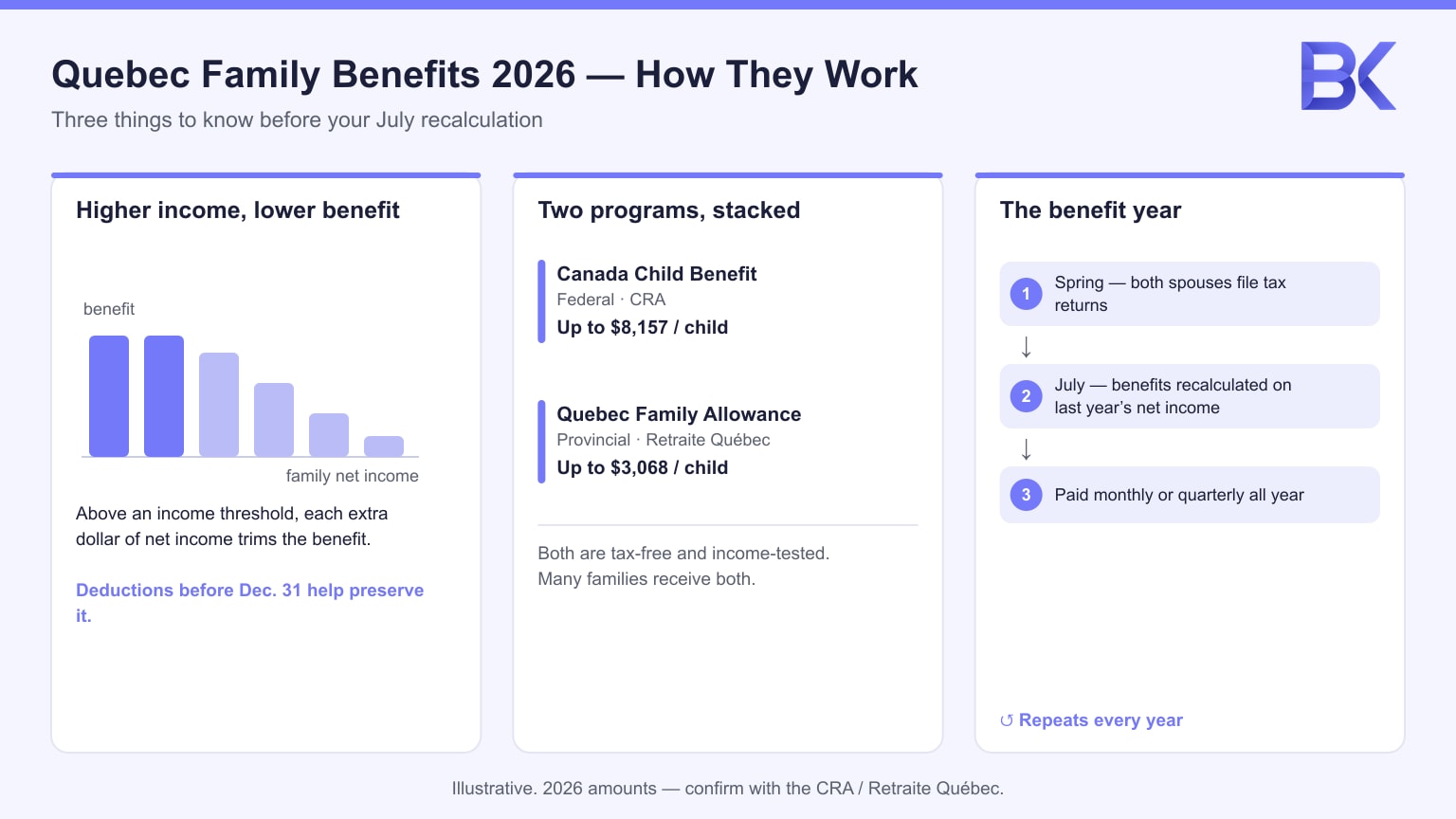
In 2026, the two core programs are the Canada Child Benefit (CCB) and the Quebec Family Allowance. Both are tax-free, income-tested benefits, and both are updated every July using tax information from the previous year. However, each program uses its own income calculation and tax-return information. Understanding how these Quebec family benefits 2026 are calculated can significantly improve your household budgeting.
Canada Child Benefit basics
The CCB is administered by the Canada Revenue Agency (CRA) for eligible families with children under 18.
The benefit is reduced gradually once adjusted family net income rises above a set threshold. The reduction rate increases with the number of children, and a further, lower rate applies above a second, higher income threshold.
Payment amounts also depend on each child’s age. A higher amount applies to children under 6 than to children aged 6 to 17. The final CCB payment for a child is made for the month in which the child turns 18.
For the July 2026 to June 2027 benefit period, the maximum CCB is $8,157 per year for each child under age 6 and $6,883 per year for each child aged 6 to 17. Payments begin to decrease when adjusted family net income for 2025 exceeds $38,237.
To receive the CCB, you must usually:
- live with the child
- be primarily responsible for the child’s care
- be a resident of Canada for tax purposes
- file annual tax returns for both spouses or partners
Quebec Family Allowance basics
The provincial program is administered by Retraite Québec and supports eligible families with dependent children under age 18 who live with them in Quebec.
Like the CCB, Quebec Family Allowance is income-tested. Retraite Québec sets maximum and minimum annual amounts per child. The payment is gradually reduced when family income exceeds a threshold based on whether the household is a two-parent or single-parent family. The number of children affects the total benefit amount, but not the income threshold itself.
For 2026, Quebec Family Allowance ranges from $1,221 to $3,068 per child. A single-parent family may also receive an additional amount ranging from $430 to $1,077, depending on family income.
Payments are generally issued quarterly (January, April, July, October), though families can request monthly payments instead.
The amount is updated every July using family income reported on line 275 of the previous year’s Quebec income tax returns. Although this follows the same July-to-June payment cycle as the CCB, the two programs do not use exactly the same income calculation.
Some families may also qualify for additional amounts related to a child’s disability or single-parent status. If a child is born in Quebec, registration for Quebec Family Allowance is automatic once the declaration of birth is submitted to the Directeur de l’état civil.
A separate application is generally required after an adoption, a birth outside Quebec, the arrival of a new Quebec resident, or certain custody changes. Newcomers, blended families, and shared-custody households should review their file information carefully.
Comparison of Quebec Family Benefits
| Benefit Program | Who Pays | Main Factors |
| Canada Child Benefit | Government of Canada | Adjusted family net income (phase-out above a threshold), number of children, ages |
| Quebec Family Allowance | Retraite Québec | Family situation, number of children, custody, income-tested (max/min per child) |
| Related Tax Support | CRA / Revenu Québec | Childcare expenses, disability credits, deductions |
Illustrative example, not your exact amount:
A family with one child under age 6 and one child aged 8 that qualifies for the maximum amounts under both programs could receive up to $15,040 per year from the CCB: $8,157 plus $6,883.
The family could also receive up to $6,136 from Quebec Family Allowance, or $3,068 per child. Combined annual support could therefore reach approximately $21,176 before any applicable supplements. Actual entitlement depends on the income measures used by each program, marital status, custody arrangements, and the determinations made by the CRA and Retraite Québec.
Quebec-Specific Filing Rules Families Often Miss
For Quebec families, the provincial side is not just an extra payment. Retraite Québec administers Family Allowance separately from the CRA, so families should make sure their provincial file matches their real situation — especially after a move, a separation, a new child, or a custody change. Shared custody and blended-family situations need particular attention.

Report changes as soon as they happen:
- marriage or separation
- custody changes
- immigration status updates
- address changes
Each of these can affect eligibility or payment amounts. If information is not updated and an overpayment results, it may later need to be repaid.
Quebec family support rules and indexed amounts change from year to year; review current figures each year rather than assuming last year’s numbers still apply.
How Tax Planning Affects Your Family Benefits
Because both the CCB and Quebec Family Allowance are income-tested, tax planning has a direct effect on how much a family keeps.
Both benefits are updated each July using income information from the previous year, but they do not use exactly the same income measure. The CCB is based on adjusted family net income reported on the federal tax returns, while Quebec Family Allowance is based on family income reported on line 275 of the Quebec income tax returns.
A salary increase, investment income, self-employment profit, or taxable withdrawal may increase the relevant income measure and reduce future benefits. Eligible deductions may lower the income used in the calculations.
This clawback effect matters most for:
- self-employed parents — a stronger business year raises income and can lower next year’s income-tested benefits, so plan for that adjustment before year-end rather than after the notice of assessment arrives
- families receiving bonuses or other one-time income
- parents taking RRSP or RRIF withdrawals
- households with rental or investment income
The goal is not to create fear, but to prevent avoidable surprises: if CRA or Retraite Québec records don’t match the real situation, or if a couple assumes benefits start automatically, the payment structure may not be correct.
Net Income and Tax Deductions: What Actually Changes Your Benefit
Net income is one of the most important numbers in family benefit planning. For benefit purposes, family income usually means both spouses’ reported income after applicable deductions — not take-home pay.

Reviewing year-to-date employment income from pay statements, self-employment earnings, available deductions, and taxable investment income before December 31 leaves more room to plan before the following July’s benefit update. Final T4 and Relevé 1 slips should then be verified when they become available after year-end.
Items that may affect the income used to calculate future benefits include:
- RRSP deductions claimed;
- union or professional dues;
- eligible federal childcare expense deductions;
- eligible employment expenses;
- deductible self-employment business expenses;
- eligible moving expenses;
- taxable capital gains.
| Planning Item | Possible Effect on Net Income | Possible Benefit Impact |
| Claimed RRSP deduction | May reduce net income and taxable income | May help preserve income-tested benefits by lowering the income used in their calculation |
| Taxable withdrawal | May increase reported income | May reduce future payments if income-tested benefits are affected |
| Federal childcare expense deduction | May reduce federal net income | May help preserve the CCB; the Quebec childcare tax credit does not generally reduce line 275 used for Quebec Family Allowance |
A common mistake is evaluating a deduction in isolation. Claiming an RRSP deduction may reduce net income and affect future family benefits, but the decision should also be weighed against emergency savings, high-interest debt, homeownership goals, retirement needs, and available contribution room.
Making an RRSP contribution does not automatically reduce income for the same year if the deduction is carried forward and claimed on a future tax return.
Planning around RRSP and FHSA
The FHSA is intended for eligible first-time home buyers and can be an important planning tool for families preparing to buy a home in Quebec.
FHSA contributions that are claimed as a deduction reduce federal and Quebec net income and may therefore affect future CCB and Quebec Family Allowance payments. As with an RRSP, an FHSA contribution may be deducted in the year it is made or carried forward and claimed in a future year.
The potential effect on family benefits should not be the only reason to claim a deduction. The decision should also reflect available contribution room, homeownership goals, current cash flow, emergency savings, and debt obligations.
A practical order to weigh, not a universal rule:
- cash flow tight → build emergency savings before contributing aggressively to an RRSP
- debt costs high → prioritize debt reduction
- home purchase near → use the FHSA
- retirement savings behind → prioritize the RRSP
Build a clearer overall financial strategy rather than chasing benefits alone.
Quebec Taxes: Filing Basics and Newcomer Support
Although the CCB and Quebec Family Allowance are not taxable, federal and Quebec income tax returns remain essential. The CRA uses information from the federal returns to calculate the CCB, while Retraite Québec uses information transmitted by Revenu Québec to calculate Quebec Family Allowance.

Both spouses must file federal and Quebec tax returns on time every year, even when one spouse has little or no income — late filing can delay processing or affect how benefits are calculated for the household.
Families should also coordinate:
- childcare receipts
- tuition and dependent-related claims
- support payments
- self-employment records
Keep documents organized, and newly separated parents should get tailored advice, since tax filing, credits, and benefit allocation can change significantly after separation.
New residents may be able to apply for both programs before filing their first Canadian and Quebec income tax returns, provided they meet the applicable residency, immigration-status, family, and care requirements.
Separate applications and income information may be required for the CRA and Retraite Québec. Afterward, both spouses or partners must generally file their annual federal and Quebec income tax returns to continue receiving correctly calculated payments.
BK Financial supports clients in English, French, Russian, and Hebrew, helping newcomer families navigate the separate CRA and Retraite Québec processes.
Yearly Financial Planning Checklist for Quebec Families
Family benefits should be part of a broader financial planning approach. Because benefits change as income changes, review the full picture at least once a year: expected household income, taxable and non-taxable cash flow, benefit estimates, RESP savings, insurance, and debt repayment priorities.
This matters most for self-employed parents and growing families.
| Family Situation | Main Risk | Planning Focus |
| New parents | Missing or incomplete registration | Confirm registration or apply when required, and file taxes on time |
| Self-employed family | Income volatility | Estimate taxes and benefits early |
| Shared custody | Payment allocation issues | Update records accurately |
2 Real Cases: Family Benefit Planning in Action
Case 1: Newcomer family in Montreal
A newcomer couple with two children moved to Quebec and assumed that all family benefits would begin automatically. Boris Kolodner reviewed their residency status, eligibility requirements, and the separate application procedures for the federal and provincial programs.
After submitting the required applications, income information, and supporting documents, the family began receiving the payments for which it qualified. The parents also received clearer guidance on childcare receipts, annual tax filing requirements, and future tax planning.
Case 2: Self-employed parent with fluctuating income
A self-employed client saw family payments drop after a stronger business year. Boris reviewed net income, deductible expenses, and RRSP contribution options, helping the client understand the link between annual income and next year’s benefits and giving a clearer budgeting structure.
FAQ
1. Who qualifies for the Canada Child Benefit in Quebec?
Generally, the person primarily responsible for the care of a child under 18 may qualify if they live with the child, are a resident of Canada for tax purposes, meet the applicable citizenship or immigration-status requirements, and file the required annual tax returns.
2. Is Quebec Family Allowance the same as the CCB?
No. The CCB is federal, while Quebec Family Allowance is provincial. Many families receive both.
3. Do family benefits count as taxable income?
No. The CCB and Quebec Family Allowance are not taxable and do not have to be included in taxable income. Tax returns are still required because reported family income is used to calculate future payments.
4. Can RRSP contributions affect child benefits?
Yes. RRSP deductions can lower adjusted family net income in some cases, but the effect depends on income, contribution room, and your overall tax situation.
5. What happens if my marital status changes?
Update the CRA and Retraite Québec as soon as possible.
Disclaimer: This article is for general informational purposes only and does not constitute personalized financial, tax, legal, mortgage, or investment advice. Program rules, thresholds, and benefit amounts change periodically; confirm current figures with the CRA, Retraite Québec, or Revenu Québec, or speak with a licensed advisor before acting on this information.
Ready to review your family benefits and tax strategy in Quebec?
If your family benefits changed after a raise, a business income increase, a separation, or a tax filing issue, a practical review can help.
BK Financial works with Quebec families, newcomers, professionals, and self-employed clients who want clearer answers on Quebec taxes, tax deductions, RRSP planning, FHSA decisions, and monthly net income strategy. Learn more about our tax planning services.
Boris Kolodner, MBA, Financial Planner & Financial Security Advisor, can help.
Book a free consultation:
Phone: +1-514-834-5558
Email: contact@bkfinancialservices.ca
Site: https://bkfinancialservices.ca
Available in English, French, Russian, and Hebrew.