
Retirement planning begins long before the first pension payment arrives. For Quebec residents, one of the most important early decisions is how to divide savings among an RRSP, a TFSA, an employer pension plan, debt repayment, and other financial priorities.
The strongest strategy depends on more than annual contribution limits. Current and future tax rates, access to employer matching, expected pension income, liquidity needs, and the possible effect of taxable withdrawals on future benefits should all be considered.
This guide explains how RRSP and TFSA strategies work in Quebec in 2026, when each account may deserve priority, and how employees, professionals, and self-employed workers can build a more coordinated retirement savings plan.
How RRSPs Fit a Quebec Retirement Plan
The Registered Retirement Savings Plan (RRSP) is a core retirement-planning tool in Quebec. Eligible contributions may be claimed as a deduction, subject to the taxpayer’s RRSP deduction limit. The deduction does not have to be claimed in the year the contribution is made and may be carried forward to a future year.
Investment income earned inside an RRSP is generally not taxed while the funds remain in the plan. Withdrawals are normally included in taxable income, except for qualifying withdrawals under programs such as the Home Buyers’ Plan or Lifelong Learning Plan.
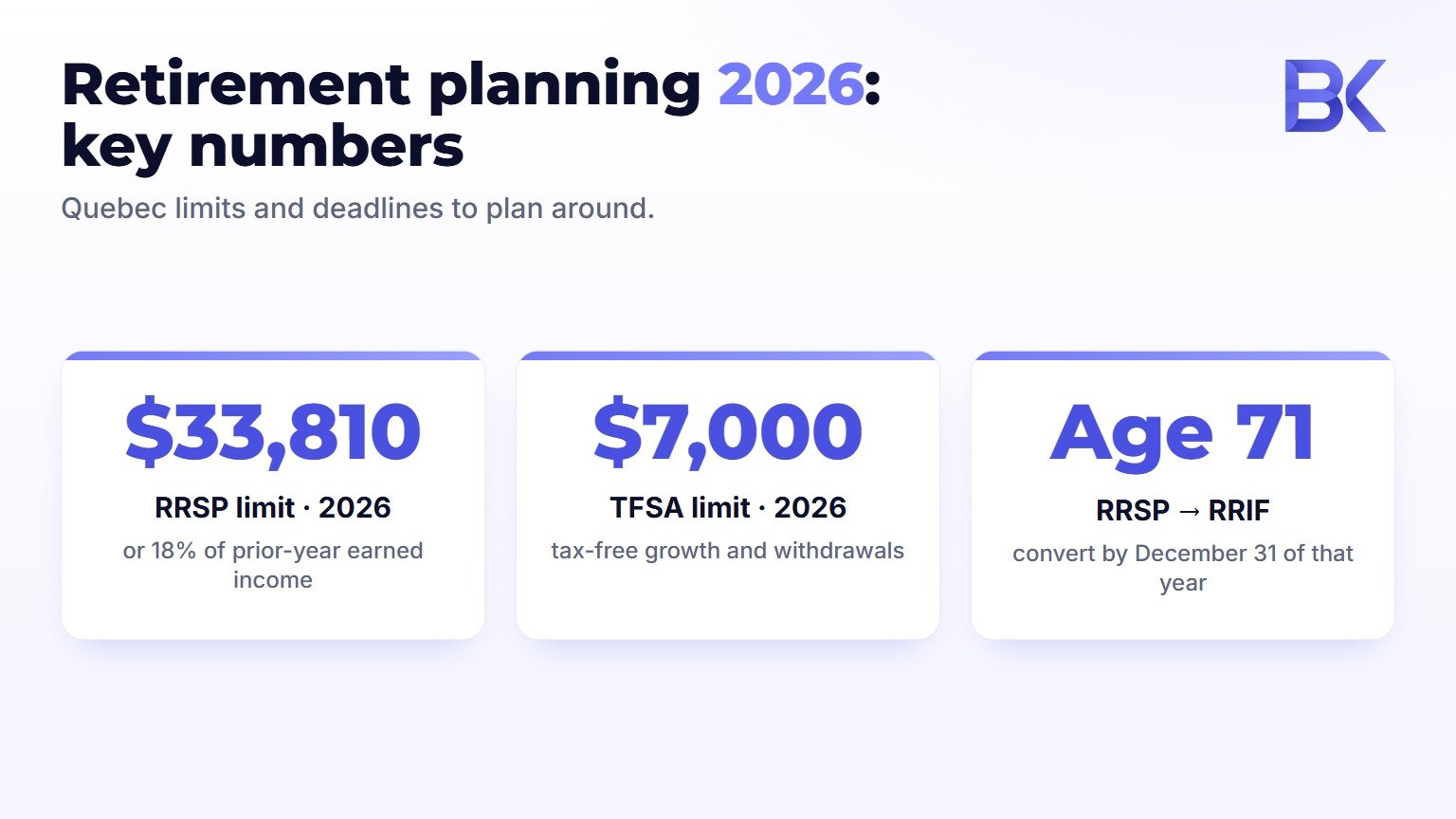
For 2026, your RRSP contribution room is generally 18% of your prior year’s earned income, up to an annual maximum of $33,810, plus any unused room carried forward from previous years. Your exact RRSP deduction limit also takes into account any pension adjustment (PA) from an employer plan and is shown on your CRA Notice of Assessment.
This strategy is generally most effective when your current tax bracket is higher than the bracket you expect in retirement. In that case, RRSP contributions can produce meaningful tax savings when the deduction rate is higher than the effective tax rate on future withdrawals.
RRSP Deduction Timing
Contributions generally deliver a bigger benefit in high-income years. A promotion or a salary increase, for example, can make an RRSP contribution particularly worthwhile for reducing that year’s tax bill.
Contributions made during the first 60 days of the following calendar year may be reported for the preceding tax year, subject to the applicable rules and available contribution room. However, an RRSP deduction is not automatically lost if it is not claimed in a high-income year. Unused contribution room and previously reported but unclaimed contributions can generally be carried forward.
The decision to claim the deduction immediately or save it for a later year should be based on current and expected marginal tax rates, available cash flow, contribution room, and the possible effect on income-tested benefits and credits.
Deferring an RRSP deduction can make sense when a significantly higher marginal tax rate is expected soon, but waiting is not automatically better. The potential additional tax savings should be weighed against the value of receiving and investing the tax savings earlier.
RRSP Withdrawal Planning
RRSP withdrawals are fully taxable as income. For that reason, it helps to coordinate them with TFSA use, your QPP start date, and any employer pension income, so no single year’s tax bill spikes unnecessarily.
Keep in mind that tax withheld by the financial institution when you make an RRSP withdrawal is only a prepayment of tax. Your final tax liability depends on your total taxable income, deductions and credits for the year.
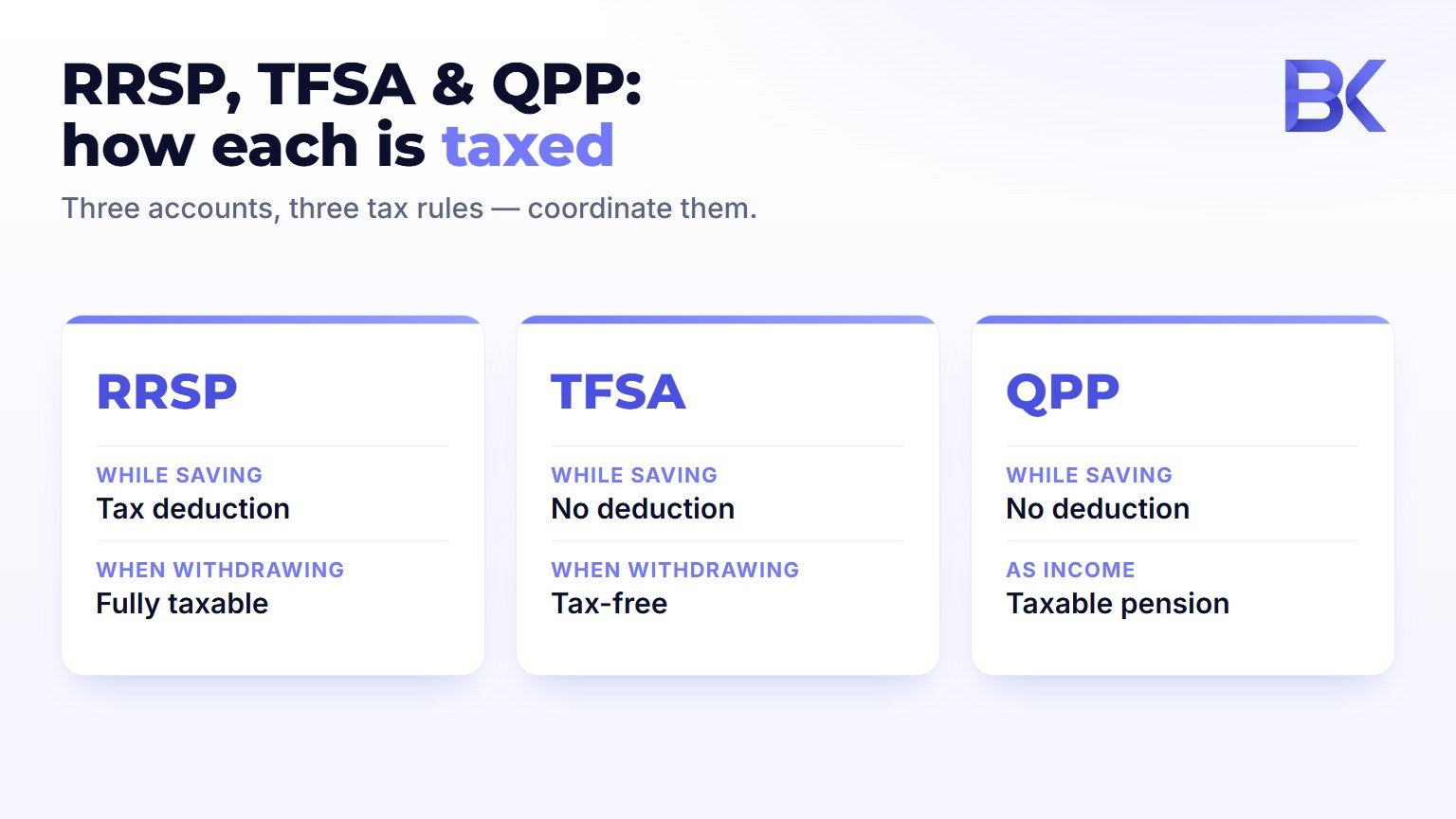
| Savings / Pension Source | Tax Treatment While Building Retirement Income | Tax Treatment When Receiving Funds |
| RRSP | Eligible contributions may generate a tax deduction; investment growth is tax-deferred | Withdrawals are generally taxable income |
| TFSA | No deduction for contributions; investment growth is generally tax-free | Withdrawals are generally tax-free |
| QPP | Mandatory contributions apply to eligible employment or self-employment income; tax credits and deductions vary by contribution component | QPP retirement benefits are taxable income |
Where a TFSA Adds Flexibility
A TFSA adds essential flexibility to a retirement plan. Unlike an RRSP, TFSA contributions are not tax-deductible, but withdrawals are tax-free and do not count as taxable income. The annual TFSA limit is $7,000 for 2026.
That distinction matters in Quebec, where taxable income affects not only income tax but also eligibility for certain benefits and credits. A larger taxable income can quietly shrink your net retirement cash flow.

TFSA for Income Smoothing
A TFSA can help fund early retirement or cover large expenses without increasing taxable income. However, using the TFSA first is not always the most tax-efficient strategy.
In lower-income years before QPP, OAS, or a workplace pension begins, planned RRSP withdrawals may help reduce future registered balances and the taxable withdrawals required later. The appropriate sequence depends on projected tax brackets, income-tested benefits, liquidity needs, and the amount of guaranteed income expected later.
TFSA for Retirees
Retirees often use a TFSA for larger expenses such as travel, home renovations, or medical costs. Because withdrawals are tax-free, this keeps reported income lower than funding the same expenses from an RRSP or RRIF.
For most households, combining both accounts often works well, balancing contributions between an RRSP and a TFSA based on current income, expected retirement income, and where tax rates are likely headed. Our guide to smart TFSA strategies in Quebec looks more closely at contribution room and common pitfalls.
A Special TFSA Note for Newcomers to Quebec
Newcomers should not assume they have accumulated TFSA contribution room since the account was introduced in 2009. If you became a Canadian tax resident later, TFSA room generally starts accumulating only for the years in which you were a Canadian resident and eligible for the account. RRSP room works differently and is based largely on prior-year earned income and the deduction limit calculated by the CRA. Always verify both limits before contributing.
RRSP or TFSA First in Quebec?
There is no universal rule that says every Quebec resident should contribute to an RRSP before using a TFSA, or vice versa. The stronger choice depends on the tax rate at which the RRSP deduction is claimed, the expected tax rate on future withdrawals, access to employer benefits, liquidity needs, and the possible effect of taxable income on retirement benefits.
A Practical RRSP-versus-TFSA Decision Framework
| Situation | Account That Often Deserves Priority | Why |
| Your current marginal tax rate is significantly higher than the rate expected in retirement | RRSP | The deduction may be claimed at a higher rate than the tax eventually paid on withdrawals |
| Your current income is relatively low | TFSA | Saving the RRSP deduction for a future higher-income year may produce more value |
| You may qualify for the Guaranteed Income Supplement (GIS) in retirement | TFSA | TFSA withdrawals do not increase taxable income or reduce federal income-tested benefits |
| You expect a large workplace pension or substantial future RRIF withdrawals | TFSA or a balanced approach | Additional taxable registered withdrawals could increase future taxes or OAS recovery tax |
| You need flexible access to savings before retirement | TFSA | Withdrawals are tax-free, and the withdrawn amount is restored to contribution room in the following calendar year |
| Your employer offers matching contributions | Employer plan first | The employer contribution may provide an immediate benefit that an individual account does not |
| You have room in both accounts | Coordinated use of both | The RRSP can provide deductions in higher-income years, while the TFSA creates a pool of tax-free retirement capital |
A fair RRSP-versus-TFSA comparison should use the same after-tax out-of-pocket cost. Because an RRSP contribution can generate tax savings, those savings should be reinvested or reflected in a larger RRSP contribution when comparing outcomes. If the resulting tax refund is simply spent, the RRSP strategy loses part of the advantage assumed in many long-term comparisons.
The annual limits alone do not determine the right priority. For 2026, the TFSA annual limit is $7,000. The RRSP annual dollar limit is $33,810, but each person’s actual deduction limit depends on prior-year earned income, unused room, pension adjustments, and the amount shown on the CRA Notice of Assessment.
A useful planning approach is to estimate taxable income over several stages: the remaining working years, early retirement before public pensions begin, the period after QPP and OAS start, and the years when mandatory RRIF withdrawals apply. The best account today is the one that supports the strongest after-tax result across all of those stages, not simply the largest current refund.
An RRSP must mature by December 31 of the year you turn 71. One common option is to convert it to a RRIF, after which minimum withdrawals begin in the following calendar year. This makes the size of your RRSP balance at age 71 an important part of long-term tax planning.
Retirement Planning for Self-Employed Quebecers
Self-employed Quebecers often have no employer-sponsored pension and must create their own retirement-income structure. Retirement planning should therefore be treated as a recurring business obligation rather than something funded only when excess cash happens to be available. Our guide to self-employed finances in Quebec covers the surrounding tax and cash-flow questions in more detail.

Sole Proprietors and Partners
Net self-employment income generally creates new RRSP contribution room and is subject to QPP contributions. Because a self-employed person pays both the worker and employer portions, the cost is higher than for an employee.
In 2026:
- QPP contributions apply above the $3,500 basic exemption;
- the maximum pensionable earnings are $74,600;
- the additional maximum pensionable earnings are $85,000;
- maximum QPP contributions for a self-employed person are approximately $9,791 when both earnings ceilings are reached.
Special rule after age 65: If you are 65 or older and already receiving a QPP or CPP retirement pension, you may be able to elect to stop contributing to QPP while you continue working. In all cases, QPP contributions stop in the year following your 72nd birthday. This choice should be evaluated as part of your overall retirement-income strategy.
These contributions build QPP entitlement, but they also affect current business cash flow. Tax instalments, QPP contributions, retirement savings, and business operating reserves should be forecast together.
Incorporated Owners: Salary versus Dividends
For an incorporated owner, the choice between salary and dividends can affect retirement planning.
Salary generally:
- creates RRSP contribution room;
- is subject to QPP contributions;
- provides reported employment income;
- creates a deductible compensation expense for the corporation, subject to the applicable rules.
Dividends generally:
- do not create new RRSP contribution room;
- are not subject to QPP contributions;
- may reduce payroll-related cash outflows in the short term;
- do not create additional QPP pensionable earnings.
The decision should not be made solely to minimize one year’s personal tax. It should account for corporate tax, personal tax, QPP participation, RRSP room, cash requirements, insurance needs, and the owner’s long-term retirement target.
A Practical Structure for Self-Employed Retirement Saving
A self-employed retirement plan can include:
- a separate business emergency reserve;
- automated monthly or quarterly retirement contributions;
- an annual estimate of business income and tax instalments;
- coordinated RRSP and TFSA contributions;
- a review of salary and dividend compensation for incorporated owners;
- QPP start-date projections;
- a retirement plan that does not depend entirely on selling the business.
The value of the business can be part of the retirement plan, but it should not be the only retirement asset. A future sale price, sale date, and tax treatment are uncertain. Building personal registered savings and reliable pension income reduces dependence on a single business exit.
Illustrative Scenario: A Self-Employed Couple Without Workplace Pensions
The following simplified example is provided for educational purposes only. It does not describe actual clients, and all figures are hypothetical. Actual results depend on investment returns, inflation, tax rules, pension entitlements, fees, life expectancy, and personal circumstances.
A self-employed Quebec couple, aged 57 and 55, earns variable income from an incorporated service business. Their combined annual compensation generally ranges from $145,000 to $190,000.
They have:
- modest RRSP balances;
- partially funded TFSAs;
- no employer pension;
- cash and investments retained in the corporation;
- an expectation that the business may eventually be sold.
Their original retirement plan relied heavily on the future value of the company. They had not established how much personal retirement capital would be needed if the business sold later than expected or for less than anticipated.
The planning process included:
- establishing a sustainable personal spending target;
- separating the business operating reserve from long-term retirement capital;
- reviewing the balance between salary and dividends;
- estimating how compensation choices affected RRSP room and QPP participation;
- creating automatic RRSP and TFSA contributions during the year;
- comparing different QPP start dates for each spouse;
- testing retirement scenarios with and without proceeds from a future business sale.
The revised plan did not assume that one account or one future transaction would fund the entire retirement. Instead, it created several potential income sources: QPP, personal RRSPs, TFSAs, corporate assets, and possible business-sale proceeds.
Under the assumptions used, the couple gained a clearer savings target, better visibility over future taxable income, and less dependence on achieving a specific sale price for the business.
Putting Your Retirement Savings Plan Together
A retirement savings plan should reflect more than the products available. It should also account for emergency reserves, high-interest debt, mortgage and housing goals, insurance, employer benefits, business cash flow, current and future marginal tax rates, and the tax treatment of each account.
There is no single order that fits everyone. As a general guide that depends on your situation, a practical sequence may include:
- building an adequate emergency fund;
- addressing high-interest debt;
- obtaining the full value of any employer matching contributions;
- using RRSP deductions strategically during higher-income years;
- building TFSA savings for flexibility and tax-free withdrawals;
- coordinating debt repayment and housing goals with long-term investing;
- reviewing the strategy annually as income and family circumstances change.
For self-employed individuals and business owners, retirement contributions should be incorporated into regular cash-flow planning rather than funded only when surplus cash happens to remain at year-end. Because expected retirement income shapes today’s choices, it helps to see how your savings, investments, tax planning, insurance, and mortgage strategy fit into one plan — including how we approach investment planning for Quebec clients.
FAQ
1. Should I contribute to an RRSP or TFSA first in Quebec?
The answer depends on your current and expected future tax rates, liquidity needs, employer benefits, and projected retirement income. Higher-income earners may receive greater immediate value from an RRSP deduction, while a TFSA provides flexible, tax-free withdrawals.
2. Can I contribute to both an RRSP and a TFSA?
Yes. Many households use both accounts. The RRSP can provide deductions during higher-income years, while the TFSA creates a source of retirement capital that can be withdrawn without increasing taxable income.
3. What is the RRSP contribution limit for 2026?
The annual RRSP dollar limit for 2026 is $33,810. Your personal limit may be lower or higher after unused room and pension adjustments are considered. The applicable amount appears on your CRA Notice of Assessment.
4. What is the TFSA contribution limit for 2026?
The annual TFSA limit for 2026 is $7,000, plus any unused contribution room carried forward from previous years.
5. How should self-employed Quebecers save for retirement?
A self-employed retirement strategy may combine QPP participation, RRSP and TFSA contributions, corporate or personal investments, business reserves, and a compensation strategy involving salary and dividends.
6. Do TFSA withdrawals affect OAS or GIS?
No. TFSA income and withdrawals are generally not included in taxable income and do not affect federal income-tested benefits such as OAS or GIS.
7. When do I have to convert my RRSP to a RRIF?
Your RRSP must mature by December 31 of the year you turn 71. One option is to convert it to a RRIF, with minimum withdrawals beginning the following year.
8. Do dividends create RRSP contribution room for a business owner?
Generally, no. Dividends do not create earned income for RRSP purposes. Salary generally does, which is one reason incorporated owners should evaluate salary and dividend decisions as part of long-term retirement planning.
9. Do newcomers to Canada receive TFSA contribution room from previous years?
No. TFSA room generally accumulates only for years in which you were a Canadian resident and eligible for the account. Newcomers should confirm their actual room before contributing.
From Saving to Spending: What Comes Next
Building retirement savings is only the first stage. The next step is deciding when to start QPP and OAS and how to draw income from RRSPs, RRIFs, TFSAs, and employer pensions without paying more tax than necessary. Read our guide to retirement income planning in Quebec.
Disclaimer: This article is provided for general informational and educational purposes only and does not constitute individualized financial, tax, investment, or legal advice. It is based on rules and amounts in effect on July 27, 2026, which may change as programs, contribution limits, and tax legislation are updated. Any strategy should be evaluated in light of your personal financial situation, objectives, and tolerance for risk. Consult a qualified financial professional before making decisions.
Build a More Coordinated Retirement Savings Plan
Review how your RRSP, TFSA, employer benefits, business income, debt, and long-term retirement goals work together.
Boris Kolodner, MBA, Financial Planner and Licensed Financial Security Advisor, helps Quebec residents develop retirement savings strategies adapted to their income, family situation, and future objectives.
Book a free consultation:
Phone: +1-514-834-5558
Email: contact@bkfinancialservices.ca
Website: bkfinancialservices.ca
Consultations are available in English, French, Russian, and Hebrew.