
Many Quebec investors only see the full impact of investment income at tax time, when the after-tax result turns out to be lower than expected. This often happens with retirees holding GICs in non-registered accounts, professionals earning more taxable interest than planned, or families who did not realize that additional investment income could affect net income and certain benefits.
Two portfolios can earn the same return and still produce different after-tax results in Quebec, depending on account type, income mix, and timing.
That is why investment income in Quebec should be reviewed as more than just yield alone. A practical approach looks at your marginal tax rate, account type, cash flow needs, and future goals so you can better understand how much of your return you may actually keep.
In this practical 2026 guide, we break down Quebec taxes, explain how interest, dividends, and capital gains are taxed, and outline how tax planning, RRSPs, TFSAs, FHSAs, and timing strategies may support better net income planning for individuals, families, and business owners.

How Investment Income Is Taxed in Quebec
Quebec residents pay tax at both the federal and provincial level — administered by the Canada Revenue Agency (CRA) and Revenu Québec — so investment income should always be evaluated on a combined basis. For higher-income investors, the tax cost on fully taxable income can be significant, which makes tax-efficient planning important. Tax rates can change, and the exact impact depends on your income, deductions, and the rules in effect for the relevant year.
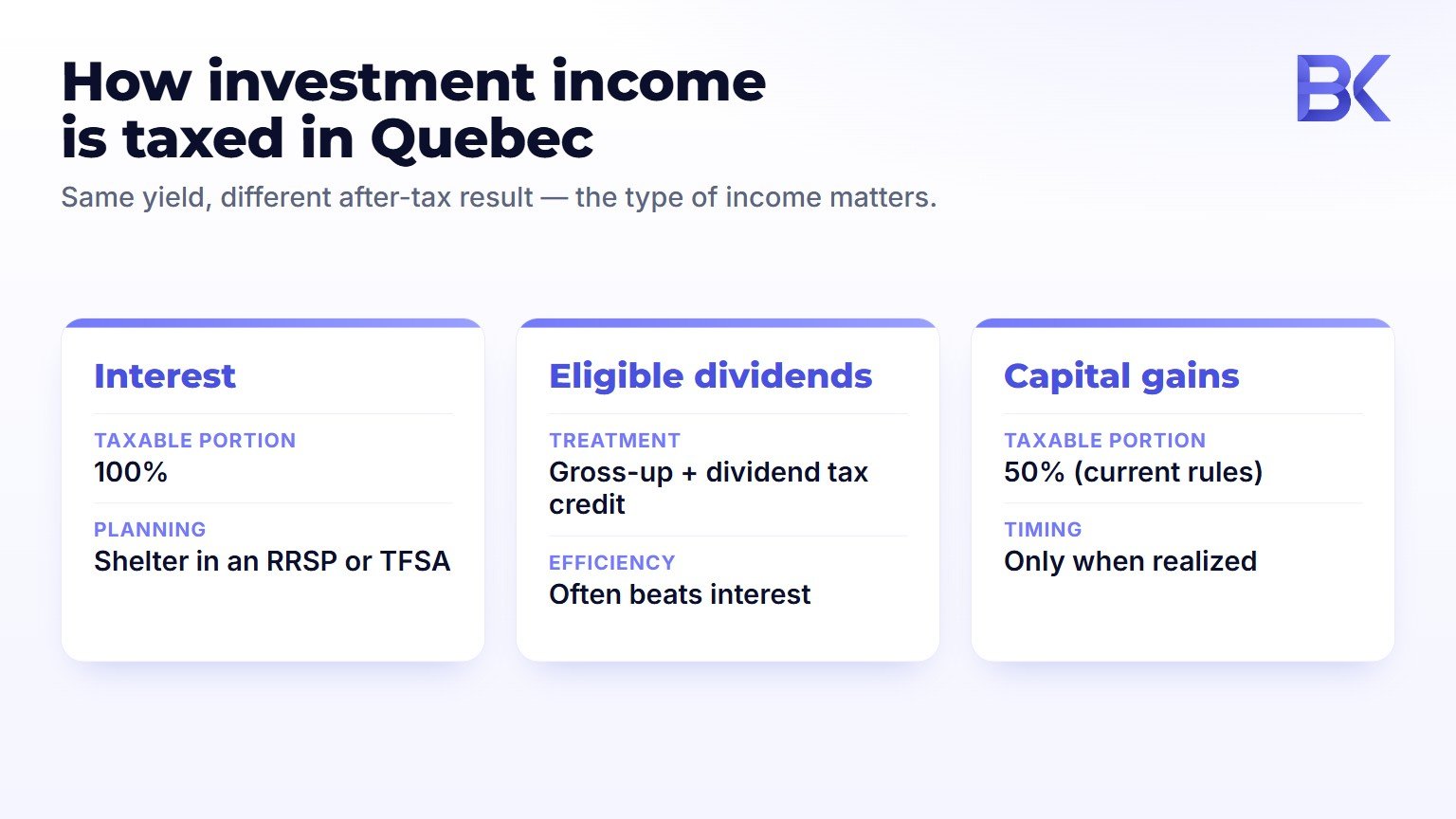
Interest income is generally the least tax-efficient type of investment income because 100% of it is included in income. Eligible dividends and capital gains often receive better treatment, but the real benefit depends on your income bracket and the source of the investment return.
Interest must generally be reported even if no T5 slip is issued because the amount is below $50. Interest from certain multi-year investment contracts may also have to be reported annually as it accrues, rather than only when the investment matures. For joint accounts, each owner generally reports the portion of interest corresponding to the funds they contributed.
Marginal tax rates
Your marginal rate affects every additional dollar of taxable investment income. If you are in a higher bracket, shifting interest-producing assets into registered accounts can make a meaningful difference. In 2026, Quebec’s top combined marginal tax rate on ordinary income is approximately 53.31%. For an investor already in the highest tax bracket, the effective marginal rate on a capital gain is approximately 26.65%, because only 50% of the gain is generally included in taxable income under current rules.
After-tax returns
The return you keep after tax matters more than the headline yield. A 5% GIC and a 5% dividend-paying investment do not produce the same net income in Quebec after tax.
| Investment income type | General tax treatment in Quebec | Basic planning note |
| Interest | 100% taxable | Often sheltered in registered accounts |
| Eligible dividends | Gross-up and dividend tax credit | Often more efficient than interest |
| Capital gains | Under current rules, 50% of a realized gain is taxable | Tax triggered only when the gain is realized |
How Dividends Are Taxed in Quebec
Dividend income can be attractive for Quebec investors because it is not taxed the same way as interest. Canadian dividends are grossed up for tax reporting, then partially offset through federal and Quebec dividend tax credits.
Eligible dividends from Canadian corporations may be taxed more favourably than bond interest, depending on your tax situation and the related calculations. However, dividends still increase taxable income and can affect benefits, credits, and clawbacks.
Eligible dividends
Eligible dividends are taxable dividends paid by Canadian corporations and specifically designated by the corporation as eligible under the tax rules. They often offer the most favourable dividend tax treatment available to individual investors.
Non-eligible dividends
Non-eligible dividends typically come from smaller private corporations. They still benefit from tax credits, but not to the same extent as eligible dividends.
A common mistake is focusing only on the cash received instead of the total tax impact. Investors should review whether dividend income may reduce income-tested benefits or increase Old Age Security clawback risk in retirement.
Foreign dividends
Foreign dividends do not qualify for the Canadian dividend tax credit and are generally reported as foreign investment income in Canadian dollars. If foreign tax was withheld, you may be eligible for a foreign tax credit, depending on the country, the applicable tax treaty and your personal tax situation.
Capital Gains and Tax Planning in Quebec
Capital gains can be one of the more tax-efficient forms of non-registered investment income, depending on the situation. Under current rules, 50% of a capital gain is generally included in taxable income. The gain is usually reported when the investment is sold or is otherwise considered disposed of under the tax rules. Certain mutual funds may also allocate taxable capital gains even when the investor has not sold their units. These inclusion rules are set by federal law and can change with future budgets, so it is worth reviewing them periodically.
That deferral feature matters because it gives investors more control over when taxable income appears. In the right circumstances, that can support better coordination around retirement, business income, or a year with lower earnings.
Realized gains
A capital gain generally arises when you sell or are considered to have sold an investment for more than its adjusted cost base, including eligible acquisition costs, plus the expenses incurred to sell it. Accurate records of purchases, reinvested distributions, commissions and other cost-base adjustments are essential, particularly when you acquire the same security at different times.
Capital losses
Capital losses generally reduce capital gains, not employment income, interest income or other ordinary income. A net capital loss may normally be carried back to the three previous taxation years or carried forward indefinitely to offset taxable capital gains in future years. The application of losses should be reviewed carefully because the special rules apply to certain property and transactions.
| Capital gains planning issue | Why it matters | Practical action |
| Timing of sale | Controls tax year | Sell in lower-income years when possible |
| Adjusted cost base | Affects reported gain | Keep detailed trade records |
| Loss harvesting | May offset gains | Review non-registered portfolio before year-end |
Watch the superficial loss rule: Tax-loss harvesting must be planned carefully. A loss may be denied if you or an affiliated person buys the same or an identical investment during the period beginning 30 days before and ending 30 days after the sale and still owns it at the end of that period.
Common Tax Mistakes Quebec Investors Make with Non-Registered Accounts
A lot of tax drag does not come from bad investments. It often comes from avoidable account and timing mistakes.
Holding too much GIC or bond income in taxable accounts
Many Quebec investors keep GICs, bonds, or high-interest savings in non-registered accounts without reviewing whether RRSP or TFSA placement would be more efficient. Because interest is generally fully taxable, this can create unnecessary pressure on net income.
Ignoring adjusted cost base tracking
If you buy the same investment several times, adjusted cost base tracking becomes important. Without good records, it is easier to misreport gains or losses when you sell.
Selling late in the year without estimating tax impact
A year-end sale can solve one problem and create another. If you realize gains late in the year without estimating the tax effect, you may increase taxable income more than expected.
Focusing on yield instead of after-tax net income
A higher yield does not always mean a better result. What matters is how much you keep after Quebec taxes, not just the income shown on the statement.
Not checking the effect on benefits and income-tested amounts
Investment income can affect Old Age Security, family benefits, and other income-tested amounts depending on your situation. This is especially important for retirees, families, and self-employed individuals managing variable income.

Deducting Investment Expenses in Quebec
Certain carrying charges, investment counselling fees and interest paid on money borrowed to earn income from non-registered investments may be deductible, subject to the applicable federal and Quebec rules. However, management fees and borrowing costs connected to an RRSP, TFSA or FHSA are generally not deductible. Investment commissions are usually included in the adjusted cost base or treated as selling expenses rather than deducted as an annual carrying charge.
RRSP for Investment Income Tax Efficiency in Quebec
One of the simplest ways to improve investment tax efficiency in Quebec is through account placement. RRSPs allow investments to grow tax-deferred, which can be especially valuable for interest-producing assets such as GICs, bonds, and high-interest savings products.
An RRSP contribution can potentially create a deduction that reduces current taxable income, depending on your contribution room and tax situation. For professionals, self-employed individuals, and families in higher tax brackets, this can support both immediate tax savings and long-term retirement planning.
Asset location
Many investors benefit from holding tax-inefficient assets inside an RRSP. This strategy can reduce annual tax drag while preserving non-registered accounts for more tax-efficient holdings.
Interest-producing investments are often considered for registered accounts because interest is fully taxable in a non-registered account. However, asset location should not be based on tax treatment alone. Expected returns, contribution room, liquidity needs, foreign withholding taxes, portfolio risk and the future withdrawal strategy should all be considered before deciding where each investment belongs.
Withdrawal planning
RRSP withdrawals are fully taxable, so the account should be reviewed as part of a broader retirement income plan. The goal is not just to save tax today, but to manage lifetime taxation.
Tax and Financial Planning for Investment Income in Quebec
Tax planning for investment income is most effective when it is connected to a full financial plan. That includes your employment income, mortgage strategy, business earnings, family needs, and retirement timeline.
For Quebec residents, this is especially relevant because combined federal and provincial tax rates can be high, and multiple credits, deductions, and government benefits — administered through both the CRA and Revenu Québec — interact with investment income. A planning decision that looks good in isolation may be less effective once the full picture is considered.
Net income management
Higher reported income can affect the federal GST/HST credit, the Quebec solidarity tax credit, Quebec family benefits, Old Age Security, and other income-tested amounts. Coordinating investment income with deductions can help reduce these side effects.
A prior-year net capital loss may reduce taxable income without reducing the net income used to calculate certain benefits and credits. As a result, applying an old capital loss may lower tax payable but may not reverse an OAS recovery tax or restore another income-tested benefit.
Registered account mix
Using RRSPs, TFSAs, and in some cases FHSAs strategically can offer more flexibility through features such as tax deductions, tax-free withdrawals, or different withdrawal timing options. For many Quebec investors, a common priority order is: build emergency savings first, use the FHSA if you are a first-time home buyer, contribute to RRSPs in high-income years, use TFSAs for flexible, tax-free growth, and place interest-producing assets in registered accounts while holding more tax-efficient assets in non-registered accounts.
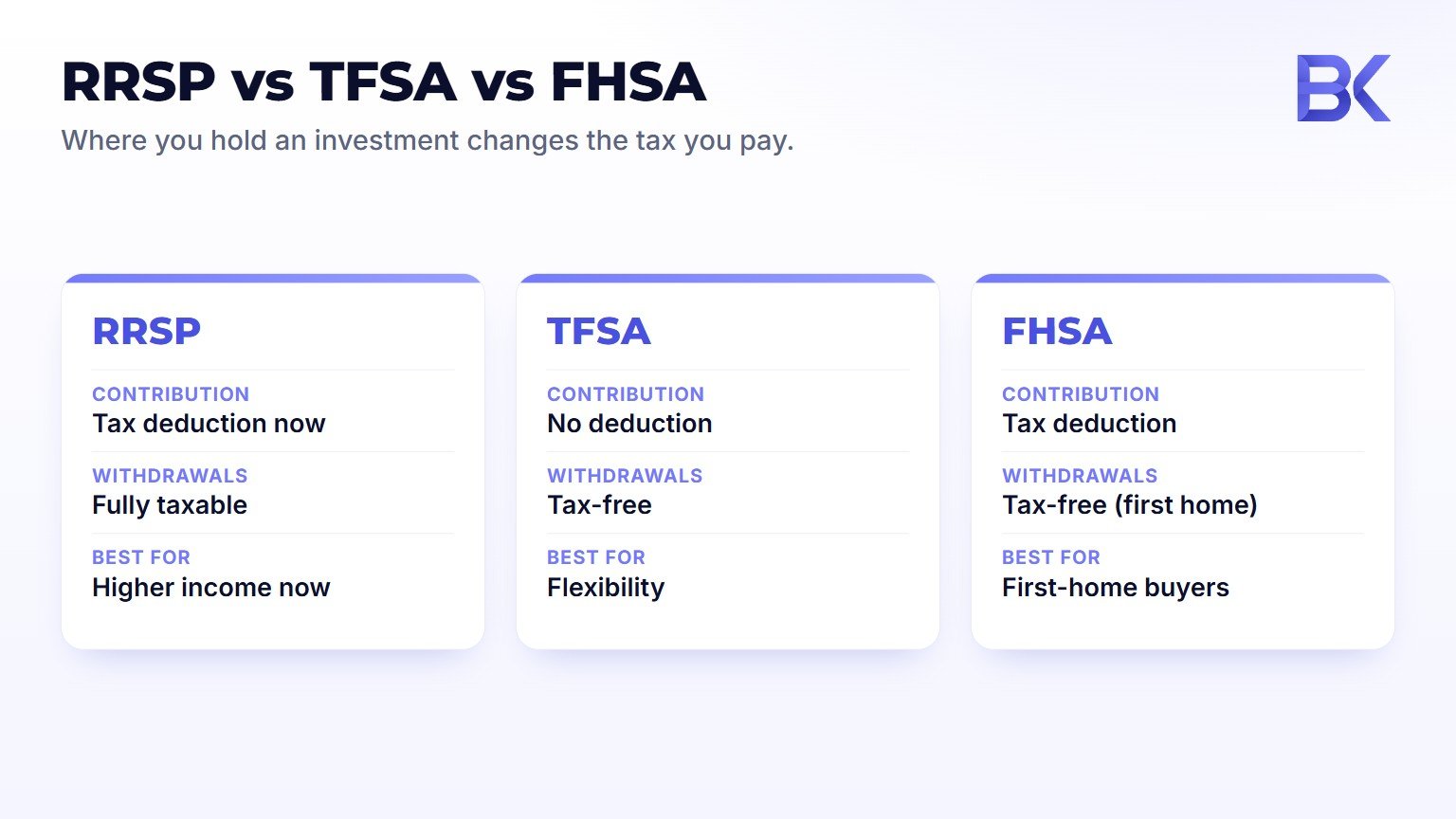
RRSP withdrawals are generally taxable and may affect income-tested benefits. TFSA income and withdrawals are generally tax-free and do not affect federal income-tested benefits or credits such as OAS, GIS and the CCB. FHSA withdrawals are tax-free only when the qualifying withdrawal conditions are met.
RRSP vs TFSA vs FHSA for Tax-Efficient Investing in Quebec
For many Quebec residents, the biggest planning question is not only what to invest in, but also where to hold it.
When RRSP may make more sense
An RRSP may be more useful for higher-income Quebec residents who want current tax deductions and are building a long-term retirement planning strategy. It can be especially relevant when your current tax rate is higher than what you expect in retirement, although that should be reviewed carefully.
When TFSA may be better
A TFSA may be a better fit when flexibility matters more. Withdrawals are generally tax-free, which can help with emergency access, medium-term goals, or retirement income planning where you want to avoid increasing taxable income.
How FHSA fits
For eligible first-home buyers, an FHSA can be a useful tool because it combines a tax deduction on contributions with tax-free qualifying withdrawals for a home purchase. The annual contribution limit is $8,000, with a lifetime maximum of $40,000. It can matter for both investment growth and tax planning, especially for younger professionals and newcomers planning a first property purchase in Quebec. Eligibility and withdrawal rules should be confirmed for the relevant year.
Year-End Tax Planning Checklist for Quebec Investors
Before December 31, review:
- your non-registered portfolio for potential loss harvesting opportunities;
- any planned sales of investments and their impact on taxable income;
- your RRSP and TFSA contribution room for the year;
- whether additional investment income could affect benefits or credits;
- your adjusted cost base records for frequently traded securities.
A short review before year-end can help avoid unexpected tax bills and improve after-tax results.
The real decision: current income, future tax bracket, and timing
The best account choice depends on your current income, expected future tax bracket, and when you plan to withdraw the money. In some cases, the right answer is not RRSP versus TFSA versus FHSA. It is using the right mix of all three.
Be careful with one-size-fits-all advice
The most tax-efficient account structure is situation-specific and should be reviewed with a professional. A family in Laval, a self-employed consultant in Montreal, and a newcomer saving for a first home may all have different priorities.
2 Real Cases: Investment-Income Tax Planning in Action
Case 1: Retiree with high interest income
A Quebec retiree came to Boris with most savings in GICs held in a non-registered account. The income was fully taxable and was increasing pressure on net income and benefit planning. Working with Boris, the client reviewed registered contribution room and gradually repositioned part of the fixed-income allocation as investments matured. Any sale or in-kind contribution from the non-registered account was assessed for possible capital-gain consequences before the assets were placed in registered accounts. In this case, the changes helped improve after-tax cash flow visibility and created more flexibility for ongoing planning.
Case 2: Incorporated professional drawing dividends
A small business owner in Quebec needed help coordinating corporate dividends, personal investment income, and retirement planning. Working with Boris, we reviewed the mix of salary, dividends, RRSP room, and non-registered investing strategy. This structured review helped reduce unnecessary tax drag and gave the client a clearer framework for retirement savings and cash flow management. Corporate investment income follows a different tax framework from personal investment income. Incorporated professionals and business owners should coordinate personal and corporate investment decisions with their accountant and financial planner.
These examples are simplified versions of actual client situations. Certain details have been modified to protect confidentiality. Individual results will vary.
FAQ
1. How is interest income taxed in Quebec?
Interest income is generally 100% taxable at your marginal rate, which makes it one of the least tax-efficient forms of investment income. The exact impact depends on your total income and the rules that apply for the year.
2. Are dividends better than interest for Quebec taxes?
Often yes, especially eligible Canadian dividends, because dividend tax credits can reduce the effective tax rate compared with interest income. Still, the outcome depends on your overall tax situation and whether higher taxable income affects credits or benefits.
3. Why are capital gains tax-efficient in Quebec?
Only 50% of a capital gain is taxable under current rules, and tax is generally paid only when the asset is sold. That timing can give investors more control over when income is reported.
4. Should I hold bonds in an RRSP or TFSA?
In many cases, tax-inefficient interest-producing assets are better placed in registered accounts, but the best choice depends on your income, time horizon, and withdrawal plan. Your account mix should be reviewed as part of your broader financial picture.
5. Can investment income affect government benefits?
Yes. Higher taxable income can reduce certain credits or trigger clawbacks, especially in retirement. The effect depends on the type of income, your total reported income, and the applicable rules.
6. Do I have to report interest income under $50 in Quebec?
Yes. You may not receive a T5 slip when the amount is under $50, but the income must still generally be reported.
7. Are foreign dividends taxed differently in Quebec?
Yes. Foreign dividends do not qualify for the Canadian dividend tax credit and are generally reported as foreign investment income. A foreign tax credit may be available where foreign tax was withheld.
8. Can I transfer investments from a non-registered account to a TFSA or FHSA without tax?
An in-kind contribution is generally treated as a disposition at fair market value. A capital gain may therefore be taxable, while a resulting loss may be denied in certain registered-account transfers.
9. Can a capital loss reduce my OAS clawback?
Not necessarily. A prior-year net capital loss can reduce taxable income without reducing the net income used to calculate certain benefits and recovery taxes.
Disclaimer: This article is for informational purposes only and is not personalized financial, tax, legal, mortgage, or investment advice. Tax rates, credits, inclusion rules, and government programs can change. Quebec and federal rules should be verified for the relevant year. Before making major financial decisions, review your situation with a qualified professional.
Ready to Review Your Investment Income Strategy in Quebec?
If you want to better understand after-tax returns, reduce unnecessary tax drag, or build a clearer RRSP, TFSA, or FHSA approach, BK Financial can help you review your options.
Boris Kolodner, MBA, Financial Planner & Licensed Financial Security Advisor, works with Quebec residents, families, professionals, newcomers, and self-employed clients who want practical guidance on investment-income tax planning, retirement planning, and net income strategy.
Free Consultation:
Phone: +1-514-834-5558
Email: contact@bkfinancialservices.ca
Site: bkfinancialservices.ca
Book Free Consultation Today — Available in English, French, Russian, Hebrew